.svg&w=384&q=75 "GoalGist logo")
Udinese Dominates Cagliari 2-0 in Serie A Clash
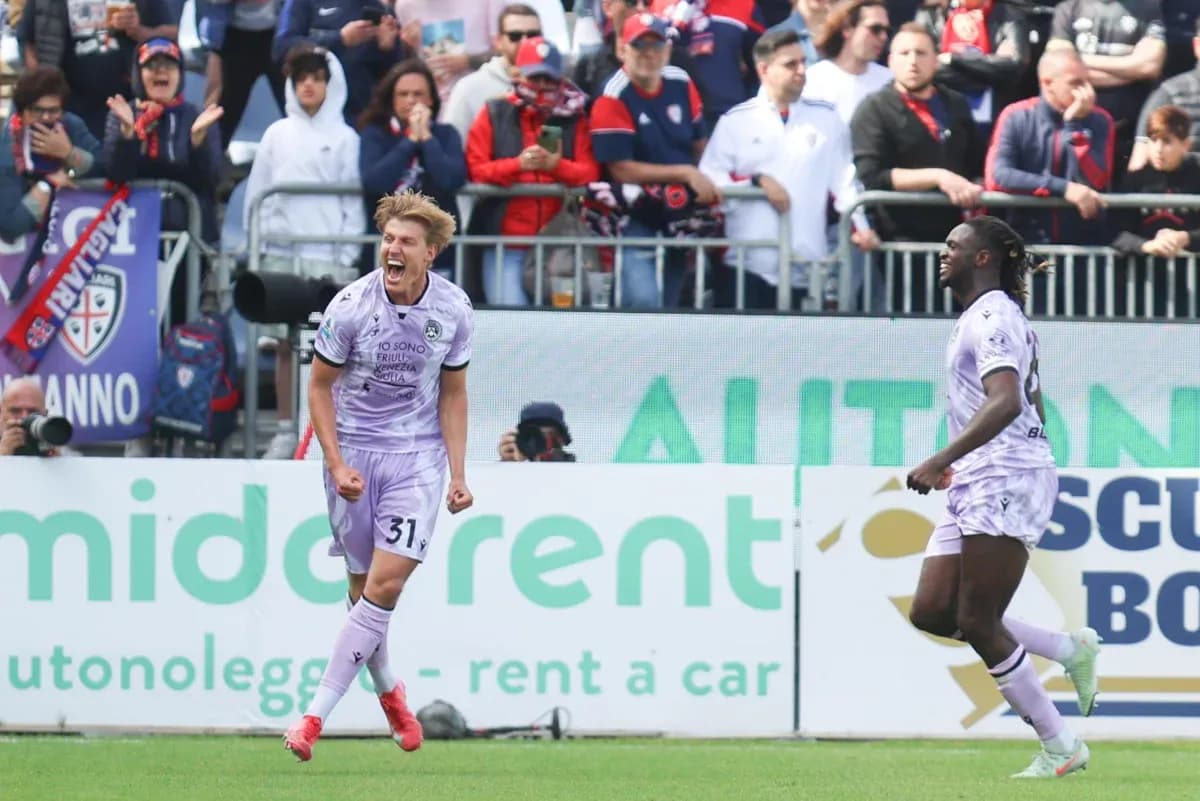
Under the sharp Sardinian light of the Unipol Domus, a survival story and a quiet European push intersected – and Udinese wrote the more convincing chapter. Following this result, the table tells a blunt tale: Cagliari, 16th with 37 points and a goal difference of -15 (36 scored, 51 conceded in total), were outclassed 2-0 by a Udinese side sitting 9th on 50 points, their overall goal difference now -1 (45 for, 46 against in total) reflecting a team with more punch and marginally tighter control of chaos.
I. The Big Picture – Structures and Seasonal DNA
Cagliari’s choice of a 5-3-2 under Fabio Pisacane was both confession and plea. Heading into this game, their season numbers framed them as a side built to suffer: in total this campaign they had scored 36 goals at an average of 1.0 per match, conceding 51 at 1.4. At home, they were marginally more assertive – 20 goals for at 1.1 per game, 22 against at 1.2 – but the defensive line of five here felt less like a platform and more like a shield.
The back five of M. Palestra, J. Pedro, A. Dossena, J. Rodriguez and A. Obert sat in front of E. Caprile, with the midfield trio of M. Folorunsho, G. Gaetano and M. Adopo asked to compress central spaces and spring S. Esposito and P. Mendy in transition. The problem? A team that had already failed to score in 14 matches in total this season was again asked to conjure goals from sparse territory.
Udinese, by contrast, leaned into their attacking identity. Kosta Runjaic’s 3-4-3 aligned perfectly with a side that, heading into this game, had been one of Serie A’s more dangerous travellers: on their travels they had scored 27 goals at 1.5 per match, conceding 26 at 1.4. The back three of B. Mlacic, T. Kristensen and O. Solet were given licence to hold a high line, shielded by a hard-running midfield of K. Ehizibue, J. Piotrowski, J. Karlstrom and H. Kamara. Ahead of them, N. Zaniolo floated as a creative fulcrum behind A. Buksa and A. Atta – a trident designed to stretch and isolate Cagliari’s wide centre-backs.
II. Tactical Voids – Absences and Discipline
Cagliari’s attacking deck was already thin before a ball was kicked. G. Borrelli (thigh injury), M. Felici (knee), R. Idrissi (knee), J. Liteta (thigh), L. Mazzitelli (injury) and L. Pavoletti (knee) all missed out, stripping Pisacane of alternative profiles in the final third. It left S. Esposito as both creator and finisher, supported by the running of P. Mendy but without a true penalty-box specialist to attack crosses or occupy Udinese’s central trio.
Udinese were not untouched either. J. Ekkelenkamp (leg injury) removed a potential linking midfielder, while A. Zanoli (knee) cut into their full-back depth. More telling, though, was the suspension of C. Kabasele for yellow cards, depriving Runjaic of an experienced organiser at the back. Yet the visitors’ squad depth allowed them to compensate with the mobility of Mlacic and the physical presence of Solet.
The disciplinary profiles of both teams added an undercurrent of risk. Heading into this game, Cagliari’s yellow-card timing showed a clear late-game spike: 26.92% of their bookings arrived between 76-90 minutes, and both of their red cards in total this season had also come in that late window. Udinese’s yellows peaked slightly earlier, with 26.87% between 61-75 minutes and 22.39% between 76-90, while their only red card in total this campaign had come as early as 0-15 minutes. This statistical backdrop foreshadowed a contest where fatigue and desperation could easily twist the closing stages – and in a match Cagliari were chasing, that risk only grew.
III. Key Matchups – Hunter vs Shield, Engine Room Battles
The most intriguing “Hunter vs Shield” duel was conceptual rather than purely individual. Udinese’s away attack – 27 goals on their travels at 1.5 per game – came up against a Cagliari home defence that had conceded 22 at 1.2 per match. On paper, the visitors carried a structural edge: their 3-4-3 naturally created overloads in the half-spaces where Cagliari’s wide centre-backs had to decide whether to step out or hold the line.
Within that, N. Zaniolo emerged as the game’s primary disruptor. Heading into this fixture, he had 6 assists and 5 goals in total, built on 53 key passes and 47 shots, a profile of a high-usage playmaker not afraid to take risks. His duel numbers – 374 contested, 140 won – painted him as a player constantly in the thick of contact. Up against a Cagliari back line anchored by A. Obert, who had amassed 9 yellow cards and 1 yellow-red in total this season, this was always going to be a clash on the edge of legality. Obert’s 63 tackles, 18 successful blocks and 40 interceptions in total spoke of an aggressive, front-foot defender; against Zaniolo’s dribbles and half-space drifting, every step out of the line carried danger.
In the “Engine Room” battle, S. Esposito was Cagliari’s heartbeat. With 6 goals and 5 assists in total this season, alongside 65 key passes and 49 fouls drawn, he is both creator and pressure valve. Yet his task against Udinese’s double pivot of Piotrowski and Karlstrom was immense. The visitors’ midfielders, backed by the legs of Ehizibue and Kamara, could compress central zones and funnel Cagliari wide, where the hosts lacked a natural wide forward to consistently threaten beyond the wing-backs.
Up front, Udinese’s bench threat also loomed large. K. Davis, even as a substitute here, entered the fixture as one of Serie A’s more efficient strikers: in total this campaign he had scored 10 goals and provided 4 assists, converting 24 shots on target from 37 attempts and winning 143 of 305 duels. His presence on the bench meant Udinese could raise the physical and aerial intensity late on if required, a luxury Cagliari simply did not share given their injury list.
IV. Statistical Prognosis – Why 0-2 Felt Inevitable
When you stitch the numbers to the narrative, Udinese’s 2-0 away win feels less like an upset and more like a logical extension of trend lines. Heading into this game, Cagliari’s home attack at 1.1 goals per match met a Udinese away defence conceding 1.4; on a neutral xG projection, you might expect the hosts to generate something close to parity. But Cagliari’s 14 total matches without scoring this season, combined with a reliance on Esposito as both playmaker and finisher, suggested that once Udinese established territorial control, the home side would struggle to convert half-chances into clear ones.
Conversely, Udinese’s away attack at 1.5 goals per game up against a Cagliari defence that concedes 1.2 at home tilted the xG balance towards the visitors. Their ability to rotate between Zaniolo’s between-the-lines creativity, Buksa’s penalty-box presence and Atta’s running in behind allowed them to probe different weaknesses within Cagliari’s back five. With no penalties missed in total this season (5 scored from 5), Udinese also carried a ruthless edge in high-leverage moments that Cagliari could not match.
Following this result, the story of the afternoon is one of structural superiority made concrete. Udinese’s flexible 3-4-3, deeper bench and sharper attacking metrics translated into a controlled, clinical away performance. Cagliari’s 5-3-2, weighed down by absences and a season-long struggle for goals, could not bend the probabilities. The 0-2 scoreline at the Unipol Domus felt less like a twist and more like the season’s underlying numbers finally speaking without interruption.