.svg&w=384&q=75 "GoalGist logo")
Fiorentina vs Genoa: Tactical Analysis of a Goalless Draw
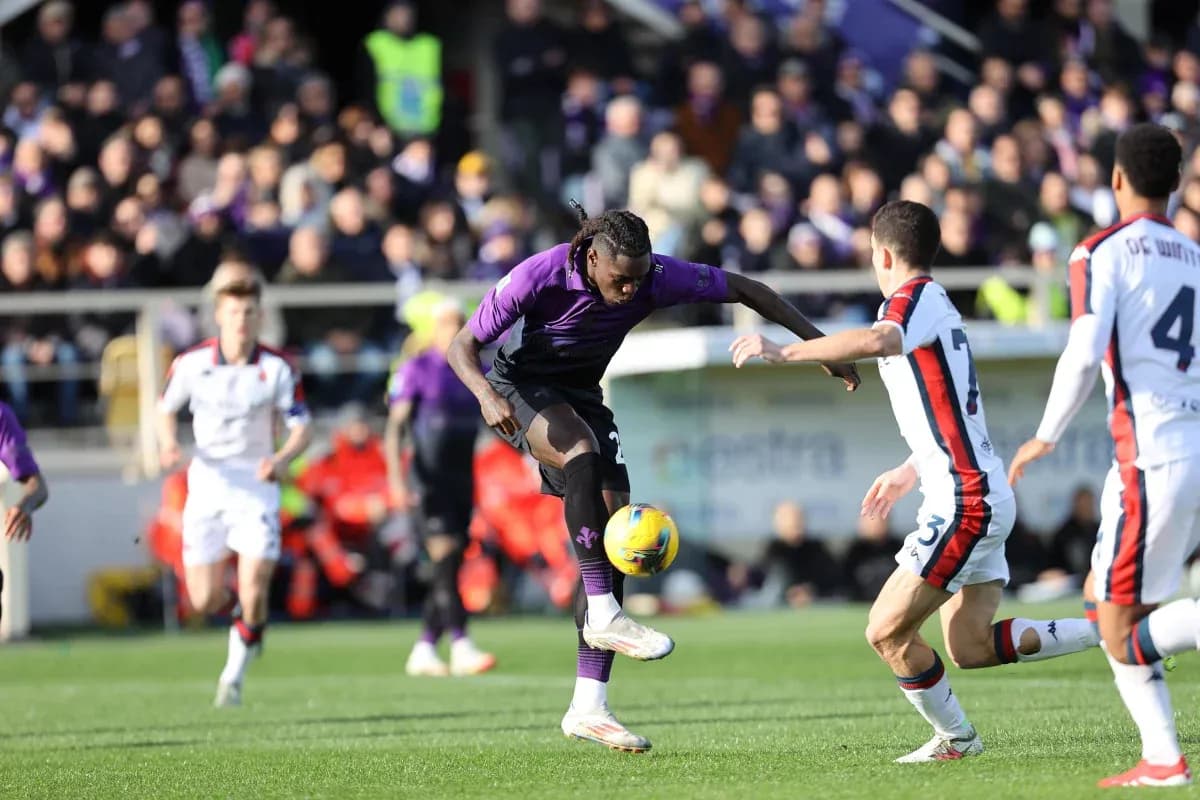
Fiorentina and Genoa played out a goalless but tactically nuanced 0-0 at Stadio Artemio Franchi in Round 36 of Serie A, a match defined more by structural discipline than penalty-box chaos. Fiorentina, under Paolo Vanoli, imposed themselves territorially with 57% possession and a 4-3-3 designed to control central spaces and overload wide channels. Daniele De Rossi’s Genoa, in a 3-4-2-1, accepted a lower share of the ball but carried a measured threat in transition and through their front three’s movements between the lines. Ultimately, both sides’ compactness and conservative risk management produced a stalemate that reflected the underlying numbers.
With no goals and no cards recorded, the event log is dominated by second-half substitutions that subtly reshaped the tactical landscape. The first structural shift came on 58', when Genoa replaced L. Colombo (OUT) with C. Ekuban (IN). This did not change the 3-4-2-1 on paper, but it refreshed the reference point up front, adding more vertical running to stretch Fiorentina’s back line.
Vanoli’s first move followed on 61': R. Piccoli (IN) came on for R. Braschi (OUT), a like-for-like change in the front line that aimed to inject new energy into Fiorentina’s attacking trident without altering the 4-3-3’s basic mechanisms. The double Genoa change on 71' was more structurally significant: R. Malinovskyi (IN) for J. Ekhator (OUT) and W. L. Ouedraogo (IN) for A. Martin (OUT). Malinovskyi’s introduction added a more technical, shooting-oriented presence in the second line, hinting at a shift toward greater threat from the half-spaces, while Ouedraogo’s arrival freshened the left side of the defensive line or wing channel, preserving Genoa’s capacity to defend wide areas and cover depth.
Fiorentina responded with midfield recalibration: on 72', M. Brescianini (IN) replaced R. Mandragora (OUT), followed a minute later (73') by G. Fabbian (IN) for C. Ndour (OUT). These two swaps re-energised the 4-3-3 midfield, prioritising forward runs and line-breaking support from the interior roles to better connect with the front three. Genoa’s final double switch on 82' — M. Doucoure (IN) for A. Marcandalli (OUT) and P. Masini (IN) for Amorim (OUT) — maintained the 3-4-2-1 shell but brought fresh legs into the back line and central midfield, signalling De Rossi’s intent to preserve compactness and manage the final phase. Vanoli’s last adjustment on 86' — A. Gudmundsson (IN) for F. Parisi (OUT) — injected a more direct, creative profile into the front line, an attempt to find a late breakthrough without unbalancing the 4-3-3.
From the outset, Fiorentina’s 4-3-3 was built to dominate the ball and territory. With D. de Gea behind a back four of Dodo, M. Pongracic, L. Ranieri and R. Gosens, the home side could form a stable 2+3 or 3+2 build-up platform. Mandragora, N. Fagioli and C. Ndour formed a midfield triangle tasked with circulating possession and finding the front three of F. Parisi, R. Braschi and M. Solomon between the lines and in wide isolation.
The statistical profile supports this approach: Fiorentina completed 417 passes, 353 accurate (85%), and generated 13 total shots, with 9 inside the box. However, only 1 shot hit the target, underlining that while the structure reliably delivered the ball into advanced zones, the final action lacked precision and dynamism. Their xG of 0.97 reflects sustained pressure and box entries rather than clear, high-quality chances. The 4-3-3 created volume but not incision, and Genoa’s back three handled crosses and cutbacks with composure.
Genoa’s 3-4-2-1 was clearly calibrated for balance. The back trio of N. Zatterstrom, L. Ostigard and A. Marcandalli (later refreshed by Ouedraogo and Doucoure) stayed compact horizontally, compressing the central lane that Fiorentina’s interiors sought to exploit. Wing-backs M. E. Ellertsson and A. Martin provided width but were conservative in their starting positions, often forming a back five in the defensive phase. In front, M. Frendrup and Amorim anchored the midfield box, screening passes into Fiorentina’s forwards.
In possession, Genoa were more selective but not toothless: 316 passes, 255 accurate (81%), with 9 total shots and 6 inside the box. Their xG of 0.58 indicates fewer but relatively meaningful incursions, often through quick combinations involving Vitinha and L. Colombo (later Ekuban) exploiting spaces behind Fiorentina’s full-backs. The 3-4-2-1 morphed into a 3-2-5 in some attacking phases, but De Rossi’s side rarely overcommitted numbers, preferring to keep rest defence intact against Fiorentina’s transitions.
Goalkeeper usage further clarifies the tactical story. De Gea made 3 saves, matching Genoa’s 3 shots on target and confirming that while Fiorentina controlled more of the ball, the more dangerous on-target moments came from the visitors’ selective attacks. At the other end, J. Bijlow finished with 0 saves despite Fiorentina’s 13 shots — a direct consequence of the home side’s inability to hit the target (only 1 shot on goal, blocked or off-frame efforts absorbing the rest). Genoa’s defensive line and midfield screen did much of the work before Bijlow was required.
Defensively, the foul count — 13 for Fiorentina, 14 for Genoa — reflects a match with frequent tactical interruptions but no disciplinary flashpoints; no yellow or red cards were issued. Both teams used fouls as a tool to manage transitions rather than as a symptom of structural breakdown. Genoa’s slightly higher foul count aligns with their more reactive, containment-based game plan, while Fiorentina’s fouls often came from counter-pressing attempts after turnovers in advanced zones.
The statistical verdict aligns tightly with the scoreline. Fiorentina’s higher xG (0.97 to 0.58), greater shot volume, and superior possession underline a stronger Overall Form on the ball: they controlled tempo, circulated effectively, and kept Genoa penned back for stretches. Yet their Defensive Index — limiting Genoa to 9 shots and 0.58 xG while allowing only 3 on-target efforts — was matched by Genoa’s own defensive performance, which forced Fiorentina into low-quality finishing and blocked 5 shots.
Pass metrics reinforce the tactical identities: Fiorentina’s 417 passes at 85% accuracy illustrate a patient, structured build-up side; Genoa’s 316 passes at 81% show a more direct, vertical team that still maintained reasonable technical security. With both goalkeepers finishing with 0 goals conceded and 0 goals prevented, the game’s equilibrium came from organised defensive structures on both sides rather than extraordinary individual interventions. The 0-0, in the end, was a faithful expression of two systems prioritising control and stability over all-out risk.