.svg&w=384&q=75 "GoalGist logo")
Brighton Dominates Wolves 3-0 in Premier League Showdown
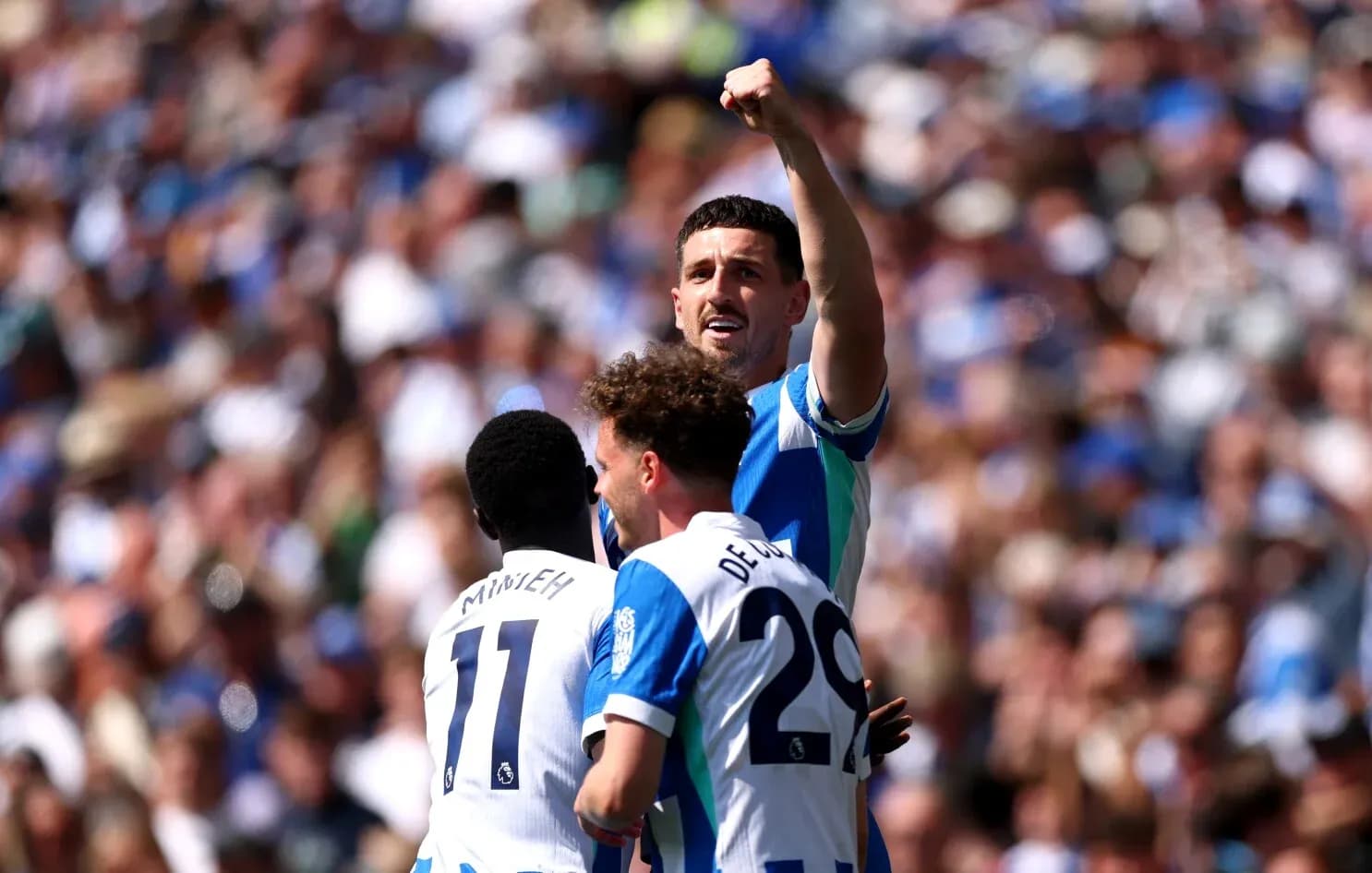
Under a sharp south‑coast sky at the Amex Stadium, Brighton’s 3–0 dismantling of Wolves felt less like a routine late‑season win and more like a manifesto. Matchday 36 of the Premier League, with John Brooks in charge and the stakes diverging sharply—Brighton chasing Europe, Wolves staring at relegation—became a ninety‑minute illustration of two clubs heading in opposite directions.
Following this result, the table tells the first half of the story. Brighton sit 7th on 53 points, their overall goal difference a healthy +10, built from 52 goals scored and 42 conceded. At home they have been formidable: 18 matches, 9 wins, 6 draws, just 3 defeats, with 30 goals for and 17 against. Wolves, by contrast, are marooned in 20th on 18 points, their overall goal difference a brutal -41, the product of 25 goals scored and 66 conceded. On their travels they have yet to win in 18 attempts, drawing 5 and losing 13, with only 7 goals scored and 33 conceded. The 3–0 scoreline here simply confirmed patterns that have been building all season.
I. The Big Picture – Brighton’s controlled aggression vs Wolves’ fragility
Fabian Hurzeler again leaned into Brighton’s possession‑first identity, underpinned by a season‑long preference for the 4‑2‑3‑1 (used 31 times). Even without a listed formation for this specific fixture, the personnel told the tale: Bart Verbruggen in goal, a back line of Ferdi Kadioglu, Jan Paul van Hecke, Lewis Dunk and Maxim De Cuyper, with Carlos Baleba and Pascal Groß anchoring midfield. Ahead of them, the dynamism of Yankuba Minteh, Jack Hinshelwood and Kaoru Mitoma supported Danny Welbeck as the central reference point.
Rob Edwards’ Wolves arrived with a defensive core—Daniel Bentley behind Yerson Mosquera, Santiago Bueno and Toti Gomes—shielded by Pedro Lima, João Gomes, André and Hugo Bueno, with a front three of Adam Armstrong, Mateus Mané and Hwang Hee‑chan. On paper it echoed the season’s reliance on three‑centre‑back structures (3‑4‑2‑1, 3‑5‑2, 3‑4‑3), but in practice it became a low, reactive block under siege.
Brighton’s seasonal DNA is clear: overall they average 1.4 goals for and 1.2 against per game, but at home that climbs to 1.7 scored and just 0.9 conceded. Wolves, meanwhile, average only 0.7 goals per game overall, dropping to 0.4 on their travels, while conceding 1.8 both home and away. The gulf in attacking output and defensive solidity was written into the fixture before a ball was kicked, and the match merely coloured in the outlines.
II. Tactical Voids – Who was missing, and how it shaped the contest
Both squads were thinned in key areas. Brighton were without D. Gómez, S. Tzimas, A. Webster and M. Wieffer, all listed as Missing Fixture, three with knee injuries and Wieffer with an unspecified injury. The absence of Webster and Wieffer, in particular, could have stripped Brighton of aerial presence and midfield control. Instead, van Hecke and Baleba stepped into the void with authority, while Dunk’s leadership—this season already backed by 10 yellow cards and 26 blocked shots—anchored the back line.
Wolves’ problems were even more structural. L. Chiwome and E. Gonzalez (both knee injuries) were joined on the sidelines by S. Johnstone (knock) and J. Sa (ankle injury). With Sa unavailable, Bentley had to front a defence already burdened by a season of pressure. The lack of depth at both ends of the pitch left Edwards with a bench heavy on defenders—David Møller Wolfe, Rodrigo Gomes, Matt Doherty, Ladislav Krejčí, Jackson Tchatchoua—and fewer game‑changing attacking options, aside from Tolu Arokodare and Jean‑Ricner Bellegarde.
Disciplinary history also shaped the risk calculus. Brighton, whose yellow‑card distribution peaks at 46–60 minutes (27.91%) and shows another late‑game spike at 76–90 and 91–105 (both 15.12%), are used to walking the tightrope of aggressive pressing. Wolves are even more combustible: 28.57% of their yellows come between 46–60 minutes, with significant clusters from 61–75 (20.78%) and 76–90 (19.48%), plus three separate red‑card windows between 31–75 minutes. In a match where Wolves were likely to be chasing shadows, that volatility was always a lurking threat.
III. Key Matchups – Hunter vs Shield, and the battle for the engine room
The headline duel was always going to be Danny Welbeck against Wolves’ beleaguered back three. Welbeck’s season—13 goals and 1 assist, from 45 shots and 27 on target—marks him out as Brighton’s primary finisher. His underlying profile is that of a complete forward: 460 passes with 20 key passes, 23 tackles, and a willingness to work both ways. Crucially, his penalty record is imperfect: he has scored 1 but missed 2 spot‑kicks, a detail that slightly dents Brighton’s otherwise flawless penalty record as a team (3 scored from 3, 100.00%, with no misses). In open play, though, his movement between Mosquera and Santiago Bueno was always likely to stretch a defence that has already suffered 66 goals overall.
On the other side, Wolves’ “shield” was meant to be the trio of André, João Gomes and Mosquera. André’s season has been defined by controlled aggression: 76 tackles, 12 blocked shots, 28 interceptions and 11 yellow cards. João Gomes adds even more bite—108 tackles, 34 interceptions, 66 fouls committed and 10 yellows—while Mosquera has blocked 14 shots and won 148 duels. Yet their task was Sisyphean: to protect a side that has kept only 4 clean sheets overall, and just 1 on their travels.
In the engine room, Pascal Groß and Carlos Baleba faced André and João Gomes. Groß, the metronome, was given licence to dictate tempo, while Baleba’s athleticism allowed Brighton to compress the pitch and suffocate Wolves’ transitions. With Brighton keeping 10 clean sheets overall (5 at home and 5 away), the double pivot’s balance between control and protection has been a quiet cornerstone of their European push.
IV. Statistical Prognosis – A result foretold by numbers
Following this result, the statistical narrative feels almost inevitable. Brighton’s home record—9 wins from 18, only 3 defeats, and 30 goals scored—combined with Wolves’ away return of 0 wins, 5 draws and 13 defeats, framed the 3–0 as a logical outcome. Even without explicit xG figures, the underlying trends are clear: Brighton create and convert at a mid‑table‑plus rate while conceding relatively few chances, especially at the Amex; Wolves generate very little (0.4 away goals on average) and concede a steady stream of high‑value opportunities.
Defensively, Brighton’s overall concession rate of 1.2 goals per game, dropping to 0.9 at home, meshes with a side comfortable defending higher up the pitch, trusting van Hecke and Dunk—who between them have 54 blocked shots and 72 interceptions—to handle direct balls. Wolves’ 1.8 goals conceded per game, unchanged home or away, suggests structural rather than situational weakness; no tweak in shape has stemmed the flow.
In tactical terms, this was the meeting of a side whose structure amplifies its talent against one whose structure exposes its limitations. Brighton’s pressing surges in the 46–60 minute window mirror Wolves’ disciplinary spikes, turning the early second half into a decisive phase where the hosts could both create and draw fouls. As legs tired and gaps opened, Hurzeler’s bench—Georginio Rutter, Solly March, James Milner, Matt O’Riley—offered technical continuity, while Edwards’ changes were more about damage limitation.
The 3–0 scoreline, then, is less an upset than a statistical confirmation. Brighton, with a positive goal difference of +10 and a clear identity, look like a side ready to carry their football into Europe. Wolves, weighed down by -41 and winless on their travels, leave the Amex not just beaten, but starkly exposed by the numbers that have shadowed them all season.