.svg&w=384&q=75 "GoalGist logo")
Burnley and Aston Villa Share Points in Tactical 2-2 Draw
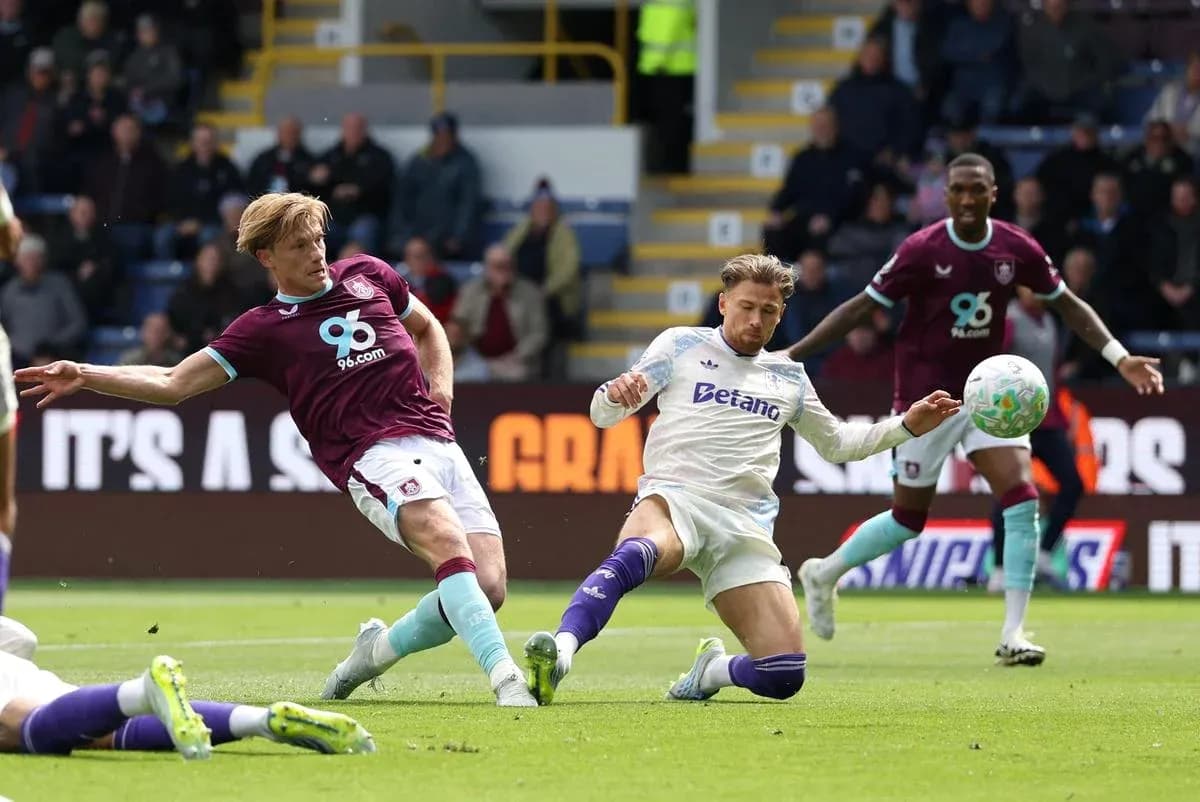
Burnley and Aston Villa shared a 2-2 draw at Turf Moor in Premier League Regular Season - 36, a match that pitted Burnley’s compact 4-2-3-1 against Unai Emery’s more ball-dominant 4-2-3-1. The scoreline reflected a genuine tactical arm wrestle: Burnley leveraged transitions and verticality, while Villa controlled territory and possession without fully killing the game. With Burnley taking an early lead, Villa turning it around after the break, and the hosts responding almost immediately, the contest became a study in how contrasting structures can produce a finely balanced outcome despite a clear statistical tilt in Aston Villa’s favour.
I. Executive Summary (Discipline and Scoring Framework)
Before the tactical layers, the disciplinary and scoring structure was straightforward and low on cards. Card verification from the events log shows: Burnley: 1, Aston Villa: 1, Total: 2. Both cautions were single, distinct incidents rather than part of an escalating pattern, which aligned with a game that had 17 fouls by Burnley and 8 by Villa but never boiled over.
The scoring followed a classic momentum swing: Burnley struck first, Villa had a potential equaliser disallowed by VAR before eventually levelling and then leading, only for Burnley to respond quickly. From there, the match became about game-state management: Villa tried to consolidate their possession advantage and protect the lead; Burnley leaned on substitutions and fresh energy to restore balance and survive Villa’s territorial pressure.
II. Scoring Sequence & Disciplinary Log
The events unfolded in strict chronological order:
- 8' Jaidon Anthony (Burnley) opened the scoring with a Normal Goal, capitalising on Burnley’s early willingness to attack quickly from their 4-2-3-1 structure.
- 40' A potential goal by Ollie Watkins (Aston Villa) was disallowed by VAR, a key psychological moment that denied Villa an earlier equaliser and underlined Burnley’s fragile but effective low block.
- 42' Ross Barkley (Aston Villa) equalised with a Normal Goal, assisted by John McGinn. This came as Villa’s sustained possession began to pull Burnley’s double pivot out of shape.
- 49' Tyrone Mings (Aston Villa) — Foul (Yellow Card). This was Villa’s only booking and reflected a necessary intervention rather than a wider disciplinary trend.
- 56' Ollie Watkins (Aston Villa) put Villa 1-2 ahead with a Normal Goal, assisted by Emiliano Martínez. The direct link from goalkeeper to striker highlighted Villa’s ability to bypass Burnley’s press when needed.
- 58' Zian Flemming (Burnley) quickly restored parity to 2-2 with a Normal Goal, assisted by Hannibal Mejbri, a crucial response that changed the game-state and allowed Burnley to retreat into a more compact block again.
- 60' Zian Flemming (Burnley) — Persistent fouling (Yellow Card). This was Burnley’s lone caution and directly tied to his dual role as both attacking outlet and aggressive presser.
Substitutions followed: Lyle Foster (IN) came on for Hannibal Mejbri (OUT) at 69'; Lucas Digne (IN) for Ian Maatsen (OUT) at 74'; Emiliano Buendía (IN) for Victor Lindelöf (OUT) at 74'; Josh Laurent (IN) for Lesley Ugochukwu (OUT) at 79'; Zeki Amdouni (IN) for Zian Flemming (OUT) at 79'; Douglas Luiz (IN) for Ross Barkley (OUT) at 80'; Lamare Bogarde (IN) for Matty Cash (OUT) at 80'; Leon Bailey (IN) for John McGinn (OUT) at 85'; James Ward-Prowse (IN) for Florentino Luís (OUT) at 87'; Jacob Bruun Larsen (IN) for Jaidon Anthony (OUT) at 87'.
III. Tactical Breakdown & Personnel
Burnley, under Mike Jackson, set up in a 4-2-3-1 with Max Weiss in goal behind a back four of Kyle Walker, Axel Tuanzebe, Maxime Estève and Lucas Pires. The double pivot of Florentino Luís and Lesley Ugochukwu sat beneath an attacking trio of Loum Tchaouna, Hannibal Mejbri and Jaidon Anthony, with Zian Flemming as the central forward. Their approach was clear: concede territory (34% possession) but maximise efficiency in transition and set attacking triggers from turnovers.
Burnley’s 15 total shots (6 on goal) from just 34% of the ball, and an xG of 1.77, show that their attacks were relatively high quality. The early Anthony goal came from exploiting Villa’s advanced full-backs and the space behind the first press. Weiss made 5 saves, but the goals prevented metric at -0.16 suggests he slightly underperformed the shot quality faced rather than overperforming.
Aston Villa mirrored the 4-2-3-1 but with a far more possession-centric identity. Emiliano Martínez anchored a back line of Matty Cash, Ezri Konsa, Tyrone Mings and Ian Maatsen. Victor Lindelöf and Youri Tielemans formed the double pivot, with John McGinn, Ross Barkley and Morgan Rogers behind Ollie Watkins. Villa’s 66% possession, 510 total passes and 439 accurate (86%) underline a controlled build-up, with the double pivot used to circulate and draw Burnley’s block out before feeding the advanced midfielders.
Villa’s 18 total shots (7 on goal) and xG of 1.42 indicate they generated a decent but not overwhelming volume of chances relative to their territorial dominance. Martínez’s 4 saves with -0.16 goals prevented show a similar slight underperformance to Weiss, reinforcing that neither goalkeeper was the decisive factor.
The disallowed potential goal for Watkins at 40' was tactically important: it showed Villa could break Burnley’s line with vertical runs even before the equaliser. Barkley’s 42' strike, assisted by McGinn, reflected Villa’s use of the half-spaces, with McGinn drifting between Burnley’s midfield and defence to create overloads.
After going 1-2 up through Watkins at 56' from a Martínez assist, Villa briefly looked set to control the game-state, but Flemming’s 58' equaliser, supplied by Mejbri, highlighted Burnley’s capacity to punch back quickly. Mejbri’s positioning as a high 10, combined with Flemming’s intelligent movement off the centre-backs, repeatedly asked questions of Mings and Konsa.
Substitutions were clearly tactical: Burnley’s introduction of Lyle Foster, Josh Laurent, Zeki Amdouni, James Ward-Prowse and Jacob Bruun Larsen added energy and ball progression as they sought to maintain a threat while shoring up midfield legs. Villa’s changes — Digne for Maatsen, Buendía for Lindelöf, Douglas Luiz for Barkley, Bogarde for Cash and Bailey for McGinn — gradually shifted them towards a more attacking, technically oriented shape, aiming to unlock a tiring Burnley block from wider and more creative central zones.
IV. The Statistical Verdict
Statistically, Aston Villa were the more dominant side in possession and territory: 66% possession, 510 passes, 439 accurate (86%), 18 shots and 8 corners compared to Burnley’s 34% possession, 255 passes, 186 accurate (73%), 15 shots and 2 corners. Yet the xG balance — Burnley 1.77, Villa 1.42 — suggests Burnley created slightly better quality chances relative to volume, validating their counter-attacking game plan.
Defensively, Burnley’s 17 fouls and single yellow for Persistent fouling (Flemming) show an aggressive but largely controlled attempt to disrupt Villa’s rhythm, while Villa’s 8 fouls and one yellow for Foul (Mings) align with a team that defended more in structure than in emergency. Both keepers posting -0.16 in goals prevented underlines that the 2-2 outcome was less about shot-stopping heroics and more about structural dynamics and chance quality. In the end, Villa’s superior Overall Form in possession met Burnley’s resilient Defensive Index and transition threat, and the numbers support the fairness of a shared point.