.svg&w=384&q=75 "GoalGist logo")
Sunderland vs Manchester United: Tactical Stalemate in Premier League
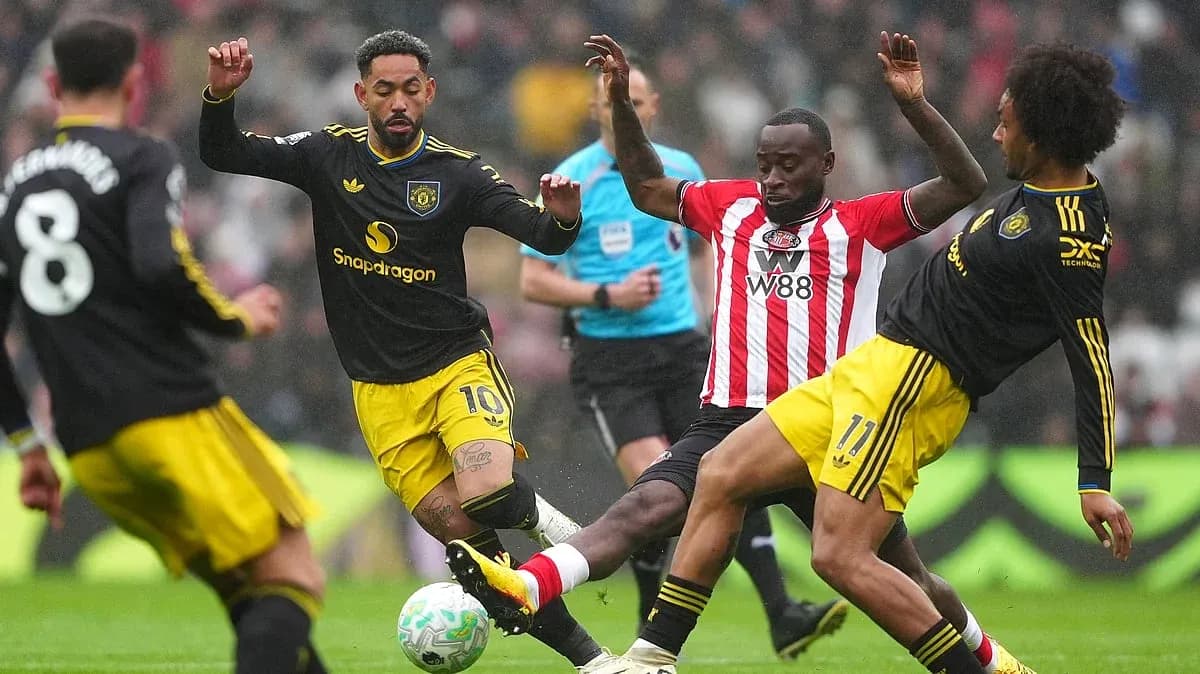
The Stadium of Light felt like a crossroads as Sunderland welcomed Manchester United in Round 36 of the Premier League season. Match finished 0-0, but the goalless scoreline disguised a meeting between two sides whose seasonal identities could not be more different: Sunderland, 12th with 48 points and a goal difference of -9 (37 scored, 46 conceded overall), grinding their way through a balanced, often attritional campaign; United, 3rd with 65 points and a goal difference of 15 (63 for, 48 against overall), a high-variance contender whose attacking power has frequently outpaced their defensive control.
Heading into this game, Sunderland’s season had been defined by tight margins. At home they averaged 1.3 goals for and 1.1 against, with 8 wins, 6 draws and only 4 defeats from 18. The Stadium of Light has not been a fortress in the classic sense, but a place where Regis Le Bris’ side generally stays in the contest, leaning on structure and discipline. United, on their travels, carried a more expansive profile: 27 goals scored and 26 conceded away, an average of 1.5 for and 1.4 against, with 6 wins, 8 draws and 4 losses. They arrive as a Champions League-chasing heavyweight, but one that leaves doors open.
I. The Big Picture: Shapes, stakes, and seasonal DNA
Neither lineup came with a declared formation, but the personnel sketched familiar outlines. Sunderland’s XI – Robin Roefs behind a back four of Lutsharel Geertruida, Nordi Mukiele, Omar Alderete and Reinildo Mandava – hinted at a compact defensive block. In front, Granit Xhaka and Noah Sadiki formed a double pivot platform, with Trai Hume, Enzo Le Fée and Chemsdine Talbi supporting lone forward Brian Brobbey. It was the architecture of a side comfortable without the ball, looking to compress central spaces and counter in waves.
United, under Michael Carrick, leaned into technical control and fluidity. Senne Lammens started in goal, protected by Noussair Mazraoui, Harry Maguire, Lisandro Martínez and Luke Shaw. The midfield triangle of Mason Mount, Kobbie Mainoo and Bruno Fernandes carried both press-resistance and creativity, with Amad Diallo and Matheus Cunha operating between the lines around Joshua Zirkzee. With United’s season-long balance of 1.8 goals scored and 1.3 conceded overall, this XI was built to dominate territory and chance volume.
II. Tactical Voids: Absences and disciplinary shadows
The absentees told their own tactical story. Sunderland were without Daniel Ballard, suspended after a red card, and R. Mundle with a hamstring injury. Ballard’s absence removed one of Sunderland’s most combative defenders, a centre-back who brings aerial presence and aggression; it placed extra responsibility on Alderete and Mukiele to command the box and on Reinildo to defend aggressively without tipping over the disciplinary edge. Reinildo himself arrived with a season red card on his record, underlining that fine line.
For United, the loss of B. Šeško (11 league goals, 1 assist overall) to a leg injury stripped them of their most prolific pure finisher. M. de Ligt’s back injury removed a powerful defensive anchor and organiser. In response, Carrick turned to Zirkzee’s link play and Maguire’s experience, but the absence of Šeško inevitably shifted more finishing burden onto Cunha and the second line of attack.
Both sides carried disciplinary warning lights. Sunderland’s season yellow-card profile peaks between 46-60 minutes (23.38%), a period when their intensity can spill into rash challenges. United show a similar spike in the same phase (21.31%), then another late-game surge between 76-90 minutes (19.67%). Red-card history also matters: Sunderland have seen dismissals in the 16-30 and 31-45 windows, plus late in added time (91-105), while United’s reds cluster between 46-60 and 76-90. This fixture was always likely to have a nervy, card-heavy middle third, and both managers had to plan for tactical reshuffles if tempers or fatigue boiled over.
III. Key Matchups: Hunter vs Shield, Engine Room battles
The “Hunter vs Shield” narrative, usually centred on Šeško’s 11-goal campaign, had to be reframed with the Slovenian out. Instead, United’s attacking threat was distributed: Matheus Cunha, with 9 goals and 2 assists overall, arrived as a dribbling spearhead, his 88 attempted dribbles and 41 successes marking him as United’s most persistent ball-carrier. Sunderland’s shield was collective: at home they concede only 1.1 goals on average, with 7 clean sheets and just 19 goals against in 18 matches. Alderete and Mukiele were tasked with handling Zirkzee’s back-to-goal play, while Reinildo’s duels and 30 interceptions across the season positioned him as the one to step out and confront Cunha’s drives.
In the “Engine Room”, the clash was even more intriguing. For Sunderland, Xhaka and Le Fée are the twin brains. Xhaka’s season line – 6 assists, 1 goal, 1684 passes at 83% accuracy and 34 key passes – paints him as a deep-lying metronome and outlet under pressure. Le Fée adds verticality: 5 assists, 4 goals, 48 key passes and 83 tackles overall make him the side’s primary connector and ball-winner rolled into one. Together they form a double axis that can both break play and progress it.
Across from them, Bruno Fernandes is the league’s standout creator: 19 assists and 8 goals, with 125 key passes and 1881 total passes at 82% accuracy. He is United’s compass and risk-taker, capable of forcing the game into the half-spaces where Cunha and Amad Diallo thrive. Mainoo’s presence alongside him offers balance and ball circulation, while Mount adds late runs and pressing energy.
The duel is not just technical but psychological. Sunderland’s midfield, used to working under pressure, needed to absorb United’s rotations without being drawn out of shape. Xhaka’s 7 yellow cards underline his willingness to commit tactical fouls; against a player like Bruno, whose penalty record this season includes 4 scored but also 2 missed, the margins around the box become critical. Sunderland have a perfect penalty record this campaign (4 from 4, no misses), while United’s spot-kick story is more nuanced – dangerous, but not infallible.
IV. Statistical Prognosis: Control vs volatility
Heading into this game, the numbers suggested a clash of tempos. Sunderland’s overall goals-for average of 1.0 and goals-against average of 1.3 point to low-to-mid scoring contests, often decided by a single moment. They had failed to score in 13 of 36 matches overall, but also collected 11 clean sheets. United, by contrast, lived in more open territory: 63 goals for and 48 against overall, with only 7 clean sheets. Their away profile – 27 scored, 26 conceded – hinted at a likely xG edge for United but also the risk of transition exposure.
Tactically, United’s dual-formation comfort (18 matches in 3-4-2-1, 18 in 4-2-3-1) makes them adaptable. At the Stadium of Light, that flexibility was aimed at stretching Sunderland’s compact block horizontally, forcing Hume and Talbi to defend deeper than they would like and limiting Brobbey’s support. Sunderland, in turn, leaned on their 4-2-3-1 blueprint, a shape they had used 19 times this season, to keep distances short and passing lanes predictable.
Following this result, the 0-0 feels like the statistical midpoint between Sunderland’s control and United’s volatility. United likely carried the higher xG through volume and territory, but Sunderland’s defensive structure – anchored by Roefs’ command of his area and disciplined work from Geertruida, Mukiele and Reinildo – held firm, echoing their season-long resilience at home. For United, the absence of Šeško’s penalty-box presence was felt in the final action; for Sunderland, the missing aggression of Ballard was compensated by collective organisation.
In the end, this was a tactical stalemate that reaffirmed both teams’ identities. Sunderland remain the league’s awkward middleweight: structurally sound, combative, and reliant on Xhaka and Le Fée to give their defensive base a creative edge. United leave as the more ambitious, but not always ruthless, contender: Bruno-centric, multi-pronged in attack, yet still searching for the final layer of efficiency that turns dominance into decisive victories.