.svg&w=384&q=75 "GoalGist logo")
Cremonese Dominates Pisa 3-0 in Serie A Tactical Showcase
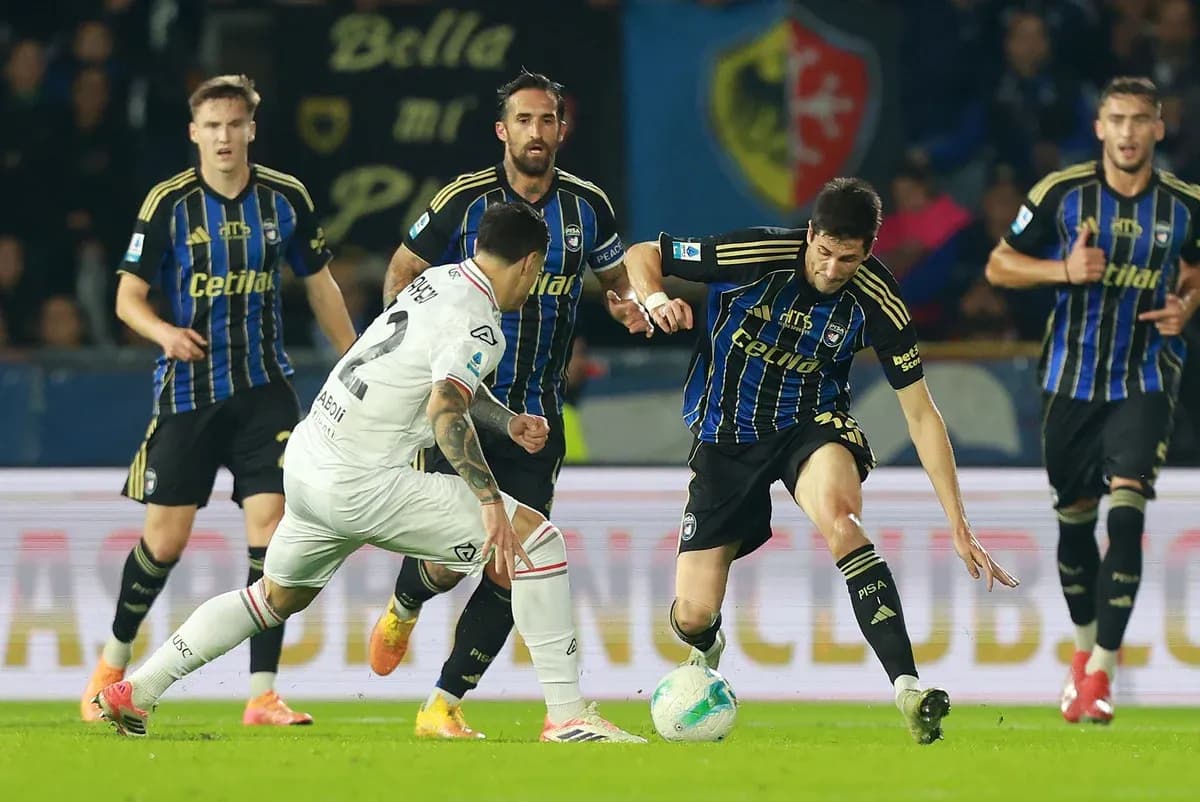
Cremonese’s 3-0 home win over Pisa at Stadio Giovanni Zini in Serie A’s Regular Season - 36 was a tactical domination built on structure, control, and ruthless exploitation of numerical superiority. Marco Giampaolo’s 4-4-2 suffocated Oscar Hiljemark’s 3-5-2 from the opening phases, turning a competitive contest into a one-sided exercise in game management once Pisa went down to nine men. The hosts translated 77% possession and 10 shots into three goals, while Pisa failed to register a single attempt, underlining the extent to which Cremonese controlled both territory and tempo.
I. Scoring Sequence & Disciplinary Log
Disciplinary events (chronological, with reasons exactly as recorded):
- 16' Rosen Bozhinov (Pisa) — Foul
- 23' Rosen Bozhinov (Pisa) — Foul
- 23' Rosen Bozhinov (Pisa) — Foul (Red Card)
- 49' Arturo Calabresi (Pisa) — Foul
- 57' Felipe Loyola (Pisa) — Foul (Red Card)
- 89' Malthe Højholt (Pisa) — Foul
Card count verification: Cremonese: 0, Pisa: 4 yellow cards and 2 red cards, Total: 6 cards.
The first key turning point came on the right of Pisa’s back three. At 16', Rosen Bozhinov collected a first yellow for Foul as he struggled to contain Cremonese’s wide pressure. Seven minutes later, again for Foul at 23', he received a second yellow and, in the same minute, a Red Card for Foul. Pisa’s 3-5-2 immediately became a 3-4-2/4-4-1 hybrid, with the entire defensive block forced to shift laterally to cover the vacant channel.
Cremonese converted that advantage into a lead on 31', when J. Vardy struck the opener for 1-0. The halftime scoreline of Cremonese 1-0 Pisa reflected not only the goal but also the structural imbalance created by Pisa’s early dismissal.
Hiljemark reacted at 37' with a double substitution to stabilize his side: A. Calabresi (IN) came on for S. Moreo (OUT), and S. Angori (IN) came on for M. Leris (OUT), effectively reinforcing the defensive line and wing coverage.
After the interval, Pisa’s discipline continued to erode. At 49', Arturo Calabresi was booked for Foul, further limiting Pisa’s ability to defend aggressively in wide areas. Cremonese punished the stretched block two minutes later: at 51', F. Bonazzoli made it 2-0, finishing a move supplied by J. Vandeputte.
The second decisive disciplinary blow arrived at 57', when Felipe Loyola was sent off with a straight Red Card for Foul. Reduced to nine men, Pisa could no longer contest midfield zones.
Giampaolo began to rotate at 59': M. Thorsby (IN) came on for Y. Maleh (OUT), and A. Zerbin (IN) replaced G. Pezzella (OUT), adding fresh legs and maintaining intensity. Pisa tried to adjust at 65' with M. Hojholt (IN) for I. Vural (OUT) and H. Meister (IN) for F. Stojilkovic (OUT), but without any shots their changes were largely about damage limitation. At 72', Cremonese refreshed the front line: A. Sanabria (IN) for J. Vardy (OUT) and D. Okereke (IN) for J. Vandeputte (OUT). Pisa introduced G. Piccinini (IN) for E. Akinsanmiro (OUT) in the same minute.
Cremonese’s final defensive change came at 85', with F. Folino (IN) for S. Luperto (OUT). One minute later, the hosts sealed the result: at 86', D. Okereke scored for 3-0 from an assist by A. Zerbin. The last disciplinary note came at 89', when Malthe Højholt was booked for Foul, capping Pisa’s fraught afternoon.
II. Tactical Breakdown & Personnel
Giampaolo’s 4-4-2 was built on clear vertical relationships. E. Audero in goal sat behind a back four of G. Pezzella, S. Luperto, M. Bianchetti, and F. Terracciano. Ahead of them, a flat but flexible midfield of J. Vandeputte and T. Barbieri wide, with A. Grassi and Y. Maleh central, ensured constant support lines into the front two, F. Bonazzoli and J. Vardy.
In possession, Cremonese used the full width of the pitch, with Pezzella and Terracciano pushing high to pin Pisa’s wing-backs, while Vandeputte and Barbieri tucked inside to overload Loyola and Vural between the lines. Grassi acted as the main distributor, recycling the ball to maintain 77% possession and enabling Cremonese to complete 735 passes, 684 accurate (93%). The hosts’ Overall Form in this match was that of a top-possession side: patient circulation, controlled tempo, and repeated probing of the half-spaces.
Defensively, Cremonese’s Defensive Index was defined by compactness rather than emergency interventions. Pisa failed to register a single shot, so Audero’s 0 Goalkeeper Saves reflect positional dominance rather than a lack of work ethic. The centre-backs, Luperto and Bianchetti, held a high line, compressing the field and keeping Pisa’s forwards S. Moreo and F. Stojilkovic disconnected from their midfield. Once Pisa went down to ten, then nine, Cremonese defended largely in rest-defense positions, with two centre-backs and one holding midfielder prepared to deal with rare transitions.
Pisa’s initial 3-5-2, with A. Semper behind Bozhinov, A. Caracciolo, and S. Canestrelli, was designed to create width via I. Toure and M. Leris as wing-backs, while E. Akinsanmiro, F. Loyola, and I. Vural formed a central trio. In theory, this could have matched Cremonese’s four-man midfield. In practice, Bozhinov’s early dismissal destroyed the symmetry. Hiljemark’s subsequent introduction of A. Calabresi and S. Angori tried to rebuild a back three and wing presence, but the constant lateral shifting against a 4-4-2 that could easily double up in wide zones left Pisa perpetually late to duels.
With nine men after Loyola’s red, Pisa’s shape collapsed into a deep 5-3-0/4-4-0, with almost no capacity to counter. Semper’s 2 Goalkeeper Saves and the xG conceded (Cremonese’s expected_goals at 1.15) suggest that while the shot volume was modest (6 on target from 10 total), the territorial dominance and numerical superiority made the scoreline feel inevitable.
III. The Statistical Verdict
The numbers crystallize the tactical story. Cremonese produced 10 Total Shots, 6 on Goal, evenly split between efforts inside (5) and outside (5) the box. Their expected_goals of 1.15 against three actual goals indicates clinical finishing, aided by Pisa’s exhaustion and reduced numbers. Pisa, by contrast, recorded 0 Total Shots, 0 on Goal, and 0 expected_goals, a stark reflection of how thoroughly their attacking structure was dismantled.
In possession, Cremonese’s 735 passes, 684 accurate (93%), underpinned their ability to shift Pisa’s low block and open channels for Vardy, Bonazzoli, and later Okereke and Sanabria. Pisa managed 218 passes, 161 accurate (74%), often under pressure and mostly in their own half. The foul count — Cremonese 10, Pisa 12 — combined with Pisa’s 4 yellow cards and 2 red cards, underlines how frequently the visitors resorted to Foul to slow Cremonese’s circulation.
Cremonese’s Overall Form on the day was that of a side fully in control of game state: early structural superiority, ruthless exploitation of numerical advantage, and intelligent rotation of forwards and wide players to maintain intensity. Their Defensive Index was equally impressive: zero shots conceded, no need for saves, and perfect control of depth. Pisa’s afternoon was defined by indiscipline and structural collapse, turning a theoretically balanced 3-5-2 duel into a one-sided tactical exhibition by Giampaolo’s 4-4-2.