.svg&w=384&q=75 "GoalGist logo")
Cagliari vs Udinese: Tactical Efficiency in Serie A Defeat
Cagliari’s 2–0 home defeat to Udinese at the Unipol Domus was defined less by territory and volume than by efficiency and structure. In a Serie A round 36 fixture where Fabio Pisacane’s side controlled 63% possession and fired 22 shots, Kosta Runjaic’s visitors absorbed pressure in a compact 3-5-2 and struck decisively in transition. Goals from A. Buksa on 56' and I. Gueye on 90' punished Cagliari’s imprecision in the final third, while Udinese’s defensive discipline and direct attacking patterns turned inferior ball share into a superior expected goals profile and three points.
The disciplinary and key-event timeline underpinned the tactical story. On 34', a VAR intervention cancelled a Cagliari penalty initially associated with Michel Adopo, a pivotal moment that denied the hosts a chance to tilt the game before the break. The card log, which must be treated as exact, reads:
44' Kingsley Ehizibue (Udinese) — Off the ball foul
53' Zé Pedro (Cagliari) — Foul
90+2' Keinan Davis (Udinese) — Argument
That produces locked totals of: Cagliari: 1, Udinese: 2, Total: 3.
Chronologically, Udinese’s tactical grip sharpened around their substitutions. At 55', J. Piotrowski (OUT) was replaced by L. Miller (IN), and B. Mlacic (OUT) by N. Bertola (IN), both changes reinforcing central stability and fresh legs in the back line. One minute later, Udinese executed their clearest pattern: H. Kamara drove and combined from midfield, feeding A. Buksa, who finished for 0–1 on 56'. The goal was a pure product of Udinese’s vertical, low-touch attacking idea.
Pisacane reacted on 62' with a double change to inject width and energy: M. Palestra (OUT) was replaced by G. Zappa (IN), and J. Pedro (OUT) by I. Sulemana (IN), effectively trying to push the wing-backs higher and add a more dynamic runner into midfield. Yet three minutes later Udinese were already managing Buksa’s load: at 65', A. Buksa (OUT) made way for K. Davis (IN), keeping a strong reference point up front for transitions and aerial outlets.
On 73', Cagliari altered the midfield profile again, with M. Folorunsho (OUT) replaced by A. Albarracin (IN), signalling a tilt toward more attacking risk and late box entries. Runjaic responded by refreshing his own front line and right side on 78': N. Zaniolo (OUT) was replaced by I. Gueye (IN), and K. Ehizibue (OUT) by J. Arizala (IN), maintaining the 3-5-2 structure but with fresher, more direct runners to exploit the spaces Cagliari were now leaving. Pisacane’s final roll of the dice came on 88', when M. Adopo (OUT) was replaced by A. Belotti (IN), and A. Obert (OUT) by Y. Trepy (IN), morphing the nominal 5-3-2 into something closer to a back four with multiple forwards.
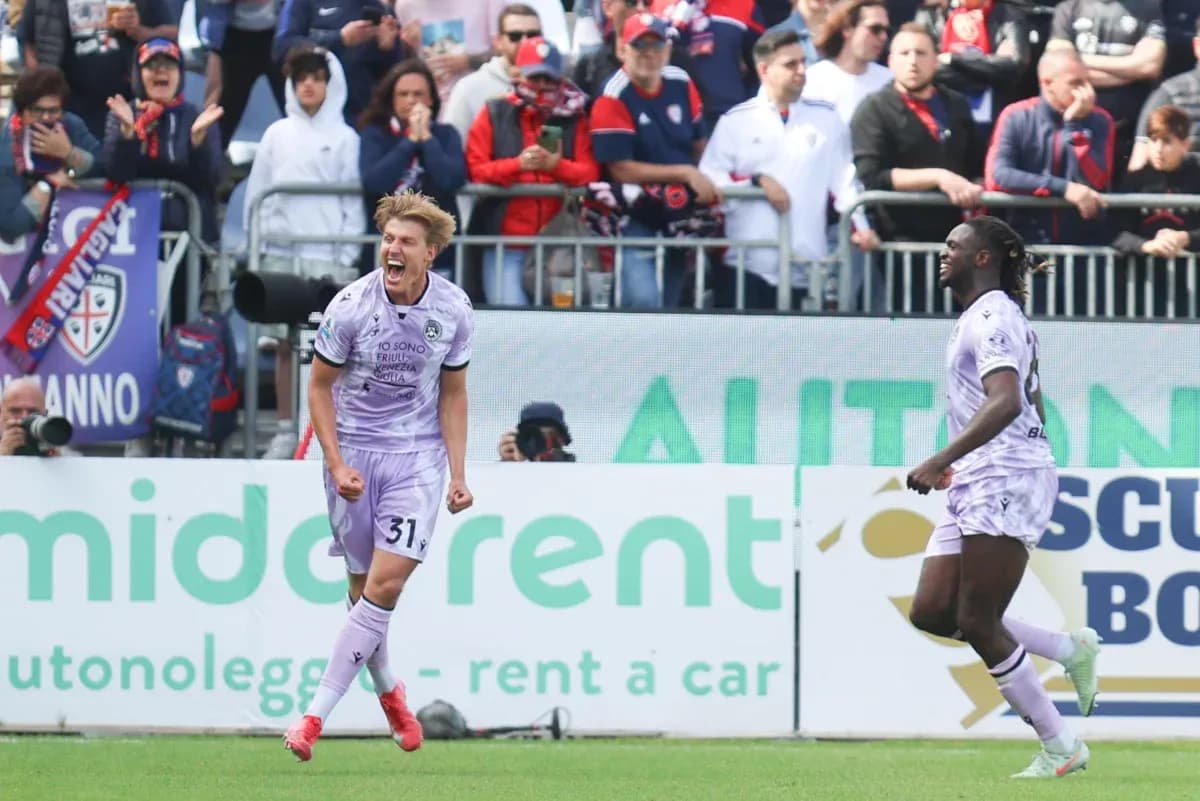
In stoppage time, Udinese’s emotional edge briefly showed: 90+2' Keinan Davis (Udinese) — Argument, a yellow card that reflected the tension of closing out an away win under pressure. But structurally they remained intact, and on 90' they killed the game: I. Gueye finished from a K. Davis assist to make it 0–2, again in line with their transition-first blueprint.
Tactically, the formations on paper—Cagliari’s 5-3-2 versus Udinese’s 3-5-2—mirrored each other, but the execution diverged. Cagliari, under Fabio Pisacane, used the back five primarily as a platform for sustained possession. With 537 total passes at 86% accuracy, they built patiently from E. Caprile through the three centre-backs A. Dossena, Zé Pedro and J. Rodriguez, trying to pin Udinese’s wing-backs deep via M. Palestra and A. Obert. The midfield trio of M. Adopo, G. Gaetano and M. Folorunsho were tasked with circulating the ball and finding the front two, S. Esposito and P. Mendy, between the lines.
The shot profile reveals the core problem: 22 total shots, but only 5 on target and just 1.41 xG. Cagliari created volume, especially inside the box (15 shots), but the quality of chances was often compromised by Udinese’s density in central zones. The three central defenders and compact midfield screen forced Cagliari into rushed finishes or blocked attempts (6 shots blocked). When Cagliari tried to overload wide channels, Udinese’s wing-backs and near-side centre-back slid across efficiently, accepting crosses but defending the six-yard box aggressively.
Udinese’s 3-5-2 under Kosta Runjaic was built for efficiency. With only 37% possession and 331 passes at 76% accuracy, they did not aim to control the ball but the spaces. The central trio of J. Karlstrom, J. Piotrowski and A. Atta screened passing lanes into Cagliari’s strikers, while the front pair N. Zaniolo and A. Buksa (later K. Davis and I. Gueye) stayed high to threaten in behind. The result was a lean but dangerous attacking output: 9 total shots, 6 on target, and a higher xG of 2.17 despite far fewer attempts.
Goalkeeper reality underscores the tactical contrast. E. Caprile made 4 saves for Cagliari, yet conceded twice, with a goals-prevented figure of 0.82 indicating he performed around expectation given the quality of shots faced. On the other side, M. Okoye needed only 3 saves but kept a clean sheet, also posting 0.82 in goals prevented. The implication is stark: Cagliari forced more work in volume, but Udinese’s defensive shape limited the danger of those efforts, while their own attacks generated clearer, higher-value chances.
Discipline and duels also tilted subtly toward Udinese’s game plan. They committed 13 fouls to Cagliari’s 10, an expected outcome for a side more often defending without the ball and breaking up rhythm. The two Udinese yellows—Kingsley Ehizibue for “Off the ball foul” and Keinan Davis for “Argument”—did not destabilize their structure, while Cagliari’s single yellow for Zé Pedro (“Foul”) reflected isolated defensive interventions rather than systemic stress.
Statistically, the verdict is that Cagliari’s Overall Form on the day—possession, passing accuracy, territorial dominance—did not translate into scoreboard impact, largely because their final-third execution lagged behind their buildup. Udinese’s Defensive Index, by contrast, was high: they allowed 1.41 xG from 22 shots, a sign of effective box protection and shot suppression quality. Coupled with an attacking output of 2.17 xG from just 9 attempts, Runjaic’s side maximized their transitions and set the game’s terms despite being out-passed and out-shot. In pure tactical terms, Udinese’s compact 3-5-2 and ruthless direct play decisively outperformed Cagliari’s possession-heavy 5-3-2.