.svg&w=384&q=75 "GoalGist logo")
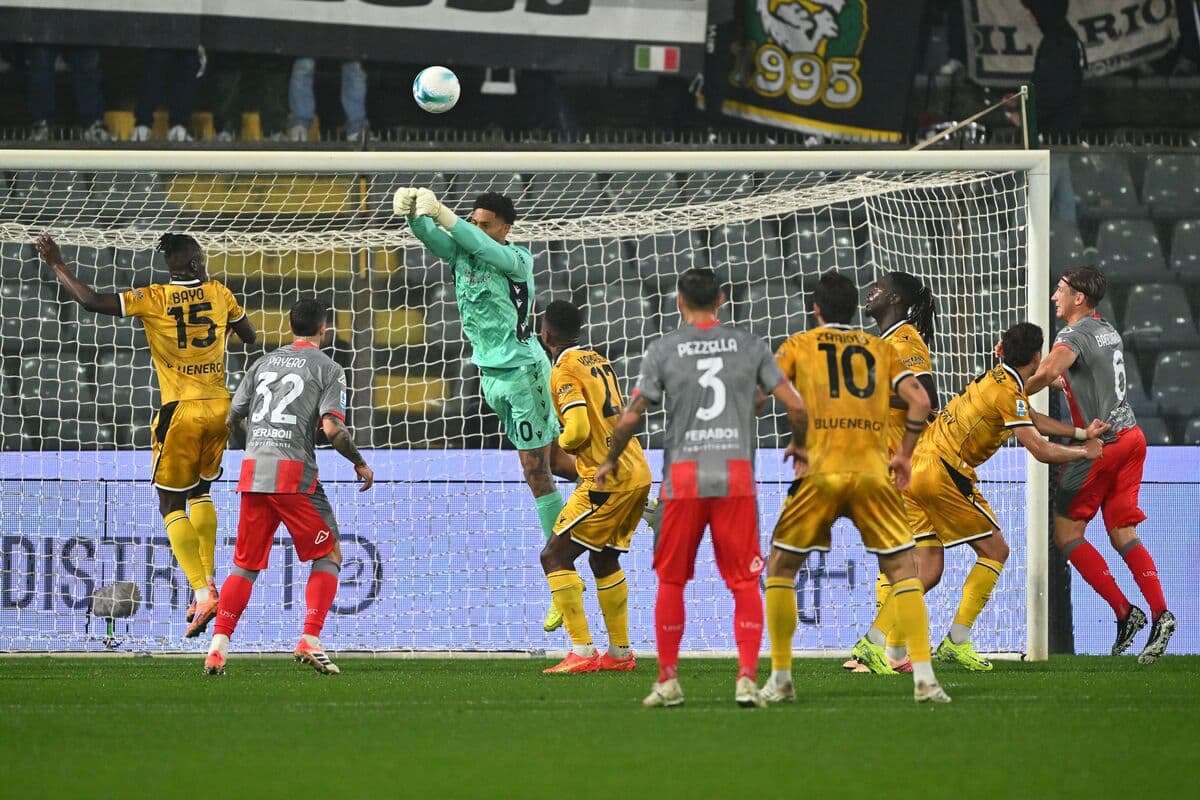
Udinese Falls to Cremonese in Tense 0-1 Defeat
Under the fading light at the Bluenergy Stadium – Stadio Friuli, this was supposed to be a late-season assertion of authority from a top-half Udinese side. Instead, the evening closed with a terse 0–1 home defeat to relegation-threatened Cremonese, a result that sharpened the narrative of both clubs’ seasons.
Following this result, the table tells a stark story. Udinese sit 10th with 50 points, their overall goal difference at -2, the product of 45 goals scored and 47 conceded across 37 matches. Cremonese, by contrast, remain in 18th on 34 points, their overall goal difference a bruising -22 from 31 goals for and 53 against. The gap in league status is clear; the gap on the pitch was anything but.
Both coaches leaned into familiarity, mirroring each other in a 3-5-2. Kosta Runjaic kept faith with Udinese’s three-at-the-back structure that has underpinned 19 league outings in this shape, while Marco Giampaolo doubled down on the same system that has framed Cremonese’s campaign in 25 matches.
Udinese’s seasonal identity has been defined by balance shading into caution. Overall they average 1.2 goals for and 1.3 against per match, but the split is revealing: at home they score just 0.9 and concede 1.1 on average, a profile of a side that often fails to turn possession into incision. They have kept 6 clean sheets at home, yet have failed to score 7 times in Udine – this defeat slid neatly into that pattern.
Cremonese arrived with a very different burden. Overall they average just 0.8 goals for and 1.4 against, a relegation candidate’s stat-line. On their travels they score only 0.7 per match and concede 1.5, with 10 away games where they failed to find the net. And yet here, in a match finished 0–1, their sparse attacking profile was enough: one goal, carefully protected, turned into a season-defining away win.
The tactical voids were significant, especially for Udinese. Suspended wing-back K. Ehizibue (yellow cards) and creative hub N. Zaniolo (back injury) stripped Runjaic of two vertical outlets and his leading assist provider, a midfielder with 6 assists and 5 goals in the league. Without Zaniolo’s 53 key passes and his willingness to duel and dribble, Udinese’s central band of J. Karlstrom, L. Miller and A. Atta lacked a true line-breaking passer between the lines.
Cremonese were also patched together. At the back, the absence of F. Baschirotto, and further up the squad the injuries to W. Bondo, F. Ceccherini and F. Moumbagna, forced Giampaolo to trust his existing 3-5-2 shell even more. The responsibility for defensive leadership and edge fell heavily on G. Pezzella, a midfielder with 8 yellow cards and 1 red this season, who again walked the fine line between aggression and recklessness.
On the night, the “Hunter vs Shield” duel was framed by two leading scorers. For Udinese, K. Davis came in with 10 league goals and 4 assists, supported by 25 shots on target from 38 attempts and a robust all-round game – 310 duels contested, 146 won. His movement between Cremonese’s lines was meant to unsettle M. Bianchetti and S. Luperto, but the visitors’ back three held a tight, compact block, funneling Davis into crowded central channels where his hold-up play was negated by numbers rather than individual dominance.
For Cremonese, F. Bonazzoli – 9 goals and 1 assist this season, with 31 shots on target from 55 – offered a different threat. Less about pure hold-up, more about timing and penalty-box instincts, he operated off the shoulder of J. Vardy, exploiting the gaps left when Udinese’s wide midfielders pushed on. With Udinese conceding 1.1 goals per game at home, the margin for error was thin; one well-constructed attack, one lapse in defensive spacing, and the visitors had the only goal they needed.
In the “Engine Room” matchup, the absence of Zaniolo deprived Udinese of their natural conduit between midfield and attack. Karlstrom’s metronomic passing and Miller’s energy could not replicate the risk-taking that so often pulls defensive blocks apart. On the other side, Cremonese had their own creative axis waiting on the bench in J. Vandeputte – 5 assists and 53 key passes this season – but Giampaolo’s starting five of Pezzella, Y. Maleh, A. Grassi, M. Thorsby and T. Barbieri was built first to disrupt, then to break.
Discipline and game-state management tilted the contest further towards the visitors. Heading into this game, Udinese’s yellow-card profile showed a pronounced late spike: 27.94% of their cautions arrive between 61–75 minutes, and 22.06% between 76–90. Cremonese, too, are at their most combustible late, with 26.09% of their yellows in the final quarter-hour. In a tight 0–1, this mutual tendency towards late bookings turned the closing stages into a series of stoppages, exactly the kind of fractured rhythm an away side protecting a lead craves.
Structurally, both teams leaned into their seasonal templates. Udinese’s three centre-backs – T. Kristensen, C. Kabasele, O. Solet – tried to build patiently, with wing-backs H. Kamara and J. Arizala tasked with stretching Cremonese’s compact 5-3-2 defensive shell. But with Udinese having failed to score in 10 league matches overall, the lack of a secondary goal threat beyond Davis and A. Buksa became glaring once they fell behind.
Cremonese, whose overall clean-sheet tally stands at 11, mirrored Udinese’s defensive resilience but added a sharper edge in transition. Their biggest away win of 1–3 this season hints at a side comfortable absorbing pressure and then striking decisively; the pattern repeated here, only with fewer chances and greater defensive discipline.
From an analytical standpoint, the Expected Goals balance (though not numerically provided) can be inferred from the underlying profiles. Udinese’s overall scoring average of 1.2, dragged down at home to 0.9, suggests a side that regularly underperforms in front of their own fans. Cremonese’s away average of 0.7 indicates that even a modest xG haul would be enough to match their typical output. In a match that finished 0–1, the visitors likely maximised a limited xG, while Udinese once again failed to convert territorial control into high-quality chances.
Following this result, the tactical verdict is sobering for Udinese: their reliance on Zaniolo’s creativity and Davis’s finishing has left them vulnerable when either is absent or contained. The 3-5-2 remains structurally sound – 11 clean sheets overall and only 47 goals conceded in 37 matches underline that – but the attacking ceiling, especially at home, is too low to reliably break down disciplined blocks.
For Cremonese, this win is a tactical manifesto as much as a lifeline. Giampaolo’s 3-5-2, anchored by Pezzella’s combative presence and Bonazzoli’s penalty-box craft, has shown it can survive and even thrive in hostile venues despite a negative goal difference of -22. If they can bottle this blend of compactness, controlled aggression and ruthless efficiency in front of goal, survival – however improbable the numbers may seem – remains within reach.