.svg&w=384&q=75 "GoalGist logo")
Parma vs Sassuolo: Tactical Insights from a Season's Epilogue
Stadio Ennio Tardini felt like a fitting stage for a season’s epilogue: Parma versus Sassuolo, two mid‑table sides whose campaigns had been defined less by glamour than by grind. Following this result, Parma closed their Serie A season in 13th on 45 points, while Sassuolo finished 11th with 49. The 1–0 home win was narrow on the scoreboard but rich in tactical detail, a match where structural choices and squad absences shaped the story as much as the decisive strike.
Parma's Tactical Setup
Parma arrived with the statistical profile of a survival specialist rather than a swashbuckling side. Overall this campaign they scored just 28 goals and conceded 46, a goal difference of -18, with a total average of 0.7 goals for and 1.2 against per game. At home they had been particularly goal‑shy, averaging 0.8 scored and 1.3 conceded, winning only 5 of 19. Yet Carlos Cuesta doubled down on his side’s identity, rolling out their most-used shape: a 3‑5‑2 that has started 19 league matches.
The back three of Mariano Troilo, L. Valenti and A. Circati formed a compact triangle in front of goalkeeper E. Corvi, with wing‑backs E. Valeri and S. Britschgi providing width. In central midfield, H. Nicolussi Caviglia, C. Ordonez and M. Keita offered a blend of circulation and ball‑winning, while up front Mateo Pellegrino and D. Mikolajewski were tasked with stretching Sassuolo’s high line and fighting for every direct ball.
Sassuolo's Tactical Approach
Across from them, Sassuolo’s season numbers told of a more expansive but fragile side. Overall they scored 46 and conceded 50 (goal difference -4), averaging 1.2 goals for and 1.3 against. On their travels they were more balanced but still porous: 21 away goals scored, 24 conceded, with 5 away wins and 9 defeats. Fabio Grosso stayed loyal to his blueprint, deploying the 4‑3‑3 that has started 36 times this season. S. Turati was shielded by a back four of W. Coulibaly, T. Macchioni, J. Idzes and U. Garcia, while the midfield trio of K. Thorstvedt, L. Lipani and I. Kone had to stitch together progression and protection. Up front, the familiar trident of D. Berardi, A. Pinamonti and A. Laurienté gave Sassuolo their edge in individual quality.
Absences Impacting Both Teams
Both managers had to navigate significant tactical voids. Parma’s creative and attacking depth was heavily hit: A. Bernabe (muscle injury), B. Cremaschi (knee), N. Elphege (thigh), M. Frigan (knee), J. Ondrejka (leg), G. Oristanio (knee) and G. Strefezza (ankle) were all unavailable. That stripped Cuesta of several ball‑carriers and line‑breaking options between the lines, making the choice of a robust 3‑5‑2 almost inevitable. The onus fell even more heavily on Pellegrino to be both outlet and finisher.
Sassuolo’s absentees were more concentrated in defensive and rotational roles but still meaningful. D. Bakola, F. Cande, E. Pieragnolo and S. Walukiewicz all missed out through knee or leg injuries, while F. Romagna and A. Vranckx were listed as inactive, and D. Boloca was sidelined by a muscle problem. This limited Grosso’s ability to reshuffle his back line or add a more conservative midfield profile, forcing him to lean on the technical quality of Thorstvedt and the work rate of Lipani and Kone to protect a back four that has already conceded 50 league goals.
Discipline and Tactics
Discipline hovered over the contest as a quiet sub‑plot. Across the season, Parma’s yellow cards have spiked in the 46–60 and 76–90 minute ranges (both at 21.21%), while Sassuolo’s late‑game aggression is even more pronounced, with 28.92% of their yellows arriving between 76–90 minutes. The red‑card histories added further edge: Troilo came in as Serie A’s leading red‑carded player, with 1 straight red and 1 second‑yellow dismissal, while Nemanja Matic, on the Sassuolo bench, also carried a red this season. That background framed a match where the margins of timing and temperament were always likely to matter.
Key Duels on the Pitch
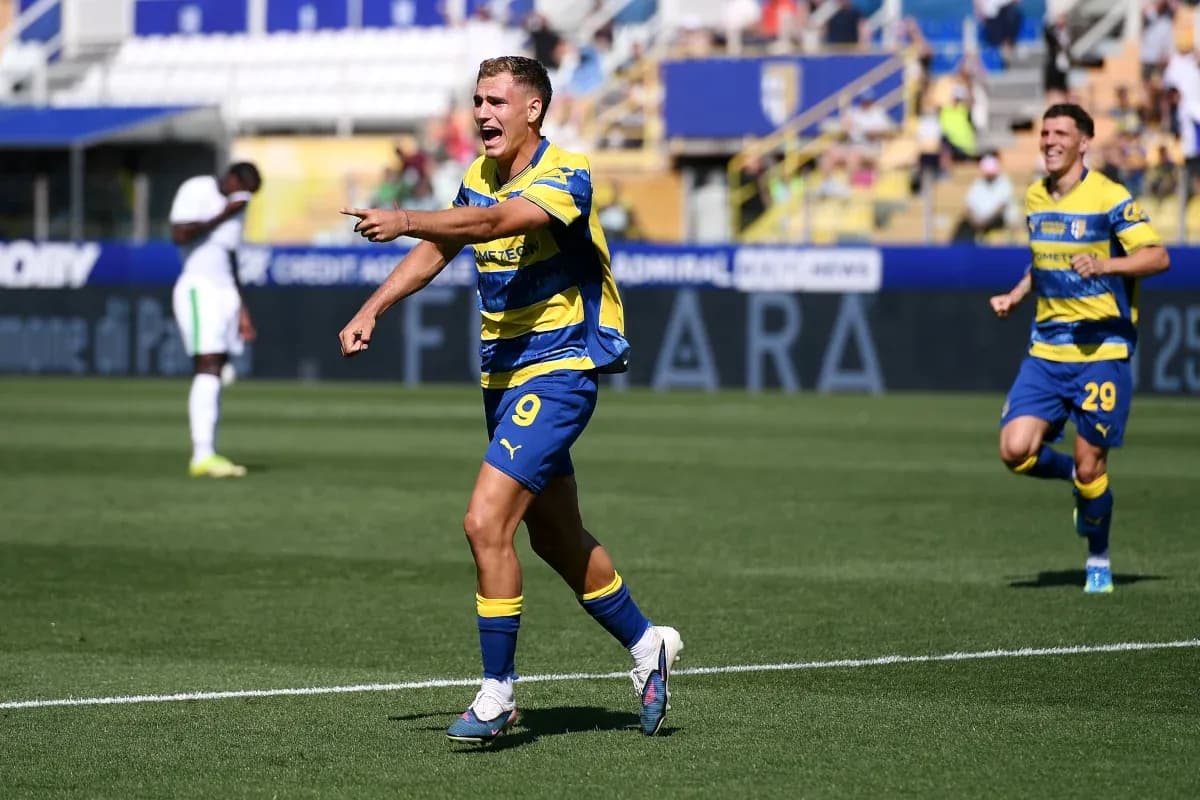
On the pitch, the key duel was the “Hunter vs Shield” battle between the leading scorers. For Sassuolo, Andrea Pinamonti’s 9 goals and 3 assists, built on 57 shots (30 on target), have made him their penalty‑box reference. Yet his season also contained a blemish from the spot, with 1 penalty missed despite winning another. Parma’s answer was Pellegrino, also on 9 league goals with 1 assist, but offering a very different profile: a 193‑centimetre target man who has attempted 48 dribbles (25 successful) and contested a remarkable 546 duels, winning 233. His willingness to back into centre‑backs, draw fouls (71 this season) and occupy both central defenders was central to Parma’s plan to disrupt Sassuolo’s build‑up and pin them back.
Behind those forwards, the “Engine Room” matchup was layered. For Sassuolo, Thorstvedt has been a quiet force: 4 goals, 4 assists, 1,055 passes at 82% accuracy, and a combative edge evidenced by 44 tackles, 13 successful blocks and 32 interceptions. His 9 yellow cards underline how often he plays on the disciplinary line, but also how central he is to breaking opposition rhythm. On the flanks, Laurienté’s season as Serie A’s second‑ranked assist provider (9 assists, 7 goals, 54 key passes and 80 dribble attempts with 29 successes) made him the primary creative outlet, constantly testing the spaces outside Parma’s wide centre‑backs.
Parma’s response was to compress the middle and use their wing‑backs intelligently. Nicolussi Caviglia and Keita were tasked with screening passing lanes into Pinamonti’s feet, while Ordonez shadowed Thorstvedt’s movements to stop him from dictating tempo. Valeri and Britschgi had to walk a tightrope: step out aggressively on Berardi and Laurienté without leaving Troilo and Circati exposed in wide channels. Troilo’s own defensive profile — 27 tackles, 18 successful blocks and 18 interceptions — suited this scenario. His timing in stepping out of the line to meet Berardi or Laurienté helped Parma keep Sassuolo’s wingers facing their own goal more often than they would have liked.
Final Stages and Outcome
The disciplinary undercurrent never quite spilled over, but it shaped the tempo. Aware of their tendency to collect late cards, Parma managed the closing stages with a compact block rather than frantic pressing, reducing the risk of another red in the 76–90 or 91–105 minute windows where they have historically been vulnerable. Sassuolo, whose yellow‑card peak also comes late, pushed numbers forward in search of an equaliser but were forced into more speculative crosses than incisive combinations, a product of Parma’s crowded central corridors.
From a statistical prognosis perspective, the result felt like the low‑scoring outcome the numbers hinted at. Heading into this game, both sides averaged only 1.2 goals scored per match, and Parma’s home attack (0.8 per game) has rarely blown opponents away. With both teams perfect from the spot this season at club level (2 penalties scored each, none missed), there was always the possibility that a single set‑piece or penalty could decide it. Instead, it was open play that delivered the decisive moment, rewarding Parma’s insistence on structural solidity over spectacle.
In the end, this 1–0 was a microcosm of their respective seasons. Parma, limited in firepower but disciplined and system‑driven, extracted maximum value from minimal chances. Sassuolo, richer in individual flair but looser without the ball, once again found that their attacking talent could not consistently out‑run their defensive concessions. At Stadio Ennio Tardini, the shield outlasted the hunters, and the table at full time reflected exactly that balance.