.svg&w=384&q=75 "GoalGist logo")
England vs Norway: World Cup Quarterfinal Showdown in Miami
Miami will drip and shimmer on Saturday night, the heat rising off the turf as England and Norway walk into a World Cup quarterfinal that feels bigger than that label suggests. One is a heavyweight used to this stage. The other has crashed the party and refuses to leave.
Norway arrive as the story of the tournament. Out since 1998, now into uncharted territory, they have already won the first two knockout ties in their history and bundled out Brazil, five-time world champions, in the last 16. They look nothing like tourists.
England are chasing something more familiar: a fourth World Cup semifinal, a way to dodge yet another quarterfinal exit. Seven times they’ve fallen at this hurdle. The scar tissue is thick.
On this furnace of a night in Florida, the margins will be brutal. And the duels are obvious.
Haaland vs Kane: Golden Boot and the crown of the modern No 9
The World Cup has waited for this. Two of the sport’s most ruthless finishers, finally sharing a pitch at this tournament with the Golden Boot race crackling in the background.
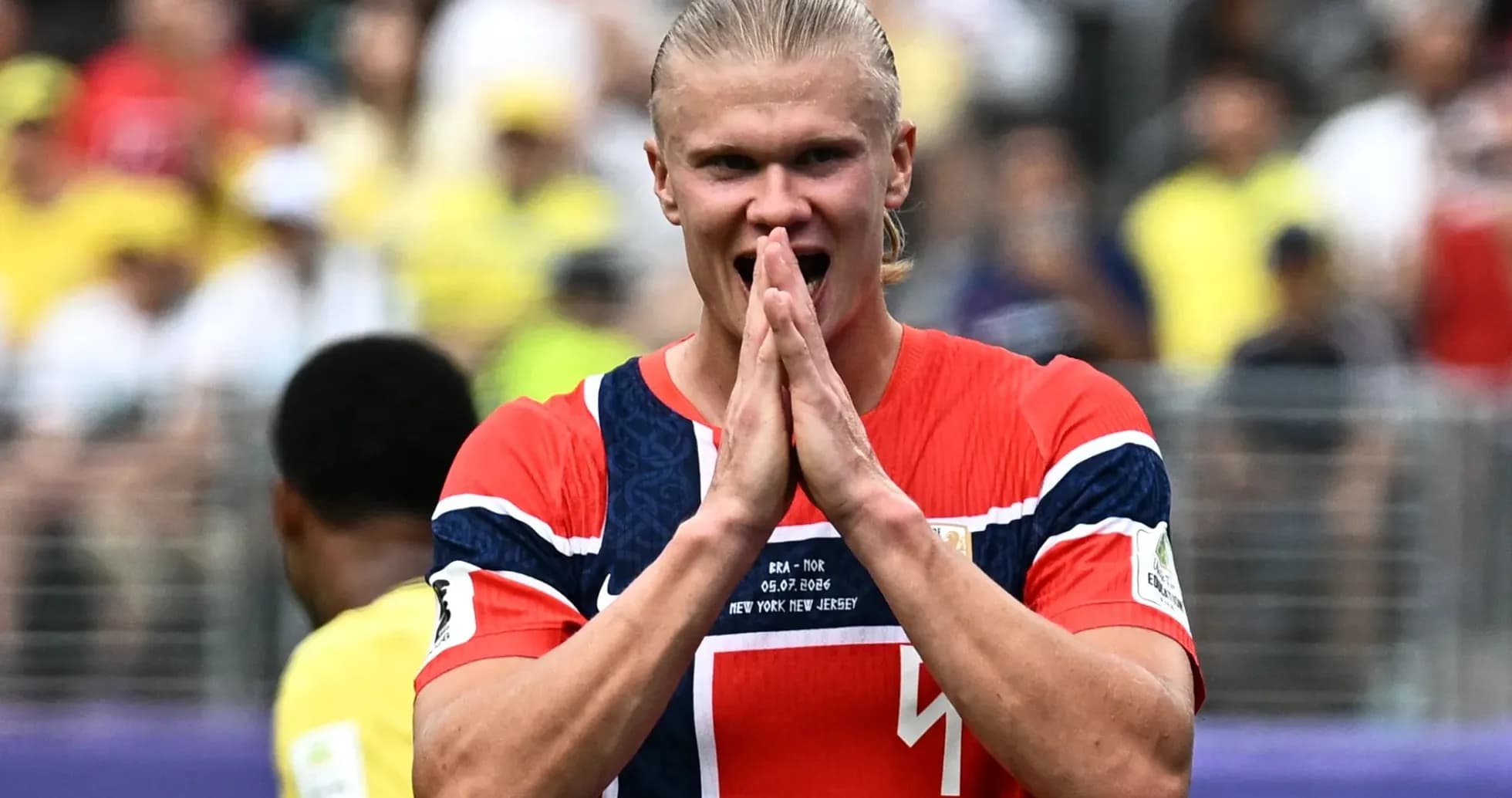
Erling Haaland should never have been in this side of the draw. Norway shouldn’t still be here, we were told. Yet he has bulldozed them forward: the winner against Ivory Coast in the first knockout round, both goals in the 2-1 victory over Brazil. Seven goals in four appearances, 14 straight internationals with at least one strike, 27 goals in that run alone. His Norway record now reads 62 in 54 caps. Those are numbers from a different era.
He stands one behind Kylian Mbappé and Lionel Messi in the Golden Boot standings, and one ahead of Harry Kane.
Kane’s path has been steadier, but no less decisive. Two goals to open against Croatia. One more against Panama to lock in top spot. Both in the late rescue act against DR Congo in the Round of 32. Then the penalty that separated England and Mexico in a wild 3-2 contest. Six goals, all of them heavy with consequence.
They are bound by shared honours and shared habits: three Premier League Golden Boots each, proven scorers in England and Germany. Yet they have barely crossed paths. Just two meetings, in the 2022/23 Premier League season, when Kane’s Tottenham and Haaland’s Manchester City traded wins and the strikers traded goals.
Now they meet with more on the line than three points. Win this duel, tilt the argument over who is the outstanding centre-forward on the planet right now. The stage, the stakes, the temperature – all of it suits them.
The Dan Burn question: England’s unlikely Haaland antidote
So how do you stop a man who scores a goal every 73 minutes in international football?
England’s most surprising answer might be a 6’7” defender who only became an international a year ago: Dan Burn.
His inclusion in Thomas Tuchel’s squad raised eyebrows. Burn made his debut just before turning 33, and all four of his England starts came against modest opposition in qualifying – Andorra and Albania. Yet his late cameo against Mexico turned into a small epic. Thrown on for the final 15 minutes with England down to 10 men and clinging to a 3-2 lead, he headed away everything, blocked everything, and turned the penalty area into his own.
The numbers against Haaland are striking. Since the Norwegian joined Manchester City in 2022, he has faced Burn eight times – six in the Premier League, two in domestic cups. Across more than 10 hours of shared pitch time, Haaland has scored just once, in their very first meeting in August 2022.
Burn is not as quick, not as agile, and nine years older. But he is two inches taller and thrives on the physical wrestle Haaland usually wins. England know that in a game where every detail matters, that track record is not something to ignore.
There is more. Haaland has only one goal in 406 minutes against Ezri Konsa, across five matches. That, too, came in their first clash back in September 2022. For a striker who has plundered 112 goals in 132 Premier League games over four seasons, with three Golden Boots, those are rare outliers – and they all wear England shirts.
By contrast, he has feasted on Marc Guehi in the past, scoring seven in five before the defender became his club teammate at City, and he has never faced John Stones as an opponent. Tuchel will know exactly which combinations have given Haaland problems and which have not.
Burn might not start. He might not even play. But if England are defending a lead late on in the Miami heat and Haaland is prowling, it would be no surprise to see that towering frame appear again.
Odegaard vs Rice: the brain of Norway against England’s hurting engine
If Haaland is the hammer, Martin Odegaard is the hand that swings it.
Against Brazil, the Norway captain delivered a masterclass in control and courage. He carried the ball forward 61 times, completed 101 of his 109 passes, and dictated a game in which Brazil’s entire squad managed only 331 passes at a far lower completion rate. Norway starved the Selecao of the ball, holding them to just 33.6 percent possession – Brazil’s lowest share ever in a World Cup match.
That number is still higher than England’s against Mexico. Tuchel’s side sank back with 10 men, barely escaping their own box for the final half-hour. It was the lowest possession figure the Three Lions have recorded since such statistics were tracked.
If England are to reach a first World Cup semifinal since 2018 and only a third since 1966, that pattern cannot repeat. They must disrupt Odegaard, break his rhythm, make him look sideways instead of forward.
No one understands his tendencies better than Declan Rice. The two have shared an Arsenal midfield 117 times over the last three seasons, driving the club to a long-awaited Premier League title and a Champions League final. Rice knows when Odegaard wants to receive between the lines, when he disguises the pass wide, when he slows play to spring a runner.
Yet Rice is not at full tilt. Neural pain has nagged at his lower back and hamstring for months. He still logged 3,094 Premier League minutes this season, and his England partner Elliot Anderson played even more. Odegaard, by contrast, played just 1,369 league minutes, arriving at this tournament with fresher legs and a cleaner body.
That gap might matter in Miami’s humidity, where every sprint and turn drains a little more. Rice’s knowledge of his club captain could be decisive. So could his ability to execute it on a body that has been pushed to its limit.
Heat, humidity and survival
This is not just a tactical test. It is a physiological one.
Miami has already staged the two hottest games of the group phase. On Saturday, the forecast sits around 33C (91F) with 58 percent humidity, a 5pm local kickoff, and thunderstorms hovering as a threat.
Norway might be marginally better acclimatised. They have played four of their five matches in open-air, hot, sticky conditions: Boston against Iraq, New York/New Jersey against Senegal, back to Boston for the rotated defeat to France, and then the draining win over Brazil again in New York/New Jersey. Only the victory over Ivory Coast in Dallas came under a roof.
England’s path has been kinder. Croatia in the enclosed Dallas stadium. Ghana in a rainy Boston. Panama in a wet New York/New Jersey. DR Congo back indoors in Atlanta. Even Mexico City, despite the storm and one-hour delay, brought cooler air than what awaits in Florida.
The team that manages its energy, its substitutions, and its hydration best might gain an edge that no whiteboard can show. Legs will go. Minds will wander. Mistakes will appear in the final 20 minutes, and someone will have to be ready to exploit them.
Norway’s left flank vs England’s patched-up right
There is another pressure point England cannot afford to ignore: Norway’s left side against an England right that has been held together by tape and improvisation.
Reece James, the only recognised right-back in Tuchel’s squad after Tino Livramento’s calf injury on the eve of the tournament, has missed the last three matches with a hamstring problem suffered against Ghana. In his absence, the right of England’s defence has become a revolving door.
Djed Spence, Ezri Konsa, John Stones and Jarell Quansah have all been asked to plug the gap. Rice even dropped in there late on against DR Congo. Quansah is now suspended after his red card against Mexico, reducing the options further.
James is pushing to be fit for the quarterfinal, and his return would be a huge relief. If he does not make it, Konsa is likely to reprise the role he handled admirably in that desperate rearguard in the last round.
Whoever starts will walk straight into a storm. Antonio Nusa, quick and elusive, loves to attack from the left and drive inside onto his right foot. His curled strike into the top corner against Ivory Coast in the Round of 32 was one of the goals of the tournament, a reminder of what happens when he is allowed to turn and face his man.
But it was his replacement against Brazil, Andreas Schjelderup, who truly changed Norway’s last game. Introduced at half-time, the Benfica winger delivered his best performance of the World Cup. First came the cross that Haaland powered in for the opener. Then the lay-off for Haaland to thrash his second into the bottom corner from the edge of the box to kill the contest.
Nusa or Schjelderup. James or Konsa. Those are not just names on a teamsheet; they are fault lines. Get that matchup wrong and the whole structure can crack.
The stage is set: Haaland against Kane for goals and glory, Odegaard against Rice for control, the heat against human limits. Norway chasing the greatest chapter in their football history. England trying to prove they are more than a nearly team with a famous past.
By Saturday night in Miami, one of these stories will be over. The other will be 90 minutes from a World Cup final.

