.svg&w=384&q=75 "GoalGist logo")
Bologna vs Inter: A Thrilling Serie A Finale
Stadio Renato Dall’Ara staged a finale worthy of Serie A’s closing act. Bologna, finishing 8th on 56 points with an overall goal difference of 3 (49 scored, 46 conceded), went toe‑to‑toe with champions Inter, who closed the campaign on 87 points and an imposing overall goal difference of 54 (89 scored, 35 conceded). Across 38 matches, Bologna’s season was defined by away efficiency and home volatility, while Inter’s was built on relentless attacking volume and defensive control. The 3-3 draw here distilled both identities into ninety breathless minutes.
Team Formations
Vincenzo Italiano leaned into aggression with a 4-3-3, a shape Bologna had used 8 times this season but rarely with such front-foot intent. L. Skorupski anchored a back four of L. De Silvestri, E. Fauske Helland, J. Lucumi and J. Miranda, with a midfield trio of L. Ferguson, R. Freuler and T. Pobega tasked with compressing the central lanes. Up front, F. Bernardeschi and J. Rowe flanked S. Castro, a fluid front line designed to drag Inter’s back three into uncomfortable wide zones.
Cristian Chivu, by contrast, doubled down on Inter’s season-long structural certainty: the 3-5-2 they had used in all 38 league matches. J. Martinez started in goal behind a defensive trio of Y. Bisseck, S. de Vrij and Carlos Augusto. The wing-backs and mezzali were where the champions’ class shone: F. Dimarco wide left, A. Diouf wide right, with P. Zielinski and N. Barella either side of P. Sucic. Up front, the league’s leading scorer Lautaro Martínez – 17 goals and 6 assists in 30 appearances – partnered F. Esposito.
Tactical Considerations
The tactical voids were significant on both sides. Bologna were without R. Orsolini, their top scorer with 10 league goals and a key ball-carrier, through a muscle injury, and also missed N. Cambiaghi, N. Casale, M. Vitik and K. Bonifazi. Deprived of Orsolini’s direct threat and his penalty pedigree – 4 spot-kicks scored but 2 missed – Italiano had to redistribute creative burden onto Bernardeschi and Ferguson, while trusting Rowe’s vertical running to stretch Inter.
Inter’s absences were more about managed risk than enforced loss. H. Çalhanoğlu, whose 9 goals, 4 assists and 90% passing accuracy from deep had often been the metronome of Chivu’s side, was sidelined by a lack of match fitness. D. Dumfries, M. Thuram and M. Akanji were all rested. Without Çalhanoğlu’s control and Thuram’s 13 goals and 6 assists, Inter’s midfield lost some of its usual balance between incision and circulation. The onus shifted heavily onto Barella and Dimarco to dictate tempo and supply Lautaro.
Statistical Insights
Across the season, Bologna’s statistical profile hinted at why this match became so open. Heading into this game, they averaged 1.3 goals scored per match overall (1.0 at home, 1.6 on their travels) and 1.2 conceded both at home and away. At Dall’Ara they were paradoxically fragile: only 6 home wins from 19, with 9 defeats, and just 19 goals scored at home. Yet they also collected 7 home clean sheets and converted all 5 penalties overall, a sign of a side capable of both collapse and resilience in the same campaign.
Inter, meanwhile, arrived as a machine. Overall they averaged 2.3 goals scored per match (2.6 at home, 2.1 on their travels) and only 0.9 conceded (0.8 at home, 1.0 away). On their travels they won 13 of 19, scoring 39 and conceding 19. With 18 clean sheets overall and only 2 matches all season where they failed to score, Chivu’s men were structurally superior to almost everyone they faced.
Disciplinary Data
The disciplinary data added another layer to the tactical backdrop. Bologna’s yellow cards peaked in the 61-75 minute window at 26.87%, with another 25.37% in the final 76-90 stretch – a late-game surge that reflects how often they were forced into reactive defending as matches opened up. Their red cards were similarly clustered in the 61-75 range (33.33%), underlining how risky their intensity could become as legs tired. Inter’s bookings also spiked late: 31.25% of their yellows arrived between 76-90 minutes, and 20.31% between 61-75, but crucially they navigated the entire league campaign without a single red card. This contrast framed a likely late-game scenario: Bologna pushing and fouling, Inter absorbing without losing numerical superiority.
Key Matchups
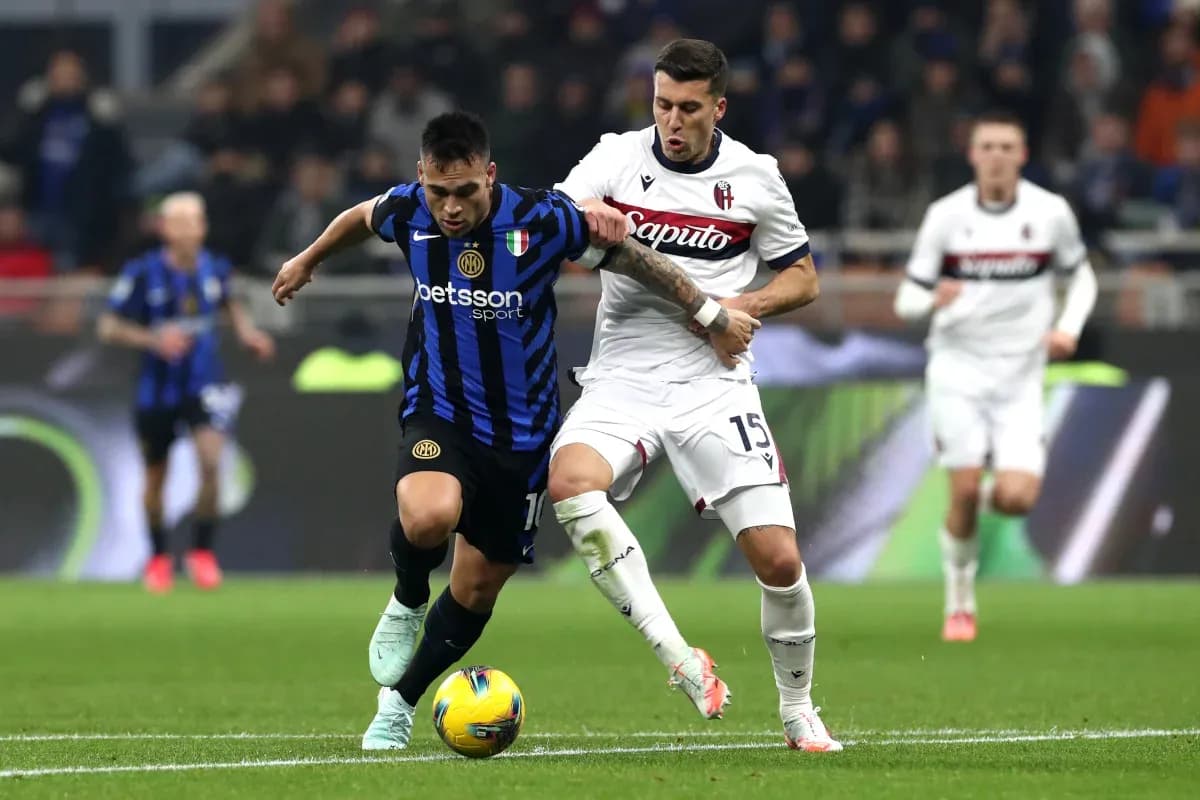
Within that context, the key matchups took on a narrative of “Hunter vs Shield” and “Engine Room vs Enforcer”. Lautaro Martínez, with 69 shots (39 on target) and a blend of penalty-box movement and link play, attacked a Bologna defence that, at home, conceded 1.2 goals per match and had suffered 9 defeats. Lucumi and Fauske Helland had to hold a high line without the safety net of an elite ball-winner screening them, relying on Freuler’s positional nous rather than sheer athletic coverage.
On the flanks, F. Dimarco – the league’s top assist provider with 16 – was the creative spear aimed at Bologna’s right side. De Silvestri, nominally a conservative full-back, was forced into a dual role: track Dimarco’s wide surges while still offering overlap to free Bernardeschi inside. Every time Dimarco advanced, Bologna’s back four risked being stretched into a back five, which in turn opened central pockets for Barella’s late runs and Lautaro’s dropping movements.
In the “Engine Room” zone, Barella’s 8 assists and 72 key passes collided with the combined graft of Freuler and Ferguson. Barella’s ability to receive under pressure and break lines with either a pass or a carry was Inter’s antidote to Bologna’s compact 4-3-3 mid-block. Conversely, Ferguson’s task was to turn Bologna’s regains into fast, vertical attacks, often looking early for Rowe’s runs in behind Inter’s wide centre-backs.
Following this result, the numbers still favour Inter’s season-long xG profile and defensive solidity as the superior foundation. Yet Bologna’s capacity to score three against a side that had conceded only 35 goals all campaign suggests that Italiano’s more expansive 4-3-3 can trouble even elite structures when the press and rotations are synchronised. Inter leave Dall’Ara with their dominance statistically affirmed, but also reminded that when their control in midfield is dented by absences, even the champions can be dragged into a wild, end‑to‑end shootout.