.svg&w=384&q=75 "GoalGist logo")
Hellas Verona vs AS Roma: Serie A Match Analysis
Under the late spring sky at Stadio Marcantonio Bentegodi, the numbers told the story before a ball was kicked. Heading into this game, Hellas Verona were 19th in Serie A on 21 points, with a goal difference of -36 after 25 goals scored and 61 conceded overall. AS Roma arrived in Verona as a side at the opposite end of the spectrum: 3rd place, 73 points, and a goal difference of 28 from 59 goals for and 31 against overall. Over 38 matches, Verona had managed only 3 wins; Roma had 23. The 0-2 full-time scoreline simply underlined a season-long imbalance.
Verona’s season-long DNA was written in their attacking averages. At home they scored just 12 goals in 19 matches, an average of 0.6 per game, and failed to score in 11 home fixtures. Paolo Sammarco stayed loyal to the club’s most-used structure, a 3-5-2 that had started 26 times this campaign, hoping that familiarity could compensate for the gulf in quality.
The back three of L. Montipo behind V. Nelsson, A. Edmundsson and N. Valentini was tasked with holding a line that, at home, had conceded 28 goals at an average of 1.5 per match. In front of them, the wing lanes belonged to M. Frese and R. Belghali, with J. Akpa Akpro, S. Lovric and A. Harroui forming a busy, combative central trio. Up front, T. Suslov and K. Bowie were asked to stretch Roma’s back three and offer counter-attacking outlets rather than sustained possession.
Yet Verona entered this game shorn of some of their more rugged or direct options. R. Gagliardini, one of Serie A’s leading collectors of yellow cards with 10 bookings this season, was suspended for accumulation. His absence stripped Sammarco of a midfielder who had made 73 tackles, 13 successful blocks and 54 interceptions in the league, and who relished the dirty work Verona needed against Roma’s technicians. Further injuries to D. Mosquera, D. Oyegoke, J. Peci and S. Serdar thinned both the defensive rotation and the ability to change games from the bench. G. Orban, a forward with 7 league goals and a red card to his name, was also unavailable as “Inactive”, depriving Verona of their most proven scorer.
Roma, by contrast, arrived with the swagger of a side whose form line read “WWWWW” and whose structure had been honed over 30 league matches in a 3-4-2-1. Piero Gasperini Gian’s selection was almost textbook: M. Svilar in goal; a back three of G. Mancini, D. Ghilardi and M. Hermoso; wing-backs Z. Celik and D. Rensch; a central pairing of B. Cristante and N. Pisilli; and a devastating trio ahead of them in M. Soule, P. Dybala and D. Malen.
Even with absentees of their own — E. Ferguson, E. Ndicka, L. Pellegrini, K. Tsimikas, Wesley Franca and B. Zaragoza all missing — Roma’s depth was evident. The spine remained intact: Mancini and Hermoso, both among Serie A’s most carded defenders with 9 yellows each, brought aggression and aerial dominance. Mancini’s 52 tackles, 14 successful blocks and 49 interceptions this season framed him as the enforcer at the heart of the back three, while Hermoso’s blend of 36 tackles, 6 blocks and 29 interceptions added a calmer left-footed balance.
Higher up, Roma’s “Hunter vs Shield” dynamic was brutally one-sided. On their travels, they averaged 1.4 goals per game (26 in 19 away matches), while Verona at home averaged only 0.6. Roma’s away defence conceded 21 goals, an average of 1.1 per match, but that still compared favourably to Verona’s overall attacking output of 0.7 goals per game. With Verona failing to score in 20 league matches overall, the probability landscape tilted heavily towards an away clean sheet.
At the tip of Roma’s spear, D. Malen embodied the “Hunter”. With 14 league goals and 2 assists in 18 appearances, he arrived as one of Serie A’s most efficient finishers, having hit 31 shots on target from 49 attempts. His penalty record, though, carried a small blemish: 3 scored but 1 missed, a reminder that even Roma’s leading scorer was not flawless from the spot. Behind him, M. Soule and P. Dybala offered creativity and chaos between the lines. Soule’s 6 goals and 5 assists, backed by 46 key passes and 95 attempted dribbles, made him Roma’s all-action conduit, while Dybala, with 6 assists and 55 key passes, was the pure playmaker, drawing 40 fouls and manipulating tempo.
The “Engine Room” battle was where Verona hoped to disrupt Roma’s rhythm. Without Gagliardini, responsibility fell more heavily on Akpa Akpro and Lovric. Akpa Akpro’s season profile — 44 tackles, 7 successful blocks, 23 interceptions and 39 fouls committed — painted him as Verona’s primary disruptor, a midfielder willing to live on the disciplinary edge. Verona’s team card data underlined that edge: 24.72% of their yellow cards arrived between 46-60 minutes, and another 21.35% between 31-45, suggesting that as the intensity of each half built, so did their propensity to mistime challenges. Roma, too, had a late-game disciplinary spike, with 23.53% of their yellows between 61-75 minutes and another 23.53% between 76-90, but their superior control of possession often meant they could manage those risks better.
Roma’s own penalty record this season was pristine at team level: 5 penalties taken, all 5 scored, with 0 missed. That clinical edge from the spot, combined with their 18 clean sheets overall (11 at home, 7 away), made them a side that punished small margins and protected leads with ruthless efficiency.
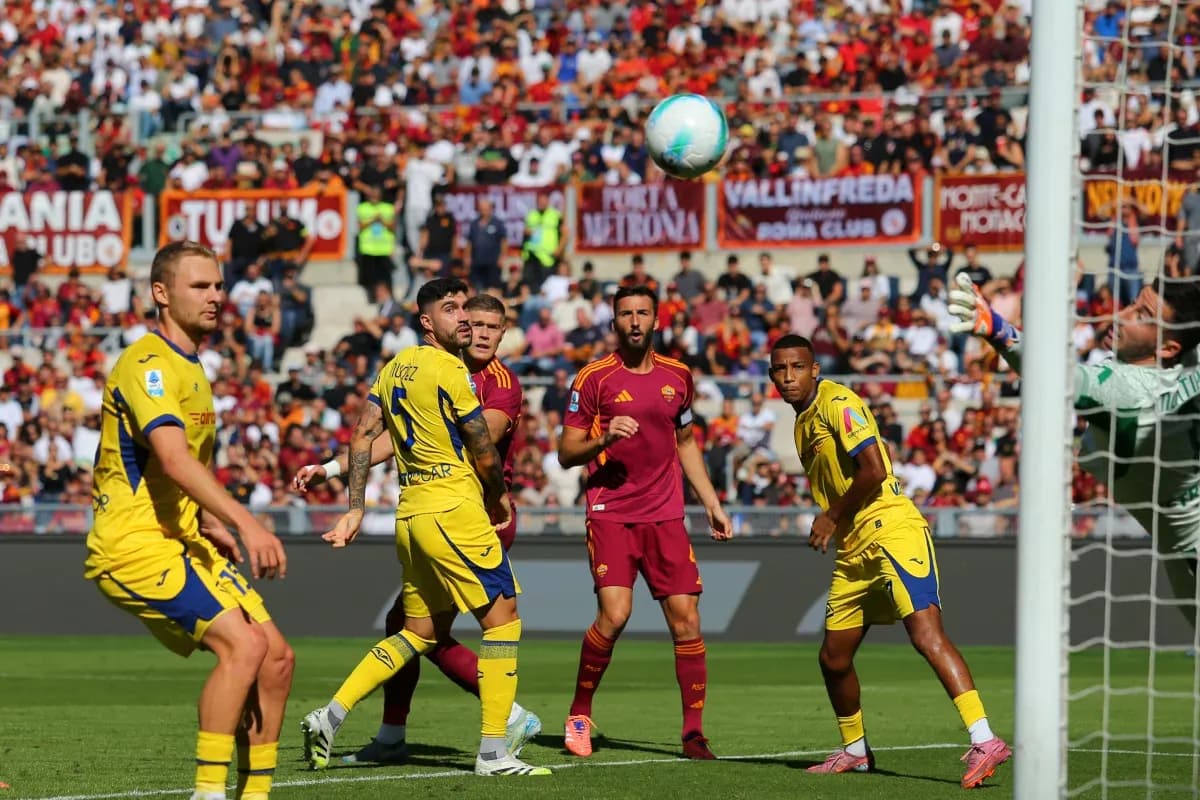
Tactically, the critical intersection lay in Roma’s structured, layered attacks against Verona’s fragile block. With no minute-by-minute goal distribution provided, the pattern still felt predictable: Roma’s wing-backs, Celik and Rensch, were positioned to pin back Frese and Belghali, forcing Verona’s 3-5-2 into a 5-3-2 and isolating Suslov and Bowie. Cristante, with his positional discipline, and Pisilli, with his energy, formed a platform from which Soule and Dybala could repeatedly receive between Verona’s lines, dragging defenders out and creating the channels Malen thrives on.
Following this result, the 0-2 away win simply confirmed what the season’s metrics had forecast. Roma’s superior xG profile — implied by their 1.6 goals scored on average and 0.8 conceded overall — translated into control at both ends of the pitch. Verona, with their 0.7 goals scored and 1.6 conceded overall, were again forced into the familiar role of a side clinging on rather than dictating.
In narrative terms, this was less an upset and more a final, clinical chapter. Roma’s hunters — Malen, Soule, Dybala — found enough cracks in Verona’s shield, weakened by suspensions and injuries, while Mancini and Hermoso ensured that any home resistance was contained. The numbers had warned us; the pitch at Bentegodi merely wrote them in bolder ink.