.svg&w=384&q=75 "GoalGist logo")
Liverpool and Chelsea Draw – A Tactical Stalemate
Anfield under grey May skies felt less like a title battleground and more like a junction of two evolving projects. Following this result, a 1–1 draw that kept Liverpool 4th on 59 points and Chelsea 9th on 49, the story of this fixture is as much about who was missing as who stood up to be counted.
I. The Big Picture – Two Rebuilds, One Stalemate
In total this campaign, Liverpool’s numbers tell of a side caught between control and chaos. Across 36 league matches they have scored 60 and conceded 48, a goal difference of 12 that underlines why they remain in Champions League territory but not in a title race. At home they have been stronger: 10 wins from 18, scoring 33 and conceding 19, with an attacking average of 1.8 goals at Anfield and 1.1 conceded.
Chelsea, on their travels, arrived as one of the division’s more dangerous away outfits: 7 wins from 18, 31 goals scored and 25 conceded, averaging 1.7 goals for and 1.4 against away from home. Overall, their 55 goals for and 49 against (goal difference 6) paint the picture of a team that can hurt anyone but rarely keeps the door fully shut.
The 1–1 scoreline matched the season-long profiles: Liverpool’s slight superiority at home blunted by Chelsea’s improved away resilience, two imperfect sides cancelling each other out rather than one imposing outright dominance.
II. Tactical Voids – The Shape of Absence
The team sheets told a story before a ball was kicked. For Liverpool, the absentees were brutal in their concentration: Alisson, Wataru Endo, Stefan Bajcetic, Conor Bradley, Hugo Ekitike, M. Salah and F. Wirtz were all listed as “Missing Fixture”, stripping Arne Slot of his first-choice goalkeeper, primary holding midfielder, and his most decisive forward.
Giorgi Mamardashvili stepped in between the posts, a different type of presence to Alisson: less of a sweeping, high-line insurance policy, more of a traditional shot-stopper. That subtly pushed Liverpool’s back line—Curtis Jones, Ibrahima Konaté, Virgil van Dijk and Miloš Kerkez—into a more conservative starting position, wary of exposing space behind.
The absence of Endo and Bajcetic forced a more creative, possession-heavy midfield triangle of Ryan Gravenberch, Alexis Mac Allister and Dominik Szoboszlai. Without a natural destroyer, Liverpool leaned on Mac Allister’s positional intelligence and Szoboszlai’s work rate rather than outright ball-winning. Ahead of them, Jeremie Frimpong and Rio Ngumoha operated as hybrid wide midfielders supporting Cody Gakpo, a structure that prioritised interchange and pressing over classic wing play.
Chelsea’s list of missing players was equally disruptive: J. Derry, J. Gittens, A. Garnacho, P. Neto, R. Sánchez and M. Mudryk all out, with one additional unnamed hamstring absentee. The suspension of Mudryk and the absence of R. Sánchez in goal altered both their vertical threat and their build-up from the back. Filip Jørgensen’s inclusion as goalkeeper shifted the distribution profile, with Chelsea more inclined to build through their back four of Malo Gusto, Wesley Fofana, Levi Colwill and Jorrel Hato rather than rely on long diagonals.
Calum McFarlane’s midfield—Andrey Santos, Moisés Caicedo, Cole Palmer, Enzo Fernández and Marc Cucurella behind Joã o Pedro—was constructed to compete technically with Liverpool’s central trio. The lack of a pure winger meant Chelsea attacked more through half-spaces and inverted runs than by hugging the touchline.
Disciplinary trends from the season also hung over the contest. Heading into this game, Liverpool’s yellow-card profile showed a pronounced late-game spike: 31.48% of their bookings arriving between 76–90 minutes. Chelsea mirrored that edge-of-control tendency, with 23.60% of their yellows in the same period and a spread of red cards across almost every 15-minute band. Both sides are emotional late in matches; this one, however, stayed within the lines, perhaps dulled by fatigue and the weight of the run-in.
III. Key Matchups – Hunter vs Shield, Engine Room vs Enforcer
Hunter vs Shield was embodied by Joã o Pedro against Liverpool’s defensive record. In total this season, Joã o Pedro has 15 league goals and 5 assists, built on 50 shots (28 on target) and a relentless duelling output of 386 contests, winning 187. He is less a pure penalty-box poacher and more a roaming focal point, drawing fouls (54) and dragging back lines into uncomfortable zones.
Against him stood a Liverpool defence that, at home, had conceded 19 in 18 matches heading into this fixture—respectable but not watertight. Without Alisson’s sweeping, Van Dijk and Konaté had to defend deeper, which suited Joã o Pedro’s preference for receiving to feet and turning. His movement between the lines, especially around Mac Allister’s zone, repeatedly asked questions of Liverpool’s compactness.
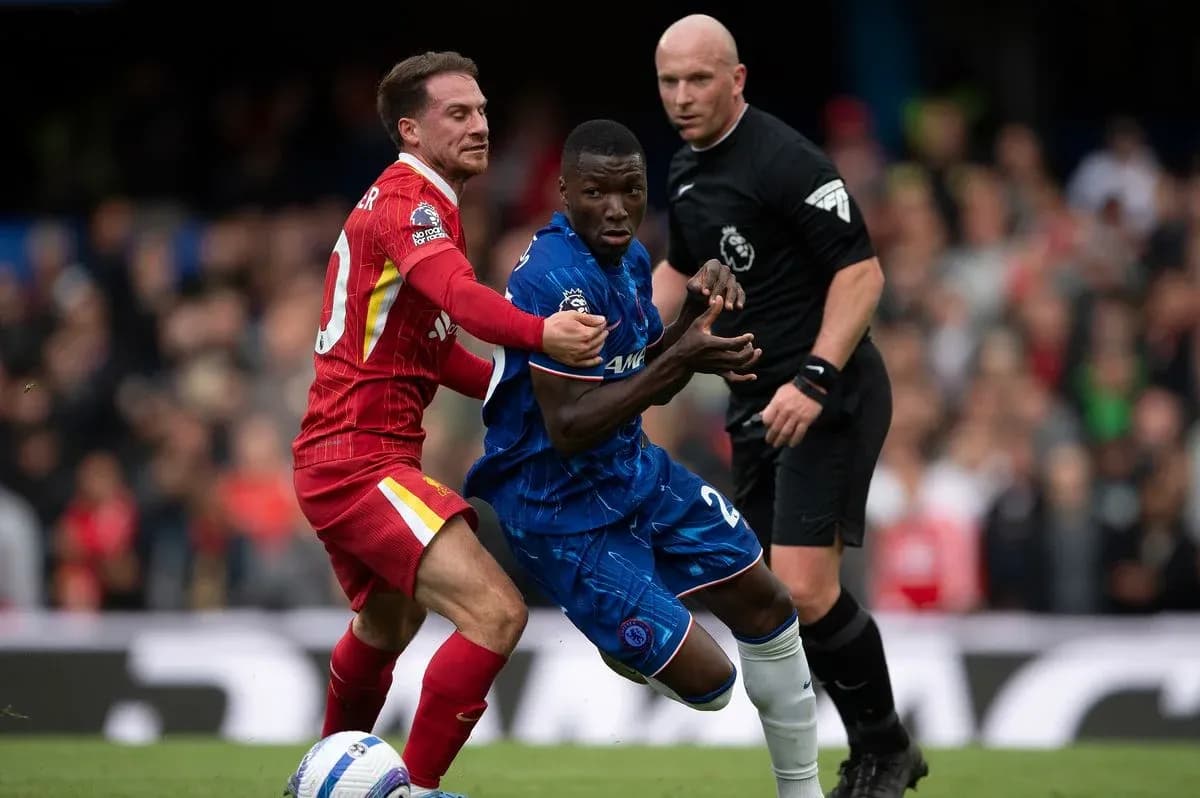
In midfield, the Engine Room duel revolved around Dominik Szoboszlai versus Moisés Caicedo. Szoboszlai’s season has been one of high volume and high influence: 34 appearances, all as a starter, 3053 minutes, 6 goals, 5 assists and an outstanding passing output of 2090 completed balls with 68 key passes and 87% accuracy. He is Liverpool’s metronome and their line-breaker rolled into one, also contributing 52 tackles, 8 successful blocks and 29 interceptions.
Caicedo, on the other side, is Chelsea’s pure enforcer. In total this campaign he has amassed 87 tackles, 14 successful blocks and 56 interceptions, alongside 1940 passes at 91% accuracy. He is also the league’s leading yellow-card collector with 11 bookings and 1 red, a testament to how often he operates on the edge. His duels—294 total, 164 won—are the base upon which Chelsea’s more expressive midfielders, like Enzo Fernández and Cole Palmer, can play.
Across 90 minutes, that duel was finely balanced. Szoboszlai’s willingness to drop deep and orchestrate pulled Caicedo away from his comfort zone screening the back four, while Caicedo’s aggression limited Liverpool’s ability to flood the half-spaces with underlapping runs from Frimpong and Ngumoha. The Hungarian’s disciplinary record—8 yellows and 1 red this season, including a missed penalty on his ledger—also meant he had to manage his own intensity in the tackle.
IV. Statistical Prognosis – Margins, xG, and Defensive Solidity
Even without raw xG numbers provided, the season-long patterns offer a clear prognosis of what this fixture represented. Liverpool, with an overall scoring average of 1.7 goals per game and conceding 1.3, tend to live in narrow margins. Chelsea mirror that volatility, averaging 1.5 goals for and 1.4 against in total.
Clean sheets underline the defensive ceiling of both sides: Liverpool have 10 in total this campaign, Chelsea 9. Neither is an elite shutout machine; both are competent but prone to lapses. Chelsea’s away defensive record—25 conceded in 18—suggested they could survive Anfield’s pressure if they managed the emotional spikes that usually hit late, where their yellow-card share (23.60% between 76–90 minutes) hints at fraying composure.
Following this result, the 1–1 draw felt almost inevitable in statistical hindsight: Liverpool’s home attack slightly dulled by the absence of Salah and Ekitike, Chelsea’s away threat channelled largely through Joã o Pedro but constrained by Liverpool’s centre-backs and Mamardashvili’s presence.
In a broader tactical sense, this was a meeting of two sides whose Expected Goals profiles would likely have sat close to parity: Liverpool with more volume and territory, Chelsea with fewer but clearer transitions. The draw preserves Liverpool’s grip on 4th and keeps Chelsea in the chasing pack, but it also underlines a shared truth—both projects are compelling, both are dangerous, and both are still one or two key pieces away from turning performances like this into routine victories rather than finely poised stalemates.