.svg&w=384&q=75 "GoalGist logo")
Sunderland vs Manchester United: Tactical Stalemate in Premier League Clash
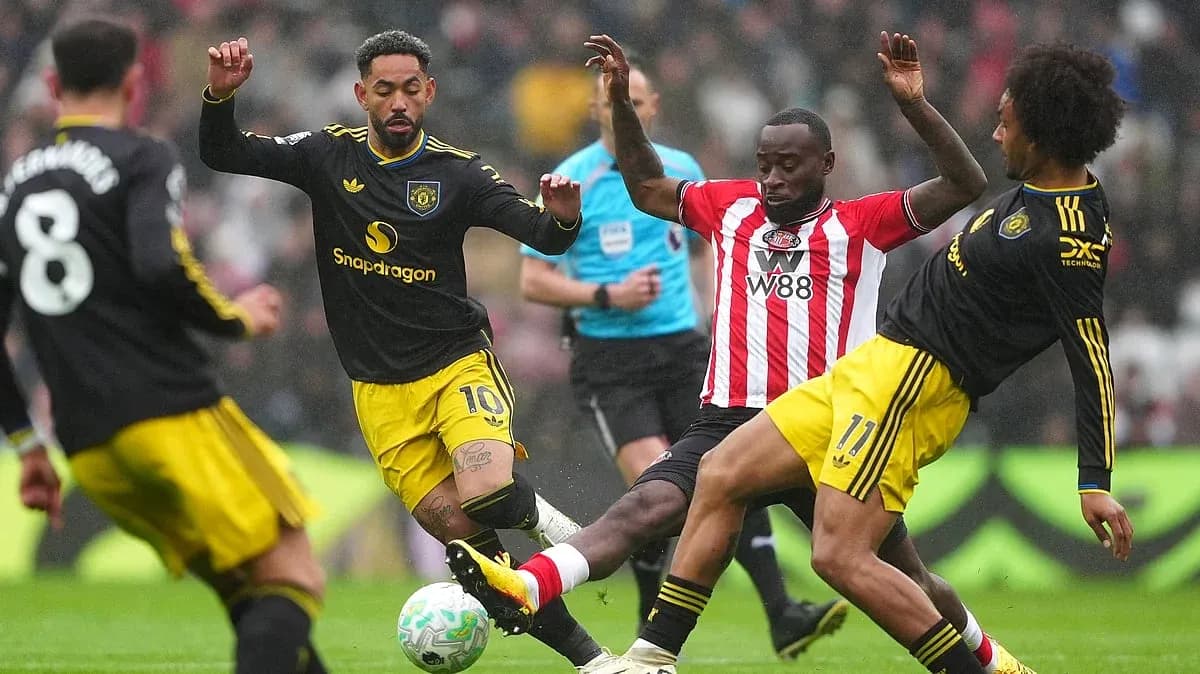
Sunderland and Manchester United played out a 0–0 at the Stadium of Light in Round 36 of the Premier League, a match defined more by structure and control than chaos. Regis Le Bris’ Sunderland edged the ball with 51% possession and generated the better chances (1.25 xG to United’s 0.62), while Michael Carrick’s side were forced into a more reactive, transitional game. Both goalkeepers were largely protected, and despite United’s three bookings, the contest stayed within tactical rather than emotional boundaries, ending as a stalemate that tactically flatters Sunderland and statistically exposes United’s attacking limitations.
Disciplinary Story
The disciplinary story is one‑sided and concentrated in the second half. All cards went to Manchester United, and all must be logged precisely:
- 54' Mason Mount (Manchester United) — Foul
- 58' Joshua Zirkzee (Manchester United) — Foul
- 90+3' Matheus Cunha (Manchester United) — Simulation
That yields locked totals: Sunderland: 0, Manchester United: 3, Total: 3.
These bookings reflect United’s difficulty in controlling Sunderland’s midfield tempo after the interval. Mount’s yellow at 54' for “Foul” signals United’s need to disrupt Sunderland’s build-up as Xhaka and Enzo Le Fée increasingly dictated the rhythm. Four minutes later, Zirkzee’s “Foul” booking at 58' underlines how even the centre-forward was dragged into defensive fire-fighting, pressing and chasing back in deeper zones. The final card, Cunha’s at 90+3' for “Simulation”, is qualitatively different: rather than a structural defensive issue, it points to United’s frustration in the final third, resorting to drawing a decision rather than creating a clear chance in open play.
Substitutions
Substitutions followed the same chronological pattern and subtly altered the tactical picture. At 65', Patrick Dorgu (IN) came on for Joshua Zirkzee (OUT), which likely pushed United towards a more flexible left-sided structure, sacrificing a central reference point up front for more mobility and defensive security on the flank. At 75', Bryan Mbeumo (IN) came on for Amad Diallo (OUT), adding direct running and vertical threat on the break, hinting at a late attempt to exploit transitions rather than sustained possession.
Le Bris waited longer but made two late, clearly intentioned changes. At 79', Nilson Angulo (IN) came on for Chemsdine Talbi (OUT), freshening Sunderland’s attacking lane with more direct penetration against a tiring United back line. Finally, at 90', Eliezer Mayenda (IN) came on for Trai Hume (OUT), a late attacking tweak that preserved Sunderland’s ambition to win rather than simply protect the point.
Sunderland's Structure
From the outset, Sunderland’s structure without a listed formation in the data can still be inferred from roles. Robin Roefs in goal, behind a back four of Lutsharel Geertruida, Nordi Mukiele, Omar Alderete and Reinildo Mandava, provided a stable defensive platform. In midfield, Granit Xhaka, Noah Sadiki, Trai Hume, Enzo Le Fée and Chemsdine Talbi supported Brian Brobbey as the lone forward. The statistical profile—15 total shots, 9 inside the box, 6 corners, and 1.25 xG—indicates a side that managed to progress the ball into good zones and sustain pressure rather than relying on speculative efforts.
Xhaka and Sadiki appear central to Sunderland’s control: 493 total passes at 84% accuracy is a high-volume, high-efficiency possession game for a team facing Manchester United. Sunderland’s 51% possession is modestly higher, but the quality of that possession is what matters: they forced United into 4 saves from Senne Lammens and created more box entries. Enzo Le Fée’s presence as a creative link likely helped Sunderland switch play and feed Brobbey, while Talbi and Hume provided width and underlapping runs.
Defensive Discipline
Defensively, Sunderland were disciplined: 12 fouls but no cards, and Roefs had to make only 1 save. That, combined with United’s xG of 0.62 from 11 shots, implies that Sunderland’s back line controlled depth well and limited United to lower-quality attempts, often from outside the box (5 shots from distance). Mukiele and Alderete’s central presence, supported by Reinildo’s aggression on the left and Geertruida’s balance on the right, allowed Sunderland to hold a relatively stable line without resorting to desperate interventions.
Manchester United's Structure
Manchester United’s starting shape, again without an explicit formation in the data, can be read from roles: Lammens in goal; a back four of Noussair Mazraoui, Harry Maguire, Lisandro Martínez and Luke Shaw; a midfield unit of Mason Mount, Kobbie Mainoo, Amad Diallo and Bruno Fernandes; with Matheus Cunha supporting Joshua Zirkzee up front. Their 49% possession and 478 passes at 82% accuracy show they were competitive in control but less incisive than Sunderland.
United’s attacking inefficiency is stark: only 1 shot on target from 11 attempts, 6 inside the box. The 0.62 xG confirms that most of these were low-quality looks, either under pressure or from poor angles. Zirkzee’s early substitution suggests Carrick was not satisfied with his ability to pin Sunderland’s centre-backs or to convert half-chances. Bruno Fernandes and Cunha, nominally creative hubs, did not translate possession into clear shots, and Cunha’s late “Simulation” card encapsulates that lack of cutting edge.
Defensive Struggles
Defensively, United were more stretched. Lammens’ 4 saves, matching Sunderland’s 4 shots on target, underline that United had to rely on their goalkeeper more often than Sunderland did. Yet, interestingly, both keepers share the same “goals prevented” value in the stats (1.81), suggesting that each faced moments where their interventions significantly altered the probability of conceding, even if Roefs had fewer actual saves. That points to Sunderland occasionally allowing high-quality, if rare, United chances that Roefs handled, while United allowed a larger volume of moderate-quality shots that Lammens had to manage.
Foul Count
The foul count is symmetrical—12 each—but the card distribution is not: Sunderland 0, Manchester United 3. That asymmetry highlights United’s more reactive, sometimes desperate defending and their growing frustration as the game wore on. Sunderland’s ability to foul without stepping into card territory speaks to better timing and collective pressing.
Statistical Summary
Statistically, Sunderland emerge as the more coherent side: higher xG (1.25 vs 0.62), more shots (15 vs 11), more shots on target (4 vs 1), slightly more possession, and higher passing volume with marginally better accuracy. United, by contrast, leaned on defensive resilience and Lammens’ shot-stopping to preserve a point. From a season-trend perspective, a home side producing this level of control and chance creation against a club of United’s stature is a positive signal for Sunderland’s overall form and attacking development, while United’s defensive index remains solid but their attacking form is under clear scrutiny.