.svg&w=384&q=75 "GoalGist logo")
Liverpool vs Chelsea: Tactical Draw Analysis of Premier League Match
Liverpool and Chelsea shared a 1–1 draw at Anfield in Premier League Round 36, a match that quickly settled into a tactical arm wrestle rather than a chance-laden shootout. Liverpool struck early through Ryan Gravenberch, but Enzo Fernández levelled before the break. From there, the contest became about control of space and rhythm rather than volume of attacks, with Chelsea edging possession and passing accuracy, and Liverpool relying on structure and transitional threats. Both sides finished with three shots on target each and xG almost identical (0.56 vs 0.5), underlining how finely balanced the game state remained after the opening exchanges.
First Half
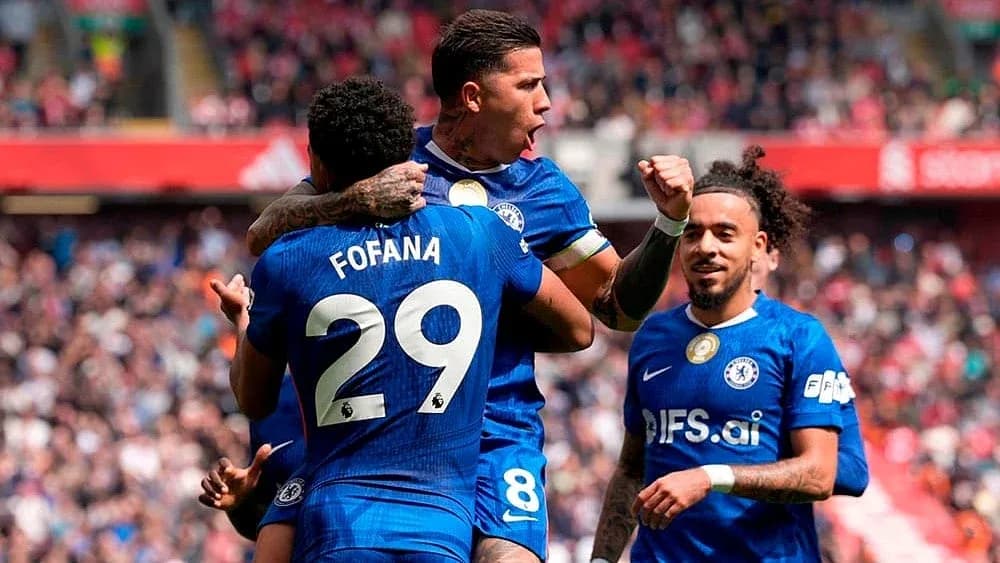
The scoring opened on 6' when Ryan Gravenberch converted for Liverpool, assisted by Rio Ngumoha, a move that immediately validated Arne Slot’s decision to load his midfield with technical profiles. Chelsea responded on 35' through Enzo Fernández, whose equaliser rebalanced the momentum before half-time at 1–1, matching the eventual final score. The second half’s key inflection point came at 50', when a Cole Palmer goal for Chelsea was cancelled by VAR; that incident framed the remainder of the match, with Chelsea sensing an opportunity but never quite breaking Liverpool’s defensive structure again.
Discipline
Discipline was a significant undercurrent, especially in the closing stages. The full card log, in chronological order, is:
- 67' Jorrel Hato (Chelsea) — Foul
- 73' Enzo Fernández (Chelsea) — Foul
- 83' Marc Cucurella (Chelsea) — Foul
- 88' Joe Gomez (Liverpool) — Argument
- 89' Moisés Caicedo (Chelsea) — Handball
- 90+4' Alexis Mac Allister (Liverpool) — Persistent fouling
That gives Liverpool: 2 yellow cards, Chelsea: 4 yellow cards, Total: 6. The late cluster of cautions reflected a game that tightened physically and emotionally as both teams chased a marginal winner without abandoning defensive caution.
Substitutions
Substitution patterns further reveal the tactical intentions. On 63', Reece James (IN) came on for Andrey Santos (OUT), a clear Chelsea shift towards more width and overlapping threat from right-back, with Malo Gusto already present as a defender, likely prompting a rebalancing of the back line. Liverpool’s first change at 67' saw Alexander Isak (IN) came on for Rio Ngumoha (OUT), swapping a young, creative midfielder for a more defined forward presence and signalling a move towards a clearer reference point in the final third. On 77', Slot doubled down on defensive solidity and build-up security: Federico Chiesa (IN) came on for Cody Gakpo (OUT), and Joe Gomez (IN) came on for Ibrahima Konaté (OUT), refreshing the back line and adding a different ball-progression profile at centre-back while introducing Chiesa as a more direct wide threat.
Tactical Approaches
Structurally, Liverpool’s approach was built on a compact, possession-sharing model rather than their historical high-volume pressing and shooting. With 48% possession, 473 total passes and 84% pass accuracy, they were content to let Chelsea have a slight territorial edge while prioritising verticality at the right moments. The shot profile — 8 total shots, 3 on target, 5 from inside the box — suggests that when Liverpool did progress, they were selective and focused on creating higher-quality central looks rather than speculative efforts from distance.
Giorgi Mamardashvili’s reality in goal was relatively controlled: 2 saves and an xG against of 0.5, with goals prevented at -0.49, aligning almost exactly with Filip Jørgensen at the other end (also 2 saves, 0.56 xG against, -0.49 goals prevented). That symmetry in goalkeeping output underlines how neither side managed to distort the shot quality landscape significantly after the first-half goals. Defensively, Liverpool’s back line of Curtis Jones, Ibrahima Konaté, Virgil van Dijk and Miloš Kerkez limited Chelsea to 6 shots total and only 4 inside the box, a respectable containment given Chelsea’s technical midfield of Enzo Fernández, Moisés Caicedo and Cole Palmer.
Chelsea’s tactical identity in this match leaned on controlled possession and structured build-up. With 52% of the ball, 515 passes and 87% accuracy, Calum McFarlane’s side prioritised circulation through Enzo Fernández and Caicedo, using Marc Cucurella and Jorrel Hato to step into midfield zones and create overloads. Yet their xG of 0.5 and only 3 shots on target indicate that Liverpool’s midfield trio — Ryan Gravenberch, Alexis Mac Allister and Dominik Szoboszlai — successfully protected central zones, forcing Chelsea to work harder for clean shooting positions. The late yellow card for Alexis Mac Allister for “Persistent fouling” at 90+4' is consistent with a holding midfielder repeatedly breaking up play rather than being overwhelmed structurally.
Out wide, Jeremie Frimpong and Rio Ngumoha (before his withdrawal) offered Liverpool vertical outlets, while Cody Gakpo’s movement between the lines helped connect midfield to attack. After Ngumoha departed, Alexander Isak’s presence shifted Liverpool towards more direct target play, but the overall shot volume remained modest, reflecting Chelsea’s own defensive organisation around Wesley Fofana and Levi Colwill.
Conclusion
Statistically, the verdict is of near-total equilibrium. Liverpool’s xG of 0.56 versus Chelsea’s 0.5 aligns with the shared 3 shots on target each and identical goalkeeper saves. Chelsea’s slight edge in possession and pass accuracy did not translate into a clear chance advantage, while Liverpool’s more transition-oriented approach produced an early goal but not a sustained wave of pressure. Both keepers underperformed marginally against their xG faced (identical -0.49 goals prevented), which, combined with the VAR-cancelled Palmer goal, hints at how narrow the margins were.
Discipline-wise, the 17 fouls per side and card totals (Liverpool 2, Chelsea 4) show a competitive but not reckless game, with Chelsea’s midfield and wing-backs more frequently on the wrong side of interventions. Overall, this was a match where structure, spacing and risk management took precedence over attacking volume, and the 1–1 scoreline, backed by the underlying numbers, feels an accurate reflection of the tactical balance.