.svg&w=384&q=75 "GoalGist logo")
Inter Held to Draw by Hellas Verona: A Tactical Analysis
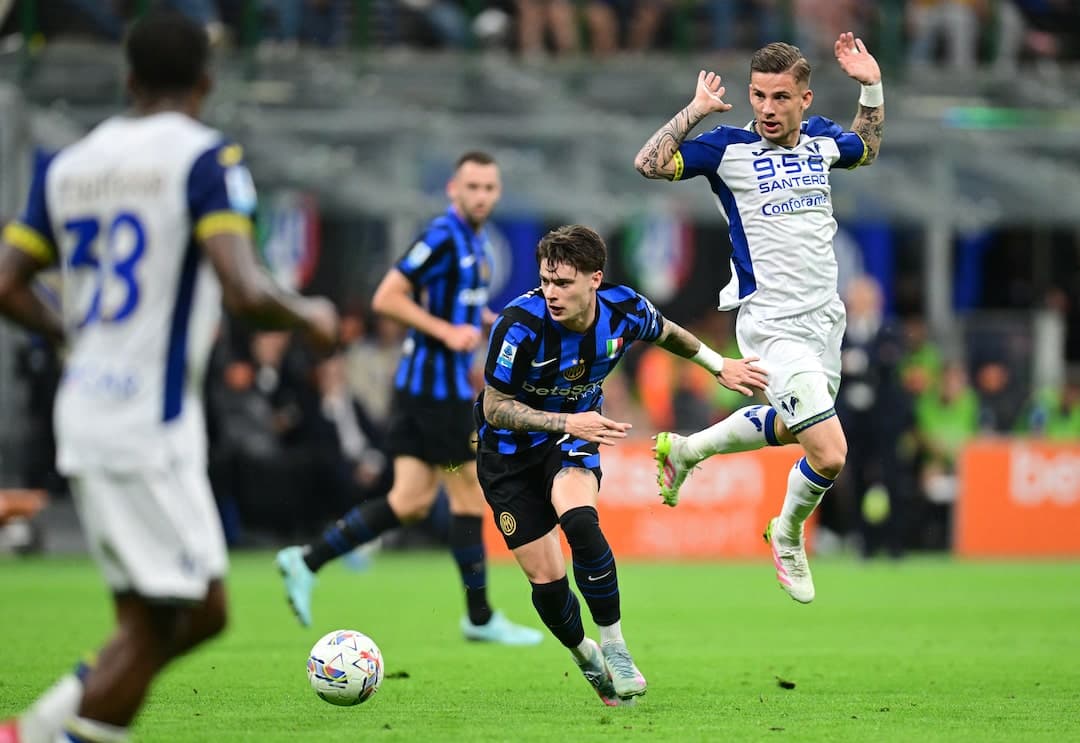
Stadio Giuseppe Meazza, early afternoon in Milan, and a title-winning machine met a side clinging to Serie A life. Inter, already embodying the league’s dominant DNA, were held 1-1 by a desperate Hellas Verona side that arrived with a five-man wall and a season of suffering in their boots. Following this result, the draw felt like two different stories stitched into one: for Inter, a stumble from a team that had collected 86 points and a towering goal difference of 54 (86 goals for, 32 against); for Verona, a point that briefly defied a campaign defined by 21 points and a bruising goal difference of -34 (25 scored, 59 conceded).
Inter’s season-long profile framed this as a mismatch. Overall they had won 27 of 37 league games, with a ruthless home record: 14 wins from 19, scoring 50 times at San Siro and conceding just 16. Their attacking average at home was 2.6 goals per game, underpinned by a 3-5-2 that had become a metronome: three centre-backs, wing-backs high, a midfield carousel, and a strike partnership headlined by Lautaro Martínez, the league’s top scorer with 17 goals and 6 assists in 29 appearances.
Cristian Chivu stayed loyal to that blueprint. Yann Sommer anchored a back three of Matteo Darmian, Stefan de Vrij and Francesco Acerbi. Ahead of them, a fluid line of five: Luis Henrique and Carlos Augusto as wide midfielders, H. Mkhitaryan and A. Diouf as interiors, and P. Sucic as the central pivot. Up front, A. Bonny joined Lautaro Martínez, the hunter-in-chief.
Across from them, Paolo Sammarco’s Verona arrived as a study in caution. Their season had been a grind: only 3 wins in 37 matches, with just 13 goals scored on their travels and 33 conceded. On their travels they averaged 0.7 goals for and 1.7 against, numbers that screamed survival football rather than expansive ambition. The 5-3-2 here was less a formation than a shield: Lorenzo Montipò behind a back five of R. Belghali, V. Nelsson, A. Edmundsson, N. Valentini and M. Frese, with a compact midfield trio of S. Lovric, R. Gagliardini and A. Bernede, and a front two of T. Suslov and K. Bowie tasked with running, chasing, and living off scraps.
The tactical voids were almost entirely on Verona’s side. The missing list told its own story: D. Mosquera and S. Serdar both out with knee injuries, D. Oyegoke sidelined by injury, and G. Orban – a key attacking reference with 7 league goals and 2 assists – marked “Inactive” and unavailable. For a team that had already failed to score in 19 of their 37 league fixtures, losing Orban’s penalty-box presence and direct threat was a brutal subtraction. Sammarco’s bench was heavy on defenders and utility midfielders, with Isaac, A. Sarr, I. Vermesan and J. Ajayi offering theoretical attacking options but none with Orban’s proven Serie A end product.
Inter, by contrast, had a bench that looked like a second title contender: F. Dimarco, N. Barella, H. Çalhanoğlu, M. Thuram, P. Zielinski, D. Frattesi, D. Dumfries and A. Bastoni all waiting. The fact that such volume of creative and defensive quality could be introduced later underscored why Inter had produced 18 clean sheets overall and failed to score only twice all season. It also shaped the game’s rhythm: Verona knew that even if they survived the opening wave, the cavalry would arrive.
Discipline was a quiet but crucial undercurrent. Inter’s yellow-card pattern across the season showed a late-game surge: 30.65% of their bookings came between 76-90 minutes, evidence of a team that often pushed the physical and tactical line as they chased or protected results in the closing stages. Verona, meanwhile, had a more volatile profile. Their yellows peaked between 46-60 minutes at 23.26%, and their red-card distribution was alarming: 50% of their dismissals arriving between 76-90 minutes, with others in the opening 0-15 and 46-60 ranges. In a match where they would inevitably be under siege, any lapse in discipline threatened to turn resistance into collapse.
The key matchup was always going to be Hunter vs Shield: Lautaro Martínez against Verona’s defensive record. Heading into this game, Inter were averaging 2.3 goals per match overall, while Verona were conceding 1.6 per game across the season. Lautaro’s 69 shots, 39 on target, and his 37 key passes painted a picture of a forward who is both finisher and creator. Up against a back line that had conceded 33 times on their travels, the expectation was that sustained pressure would eventually fracture Verona’s block.
At the other end, the “Engine Room” confrontation ran through P. Sucic and H. Mkhitaryan against R. Gagliardini. Gagliardini, one of the league’s top yellow-card collectors with 10 bookings, had compiled 73 tackles, 13 blocks and 54 interceptions. His role was clear: disrupt Inter’s rhythm, plug passing lanes into Lautaro and Bonny, and protect the half-spaces either side of Edmundsson. Every time Sucic tried to turn, every third-man run from Diouf or Mkhitaryan, ran into his zone of influence.
Inter’s defensive platform, with de Vrij and Acerbi marshalling a unit that had conceded only 0.9 goals per game overall, meant Verona’s front two were largely reduced to counters and hopeful diagonals. Without Orban, the burden on Suslov and Bowie was enormous. Their job was less about crafting sustained attacks and more about buying breath for the back five, drawing fouls, and maybe nicking a set-piece opportunity.
From a statistical prognosis standpoint, even without explicit xG numbers, the shape of the game was clear. Inter’s high-volume attack, deep bench of creators, and home scoring average of 2.6 goals per match should have produced a margin of victory greater than the 1-1 full-time scoreline. Verona’s season-long pattern – 6 clean sheets in total, only 3 of them on their travels – suggested that conceding was almost inevitable; the real question was whether they could keep the scoreline within reach and avoid the disciplinary implosion their card profile hinted at.
That they emerged with a draw at San Siro speaks to the stubbornness of Sammarco’s low block, the concentration of his back five, and the sheer work rate of a midfield built to suffer. For Inter, it was a reminder that even a champion’s machine can stall when faced with an opponent who defends their penalty area as if the entire season hangs on every cross, every second ball, every duel in the box.