.svg&w=384&q=75 "GoalGist logo")
Fulham vs Bournemouth: Tactical Analysis of Premier League Defeat
Fulham’s 1–0 home defeat to Bournemouth at Craven Cottage in Premier League Round 36 was a study in how game state and discipline can override territorial dominance. Marco Silva’s side controlled possession and territory, created the higher xG (1.33 to 0.82) and more shots (14 to 10), yet Andoni Iraola’s Bournemouth, reduced to ten men before half-time, executed a compact, transition-focused plan and stole the decisive moment through Rayan’s second-half strike.
I. Executive Summary
Fulham, with 60% of the ball and 520 passes at 88% accuracy, tried to suffocate Bournemouth with sustained pressure and width. Bournemouth, who completed 359 passes at 86% accuracy, instead leaned into a low-to-mid block after Ryan Christie’s first-half dismissal, relying on counter-attacks and set patterns down the right. The match hinged on how each side adapted to the red cards: Bournemouth reorganised effectively and found a clean, direct route to goal; Fulham, even after Bournemouth went down to ten, then losing Joachim Andersen to a red card themselves, struggled to turn volume into high-quality chances.
II. Scoring Sequence & Disciplinary Log
Discipline shaped the narrative from the outset. The full disciplinary log, in chronological order:
- -5' Marcus Tavernier (Bournemouth) — Argument
- 41' Ryan Christie (Bournemouth) — Foul
- 45+7' Joachim Andersen (Fulham) — Foul
- 50' Rodrigo Muniz (Fulham) — Foul
- 59' Saša Lukić (Fulham) — Argument
- 65' Alex Scott (Bournemouth) — Time wasting
- 77' Antonee Robinson (Fulham) — Foul
- 82' Joshua King (Fulham) — Foul
First, Marcus Tavernier was booked for Argument at -5', indicating a pre-kick-off flashpoint that set a confrontational tone. Bournemouth’s key turning point came around 40–41 minutes: a VAR “Card upgrade” check on Ryan Christie at 40' was followed by a straight red for Foul at 41', leaving Iraola’s side down to ten.
Fulham’s numerical advantage lasted only until first-half stoppage time. A VAR “Card upgrade” event for Joachim Andersen at 45+6' preceded his own red card for Foul at 45+7', restoring parity at ten versus ten just before the interval. The half-time score was 0–0, but the tactical landscape had been completely reshaped.
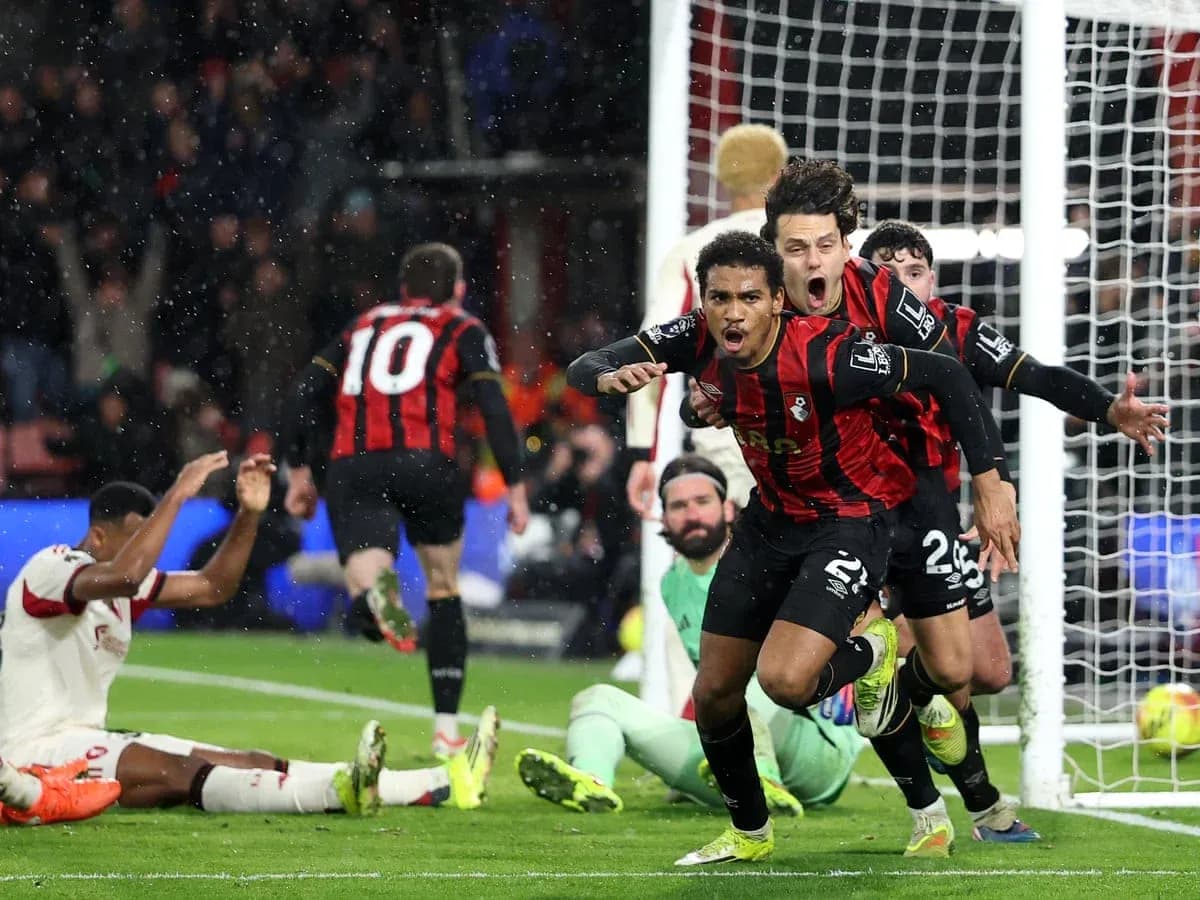
After the break, Rodrigo Muniz’s yellow for Foul at 50' reflected Fulham’s urgency and increasing risk in duels. Bournemouth struck the decisive blow at 53': Rayan finished a Normal Goal, assisted by Adam Smith, a move that capitalised on space and Fulham’s aggressive posture. Saša Lukić’s yellow for Argument at 59' showed growing frustration as Fulham chased the game.
Alex Scott’s booking for Time wasting at 65' underlined Bournemouth’s shift into game-management mode, protecting their 1–0 lead. Fulham’s push brought further defensive strain: Antonee Robinson was booked for Foul at 77', and substitute Joshua King also saw yellow for Foul at 82' as Fulham committed numbers forward. Final card totals, locked from the data: Fulham 4 yellows and 1 red; Bournemouth 1 yellow and 1 red, plus Tavernier’s earlier yellow, giving Bournemouth 2 yellows and 1 red. Overall: Fulham 5 cards (4 yellow, 1 red), Bournemouth 3 cards (2 yellow, 1 red), Total: 8.
III. Tactical Breakdown & Personnel
With formations not explicitly provided, the tactical picture must be read from roles and patterns. Fulham’s starting structure was clearly possession-oriented: Bernd Leno behind a back four of Timothy Castagne, Joachim Andersen, Calvin Bassey and Antonee Robinson, with Saša Lukić and Tom Cairney as central controllers. Ahead of them, Harry Wilson, Emile Smith Rowe and Samuel Chukwueze supported Rodrigo Muniz as the central forward.
The numbers tell the story of Fulham’s approach: 60% possession, 520 passes, and 11 of 14 shots from inside the box. They built patiently, pushing full-backs high and using Wilson and Chukwueze to pin Bournemouth’s wide defenders. However, only 2 shots on target from 14 attempts exposes a key tactical flaw: plenty of box entries but insufficient clarity in final actions. Bournemouth’s compactness forced Fulham into crowded central zones, where Bournemouth’s midfield screen and centre-backs could block (6 Fulham shots blocked) and contest second balls.
Bournemouth’s initial shape, with Đorđe Petrović in goal, a back line of Adam Smith, James Hill, Marcos Senesi and Adrien Truffert, and a midfield featuring Alex Scott, Ryan Christie, Rayan, Eli Junior Kroupi and Marcus Tavernier behind Evanilson, was more balanced between possession and transition. Once Christie was sent off, Iraola adjusted quickly: Evanilson (OUT) was replaced by Tyler Adams (IN) at 43', signalling a pivot to a more robust midfield spine and a counter-attacking threat via wide players and late runners.
The decisive goal at 53' epitomised Bournemouth’s adapted plan. Adam Smith, operating as an outlet on the right, provided the assist for Rayan, who attacked the space created by Fulham’s advanced full-backs. With Fulham’s centre-backs having been disrupted by Andersen’s dismissal at 45+7' and the subsequent reshuffle (Emile Smith Rowe (OUT) for Issa Diop (IN) at 46'), Bournemouth found a seam between lines that Fulham never fully closed.
Silva’s substitution pattern confirmed Fulham’s attacking intent but also their structural risk. At 62', Harry Wilson (OUT) made way for Oscar Bobb (IN), and Samuel Chukwueze (OUT) for Kevin (IN), injecting fresh dribbling and movement but removing some of the original wide balance and pressing cohesion. At 76', Tom Cairney (OUT) for Joshua King (IN) further tilted the side towards attacking profiles, and at 83', Timothy Castagne (OUT) for Jonah Kusi-Asare (IN) suggested an all-in approach, sacrificing defensive stability for extra presence in advanced zones.
Bournemouth, meanwhile, used their bench to protect and manage the lead. Marcus Tavernier (OUT) for Amine Adli (IN) at 78', Eli Junior Kroupi (OUT) for Enes Ünal (IN) at 79', and Rayan (OUT) for David Brooks (IN) at 79' refreshed legs in wide and attacking areas to maintain counter-threat and defensive work rate. Finally, Alex Scott (OUT) for Alex Tóth (IN) at 90' was a late adjustment to see out the match.
In goal, Leno’s 3 saves and Petrović’s 2 reflect the shot quality and volume: Fulham forced Bournemouth’s keeper into fewer but generally manageable interventions, while Bournemouth’s lower shot count (10 total, 5 on target) was more selective and efficient. Both keepers’ goals prevented values were equal at 0.16, indicating neither was disproportionately overperforming or underperforming relative to the chances faced; the difference came from Bournemouth converting one of their moderate-quality opportunities while Fulham failed to finish theirs.
IV. The Statistical Verdict
From a statistical standpoint, Fulham’s overall form in this match looked strong: superior possession, more shots, higher xG (1.33 to 0.82), more corners (11 to 2) and a higher passing volume and accuracy. Their attacking structure produced territorial dominance and box entries, but their shot selection and finishing under pressure were insufficient.
Bournemouth’s defensive index in this context is impressive. With only 40% possession, 10 total shots and 2 blocked shots, they nonetheless restricted Fulham to just 2 shots on target from 14 attempts and matched Fulham in goals prevented (0.16). The foul count (Fulham 12, Bournemouth 21) and Bournemouth’s Time wasting booking for Alex Scott underline how committed Iraola’s side were to disrupting rhythm and protecting the lead.
Discipline, however, was a double-edged sword. Bournemouth’s early Argument booking for Marcus Tavernier and Christie’s red for Foul forced a tactical retreat, but their compact ten-man structure, followed by Fulham’s own red for Joachim Andersen, created a more open, transitional environment that suited Bournemouth’s direct runners. Fulham’s four yellows and one red, many for Foul and one for Argument, reflected both the aggression needed to chase the game and the frustration of failing to translate dominance into goals.
In synthesis, the match was a clear example of how game state, red cards and in-game tactical adaptation can invert the expected outcome suggested by possession and xG. Fulham’s control was real but sterile; Bournemouth’s resilience and clarity in transition were decisive.