.svg&w=384&q=75 "GoalGist logo")
Fiorentina vs Atalanta: Serie A Season Finale Ends in Draw
Stadio Artemio Franchi closed its Serie A season under floodlights and tension, with Fiorentina and Atalanta sharing a 1-1 draw that felt like a snapshot of their entire campaigns. Heading into this game, Fiorentina sat 15th on 42 points, their overall goal difference at -9 (41 scored, 50 conceded), a side defined by stalemates and thin margins. Atalanta arrived in Florence in 7th with 59 points and a far healthier overall goal difference of 15 (51 for, 36 against), chasing European football on the back of a controlled, system-driven year.
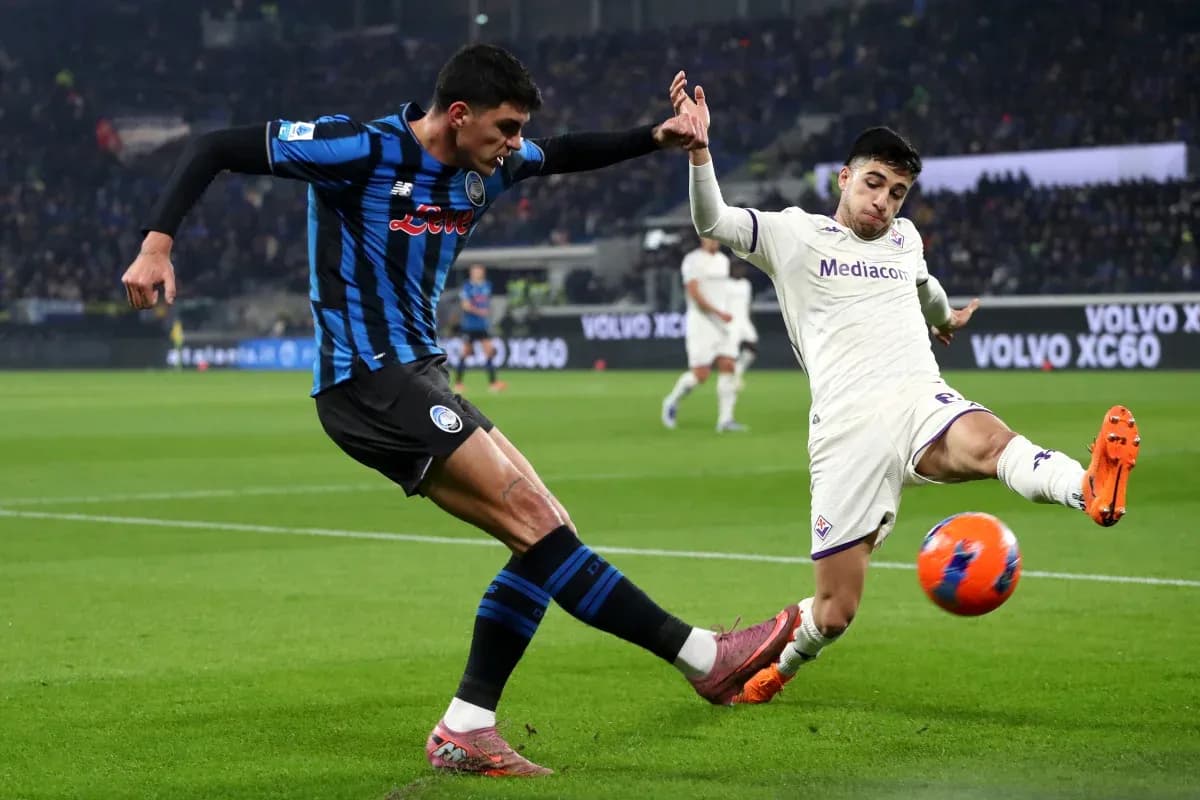
The match itself followed that script. Fiorentina’s 4-3-3 under Paolo Vanoli was expansive on paper but cautious in its execution, while Raffaele Palladino’s Atalanta, in their familiar 3-4-2-1, tried to compress space and then explode into it. Fiorentina struck first before half-time, Atalanta replied after the break, and the final whistle confirmed what the table had already suggested: one side built to survive, the other built to contend.
Tactical voids and what was missing
The absentees shaped the tone before a ball was kicked. Fiorentina were without M. Kean (calf injury) and F. Parisi (knee injury), stripping Vanoli of a vertical runner in attack and a natural left-back outlet. More importantly, L. Ranieri was suspended after a red card, removing a defender whose season had been defined by edge and aggression: 8 yellow cards and 1 red in Serie A, plus 34 tackles, 13 successful blocks and 24 interceptions. His absence forced a recalibration of the back line and mentality.
In his place, the centre-back pairing of P. Comuzzo and D. Rugani was more conservative, less front-footed. The full-backs Dodo and R. Gosens were asked to provide width but also to protect a back four that, heading into this game, had conceded 21 goals at home and 29 on their travels. Without Ranieri’s bite, Fiorentina lacked a natural enforcer to step out and break Atalanta’s patterns early.
Atalanta had their own voids. L. Bernasconi (knee injury) and O. Kossounou (thigh injury) were unavailable, trimming Palladino’s defensive rotation. That pushed the responsibility squarely onto the starting back three of G. Scalvini, I. Hien and H. Ahanor, with wing-backs R. Bellanova and Y. Musah tasked with enormous vertical workloads.
Disciplinary trends hung over the contest. Fiorentina’s season-long yellow card distribution revealed a late-game problem: 25.30% of their yellows came between 76-90 minutes, with an additional 15.66% between 91-105. Atalanta were not far behind in the closing stretch, with 23.33% of their yellows between 76-90 and 15.00% from 91-105. This was always likely to become a match where fatigue and late decisions could tilt the balance, even if no red cards emerged on the night.
Hunter vs shield: where the goals were meant to come from
The “Hunter vs Shield” duel tilted towards Atalanta on paper. Heading into this game, they had scored 51 goals overall, with 26 of those on their travels at an away average of 1.4 goals per match. Fiorentina, by contrast, were modest at home: 21 goals at the Franchi, averaging 1.1 per game.
Atalanta’s top scorers were on the bench but looming over the contest. G. Scamacca, with 10 league goals from 24 appearances and 2 penalties scored, is the purest finisher in the squad: 49 shots, 22 on target, a classic penalty-box threat. N. Krstović, also on 10 goals and 5 assists, offers a different profile: 75 shots, 34 on target, 21 key passes and 39 dribbles attempted, a hybrid between finisher and creator. Both were available as substitutes, ready to change the rhythm against a Fiorentina defence that has kept only 10 clean sheets in total (6 at home, 4 on their travels).
Fiorentina’s attacking responsibility fell heavily on A. Gudmundsson, leading the line from the left of the front three. Across the season he delivered 5 goals and 4 assists, with 28 shots (15 on target) and 32 key passes. He is also a reliable penalty taker, scoring 3 spot-kicks without a miss, a valuable edge in a side that converted all 6 of their penalties overall. Around him, R. Piccoli and J. Harrison offered vertical running and pressing, but lacked the pure numbers that Atalanta’s forwards brought from the bench.
Defensively, Atalanta’s shield has been among the league’s most reliable. Heading into this fixture they had conceded only 36 goals overall, with just 21 on their travels at an away average of 1.1 goals against. Fiorentina’s attack, averaging 1.1 goals per match both at home and on their travels, were always going to have to work for every chance.
The engine room: control vs disruption
The midfield battle was the game’s true theatre. Fiorentina’s trio of R. Mandragora, M. Brescianini and G. Fabbian tried to stitch together possession and protect the back four. Without Ranieri behind them, Mandragora in particular had to sit deeper, screening passing lanes into G. Raspadori and the half-spaces where L. Samardzic and K. Sulemana floated.
Atalanta’s engine room, built around M. De Roon and M. Pasalic, was about control and tempo. De Roon anchored, allowing Pasalic to step higher, while Musah and Bellanova provided width and ball-carrying from the flanks. The structure mirrored Atalanta’s season-long identity: a 3-4-2-1 used in 34 league matches, designed to overload wide channels before collapsing attacks into central zones.
On the bench, Fiorentina’s most intriguing card was M. Pongračić. His season numbers – 31 tackles, 27 successful blocks and 35 interceptions – underline a defender who reads danger well and, crucially, blocks shots. But his 12 yellow cards highlight the risk in unleashing him into a game already balanced on discipline and rhythm.
Atalanta’s creative ace among the substitutes was C. De Ketelaere. With 5 assists, 63 key passes and 102 dribbles attempted, he has been one of Serie A’s most persistent line-breakers. Introduced in the right moment, his ability to receive between the lines and draw fouls could have tilted the midfield duel in Atalanta’s favour.
Statistical prognosis and what the draw tells us
From a statistical lens, a draw sits somewhere between justice and frustration for both. Heading into this game, Fiorentina were a team of equilibrium: 38 matches, 15 draws, goals for and against almost mirrored at home (21 scored, 21 conceded). Atalanta, with 14 draws and a strong defensive record, have often controlled matches without always killing them.
Expected Goals data is not provided, but the season-long patterns are revealing. Fiorentina’s attack, at 1.1 goals per match overall, rarely overwhelms; their defence, conceding 1.3 overall, rarely collapses outright but bends under sustained pressure, especially away where they ship 1.5 per game. Atalanta’s balance – 1.3 goals scored overall against 0.9 conceded – suggests that on most days they edge the underlying chances.
In that context, the 1-1 at the Franchi feels like a meeting point between a side still learning to suffer without breaking and another that sometimes lacks the ruthlessness its structure deserves. Following this result, Fiorentina close their season as a team defined by margins and survival, Atalanta as a side whose European push rests on a solid spine, a deep bench of scorers, and a tactical identity that remains one or two clinical moments away from something more.