.svg&w=384&q=75 "GoalGist logo")
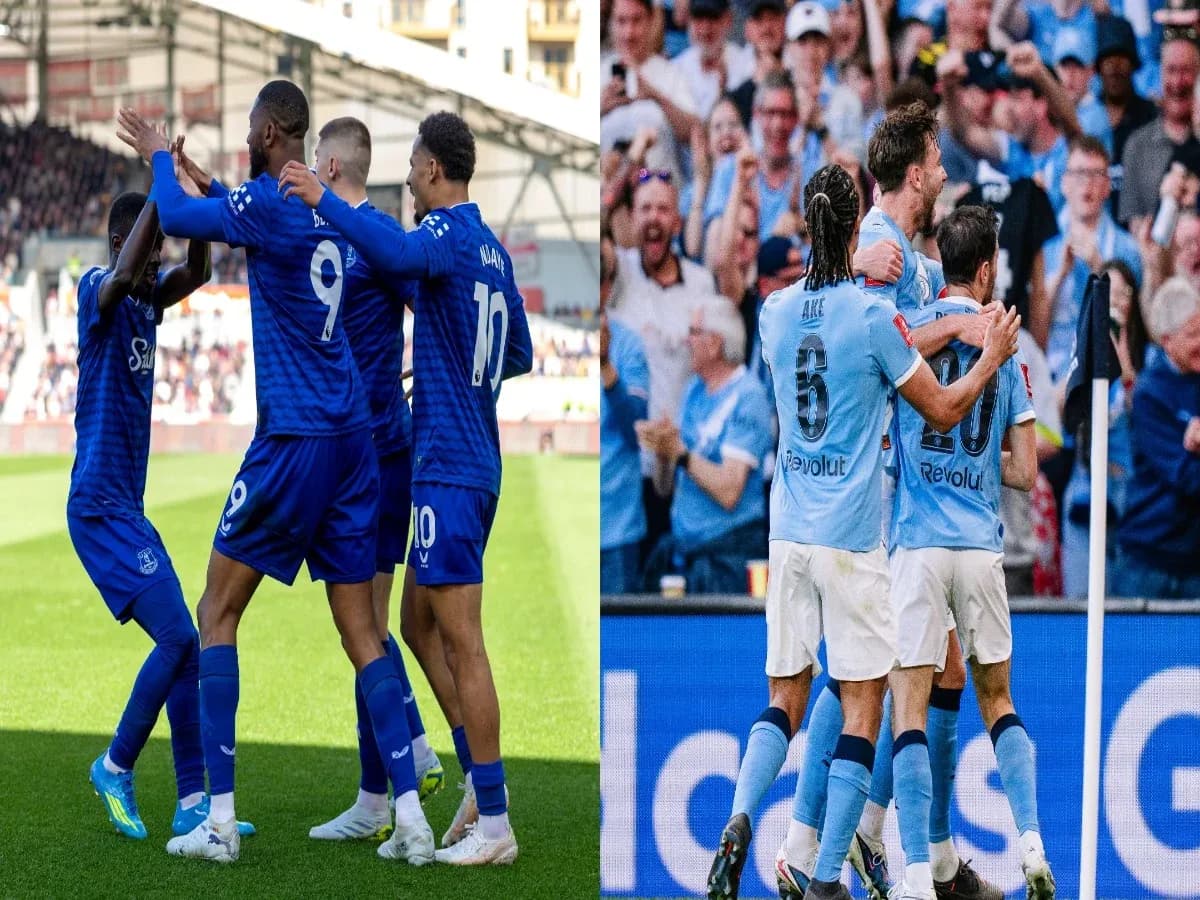
Everton vs Manchester City: A Chaotic 3–3 Premier League Draw
Everton and Manchester City produced a chaotic 3–3 draw at Hill Dickinson Stadium in Premier League Round 35, a match that swung violently away from the underlying numbers. City dominated territory and the ball, leading 1–0 at half-time and posting 75% possession with 20 shots, yet they were repeatedly punished in defensive transition. Everton, operating with only 25% of the ball but generating 2.77 xG to City’s 1.37, turned a passive first half into a ferocious second‑half surge, scoring three times in 13 minutes before being pegged back at the death.
First Half
The scoring opened on 43' when J. Doku cut through Everton’s right side to finish a move created by R. Cherki, giving City a 1–0 lead that reflected their control. On 45', Michael Keane was booked for a foul, signalling Everton’s growing desperation before the interval. Early in the second half, Beto collected a yellow card for another foul on 48', and James Tarkowski followed on 53' for yet more aggressive defending as Everton tried to disrupt City’s rhythm.
Second Half
The game flipped with Everton’s first substitution: at 64', T. Barry (IN) came on for Beto (OUT). Four minutes later, on 68', Barry equalised with a direct, incisive finish, punishing City’s high line. On 73', J. O'Brien surged forward from right-back to make it 2–1, heading or finishing from J. Garner’s delivery as Everton attacked the space behind City’s full-backs.
Tension rose immediately: on 74', Gianluigi Donnarumma was booked for an argument, underlining City’s frustration. In the same minute A. Semenyo (OUT) was replaced by P. Foden (IN), and at 75' Nico (OUT) made way for M. Kovacic (IN) as Pep Guardiola sought more control and vertical passing from midfield.
Everton struck again on 81' when Barry scored his second, finishing another rapid transition to make it 3–1. City responded almost instantly: on 83', E. Haaland converted from close range after a Kovacic assist, cutting the deficit to 3–2. Everton’s back line, already stretched, saw further discipline issues when Jake O'Brien was booked for a foul on 86'.
Guardiola’s last attacking adjustment came on 87', with B. Silva (OUT) replaced by O. Marmoush (IN), adding a more direct forward threat. Deep into stoppage time, Everton refreshed tired legs: at 90+2', M. Rohl (OUT) was replaced by N. Patterson (IN), and K. Dewsbury-Hall (OUT) by C. Alcaraz (IN), shifting energy into the wide and central channels to protect the lead. On 90+6', T. Iroegbunam (OUT) was withdrawn for H. Armstrong (IN), another defensive-minded change.
Yet City’s pressure finally told: in regulation time at 90', Doku struck again, this time assisted by centre-back M. Guehi, who had pushed high to overload Everton’s box. The Belgian’s late equaliser sealed a 3–3 scoreline that matched neither side’s emotional trajectory nor the xG balance.
Tactical Analysis
Tactically, Everton’s 4-2-3-1 under Leighton Baines was built to absorb and then spring. J. Pickford made just 1 recorded save, but Everton’s defensive structure forced City into lower-quality chances relative to their volume. The centre-back pairing of Tarkowski and Keane stayed narrow, with V. Mykolenko and J. O'Brien tucked in, conceding width but protecting the central lane where Haaland operates. The cost was territorial: Everton completed only 200 passes at 69% accuracy, rarely sustaining possession.
The double pivot of T. Iroegbunam and J. Garner did the heavy lifting without the ball, screening against B. Silva and Nico in the first phase, then against Kovacic and Foden after the changes. Garner’s assist for O'Brien’s goal highlighted his capacity to break lines with early, direct service once Everton recovered the ball. Ahead of them, M. Rohl and K. Dewsbury-Hall were tasked with shuttling into the half-spaces, often dropping to form a temporary 4‑4‑1‑1 out of possession, with I. Ndiaye drifting inside from the left to support Beto.
Beto’s role was mostly sacrificial: back to goal, contesting long clearances, and drawing fouls (including his own booking) to relieve pressure. The match’s turning point was his replacement by T. Barry. Barry attacked the space behind City’s advanced full-backs, transforming Everton’s transitions from survival outlets into real scoring threats. His two goals, both from quick, vertical attacks, exposed City’s rest defence: A. Khusanov and Guehi were repeatedly left in wide-open two‑versus‑two or two‑versus‑three situations.
For City, the nominal 4‑2‑3‑1 often resembled a 2‑3‑5 in possession. N. O'Reilly and M. Nunes pushed high and narrow, while Nico dropped alongside B. Silva to orchestrate. With 610 passes at 90% accuracy, City constructed long, patient sequences, but their 1.37 xG shows Everton kept most attempts from less dangerous zones despite conceding 20 shots. Haaland’s goal came only once Kovacic entered, providing more aggressive line-breaking passes and late box runs.
Doku was City’s most decisive individual. His first goal stemmed from a classic isolation on Everton’s right, exploiting the gap between O'Brien and Tarkowski; his second, in the 90th minute, came from a broken structure where Guehi’s advanced position created chaos in the box. Cherki’s assist for the opener and Foden’s introduction added technical quality between the lines, but City’s main failing was transition defence: with only 5 fouls and 1 yellow card (Donnarumma’s for argument), they lacked the tactical fouling and counter-press intensity usually associated with Guardiola sides.
Statistical Summary
Statistically, the match underlined a stark contrast between control and threat. City’s 75% possession, 20 total shots (4 on target), 9 corners, and 551 accurate passes suggest dominance, yet their xG of 1.37, matched by Everton’s 0.74 goals prevented figure, shows they were largely kept at arm’s length until late chaos. Everton, with only 14 shots but 6 on target and 10 inside the box, maximised each foray forward, their 2.77 xG reflecting the high quality of Barry’s and O'Brien’s chances.
Disciplinary data reinforces the tactical story: Everton’s 4 yellow cards (Keane 45', Beto 48', Tarkowski 53', Jake O'Brien 86') came from persistent, often necessary fouls to disrupt City’s flow. City’s solitary yellow for Donnarumma, for argument rather than a tactical foul, encapsulated a side more frustrated than cynical. In the end, the statistical verdict is of a City team that controlled almost everything except Everton’s transitions and mentality, and an Everton side that turned limited possession into maximised damage, only to be denied by Doku’s late, data-defying equaliser.