.svg&w=384&q=75 "GoalGist logo")
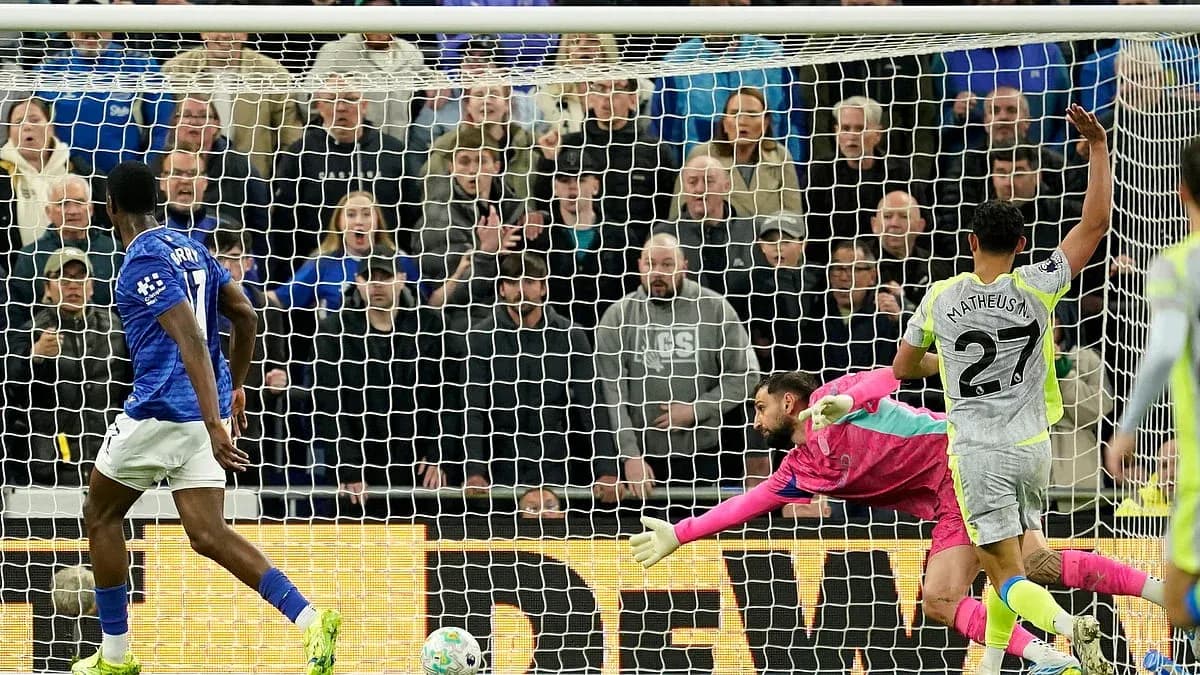
Everton vs Manchester City: A Thrilling 3-3 Draw at Hill Dickinson Stadium
The Hill Dickinson Stadium had the feel of a cup tie rather than a late-season league fixture. Regular Season - 35 in the Premier League, a mid-table Everton against title-chasing Manchester City, and yet the final ledger read like something far more chaotic: 3-3 after 90 minutes, a point each, and two very different stories folding into the same scoreline.
Following this result, the standings context frames the drama. Everton sit 10th on 48 points, with a goal difference of 0 after scoring 44 and conceding 44 overall from 35 matches. Manchester City, by contrast, are 2nd with 71 points and a goal difference of 37, built on 69 goals for and 32 against across 34 games. On paper, this was a mismatch: City’s overall scoring rate of 2.0 goals per game against an Everton side that average 1.3 both for and against. On the pitch, it became a tactical arm-wrestle defined as much by absences as by stars.
Tactical voids and reshaped identities
The team sheets told their own story. Everton’s 4-2-3-1 under Leighton Baines was stripped of three senior pillars: J. Branthwaite (hamstring injury), I. Gueye (injury) and J. Grealish (foot injury), all listed as Missing Fixture. Without Branthwaite’s left-footed balance and Gueye’s screening, Baines doubled down on structure: J. Tarkowski and M. Keane as the central pairing, J. O'Brien at right-back, V. Mykolenko on the left, and a double pivot of T. Iroegbunam and J. Garner.
Garner, one of the league’s top assist providers with 7 overall, and also among its most-carded players with 10 yellow cards in total, became the axis of Everton’s plan. His season profile – 113 tackles, 9 blocked shots, 53 interceptions – underlines why Baines trusted him to be both metronome and firefighter. With Grealish unavailable, creative burden shifted to K. Dewsbury-Hall and M. Rohl between the lines, with I. Ndiaye drifting from the left to connect with Beto.
City’s voids were even more structurally significant. Pep Guardiola had to navigate without R. Dias (muscle injury), J. Gvardiol (broken leg) and Rodri (groin injury), all Missing Fixture. That ripped out his usual defensive and midfield spine. In response, Guardiola mirrored Everton’s 4-2-3-1: a back four of M. Nunes, A. Khusanov, M. Guehi and N. O’Reilly in front of G. Donnarumma, with Nico and B. Silva as the double pivot.
The absence of Rodri forced Bernardo Silva deeper than his usual advanced role. His league numbers – 42 tackles, 6 blocks, 18 interceptions – show he can handle the defensive load, but it also deprived City’s attacking band of one of its most subtle final-third connectors. That responsibility flowed instead to R. Cherki, the league’s second-ranked assist provider with 11 in total, supported by the direct running of J. Doku and A. Semenyo behind E. Haaland.
Disciplinary risk hung over the game from the outset. Heading into this game, Everton’s yellow-card timing showed a late-game surge: 22.39% of their yellows arrived between 76-90 minutes, with another 16.42% from 91-105. City, too, tend to pick up cautions in the second half, with 21.67% between 46-60 and 20.00% between 76-90. In a match that remained alive deep into the final stretch, both midfields were walking a tightrope between aggression and recklessness.
Key matchups: Hunter vs Shield, Engine Room vs Engine Room
The headline duel was always going to be E. Haaland against Everton’s central defence. Haaland entered as the league’s top scorer with 25 goals and 7 assists, underpinned by 96 shots (54 on target). His physical profile and penalty-box instincts are well known, but the detail matters: he has already missed 1 penalty this season, a reminder that even his ruthlessness has a crack.
Everton’s “shield” was a collective rather than an individual. Tarkowski and Keane had to hold the line, but O’Brien’s presence on the flank was equally critical. His season shows 16 successful blocked shots and 293 duels contested, with 182 won; he is not shy about front-foot defending. The risk, however, is discipline: O’Brien has already seen 1 red card this season, and Everton’s red-card distribution reveals a worrying pattern – 50.00% of their reds arrive between 76-90 minutes. Against a City side that often ramps up pressure late, that volatility was a constant undertone.
In midfield, the “Engine Room” battle pitted Garner and Iroegbunam against Bernardo and Nico. Garner’s 1,617 passes at 86% accuracy and 49 key passes overall show how he stitches Everton’s phases together. Without Gueye, his defensive volume – 113 tackles – had to coexist with his playmaking. On the other side, Bernardo’s 1,952 passes at 90% accuracy formed City’s primary circulation hub, with Nico tasked with doing much of Rodri’s dirty work. The tension here was between Everton’s need to compress space centrally and City’s ability to drag them wide through Cherki and Doku.
Cherki’s profile is particularly telling. With 57 key passes and 11 assists overall, plus 97 dribble attempts and 46 successes, he thrives in half-spaces, slipping passes between lines. His duel with Mykolenko and the right-sided interior (Rohl or Dewsbury-Hall depending on phase) was where City tried to prise open Everton’s block. On the opposite flank, Doku’s 132 dribble attempts and 74 successes made him the chaos agent against O’Brien – a direct test of O’Brien’s timing and temperament.
Statistical prognosis and xG lens
From a season-long statistical vantage point, a high-scoring draw sits right at the intersection of both teams’ tendencies. Everton at home average 1.4 goals for and 1.3 against, City on their travels average 1.7 for and 1.1 against. Put crudely, the expectation before a ball was kicked was that City would edge both territory and xG, but that Everton would create enough to threaten.
City’s overall defensive record – only 32 goals conceded in 34 matches, an average of 0.9 per game – usually underpins a controlled xG profile. Yet the absence of Dias, Gvardiol and Rodri inevitably inflates the quality of chances they allow, especially against a side like Everton that are comfortable playing without the ball and striking in waves. Everton’s 11 clean sheets in total show they can be structurally sound, but their equal 44 goals for and against underline why chaotic scorelines are never far away.
A 3-3 final score suggests an xG map where City still likely shade cumulative quality through volume and territorial dominance, driven by Haaland’s shot load and Cherki’s chance creation, but Everton’s attacks arrive in more concentrated, high-value bursts: Beto’s penalty-box looks, second balls around Dewsbury-Hall, and late surges from Ndiaye. With both teams perfect from the spot this season in terms of conversion rate – Everton have scored 2 of 2 penalties, City 3 of 3 – but with Haaland having missed 1 penalty in his broader season data set, even the dead-ball moments carried narrative tension.
In the end, the 3-3 at Hill Dickinson Stadium reads like a convergence of profiles: Everton’s mid-table volatility meeting City’s slightly destabilised, injury-hit title machine. The numbers had forecast City’s superiority in xG and defensive solidity, but the absences in sky blue and the resilience in royal blue combined to produce a spectacle where structure bent, individual quality flared, and both sides walked away knowing that the story of this season will remember not just the points, but the chaos that earned them.