.svg&w=384&q=75 "GoalGist logo")
Cagliari's 2–1 Victory Over Torino: A Statement of Identity
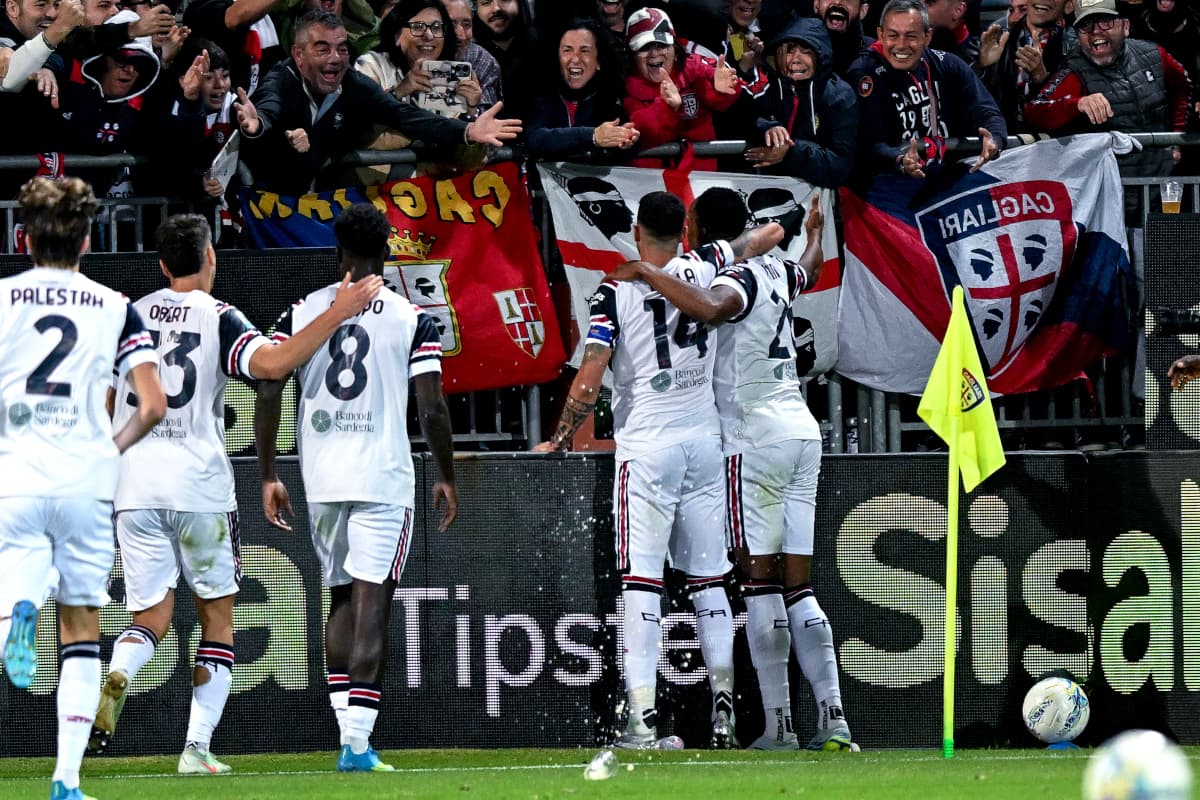
Under the warm lights of Unipol Domus, Cagliari’s 2–1 victory over Torino felt like more than just three points in Round 37 of Serie A. It was a statement of identity at the end of a bruising campaign: a team that has lived on the edge of the relegation zone finding clarity in structure and character against a mid‑table side whose numbers hint at instability.
I. The Big Picture – A narrow win, a clear identity
Following this result, Cagliari sit 16th on 40 points, their season distilled into a negative goal difference of -14 (38 scored, 52 conceded overall) but enough resilience to keep their heads above water. At home they have been marginally better: 19 games, 7 wins, 4 draws, 8 defeats, with 22 goals for and 23 against. An average of 1.2 goals for and 1.2 against at home underlines a team that plays on fine margins.
Torino, 12th with 44 points and a goal difference of -19 (42 for, 61 against overall), arrive as a paradox. On their travels they have played 19 times, winning 4, drawing 5 and losing 10, scoring 17 and conceding 34. Their away average of 0.9 goals scored and 1.8 conceded paints a picture of a side that can be picked apart once the structure loosens.
The tactical shapes told their own story. Fabio Pisacane’s decision to go 4‑3‑2‑1 gave Cagliari a compact spine and dual creators behind a lone striker, while Leonardo Colucci’s 3‑4‑2‑1 for Torino looked more like a platform for transition, leaning on individual quality in the front three.
II. Tactical Voids – Who was missing, and what that changed
Cagliari’s squad sheet was shaped by absences in key zones. In attack, the loss of L. Pavoletti (knee injury) and J. Pedro (suspended for yellow cards) stripped Pisacane of two experienced reference points in and around the box. M. Felici and R. Idrissi (both knee injuries) and J. Liteta (thigh injury) removed further rotation options in advanced areas, while L. Mazzitelli’s calf injury limited midfield variety.
Those absences nudged Cagliari toward a more vertical, hard‑running front: P. Mendy as the spearhead, backed by M. Palestra and S. Esposito as advanced midfielders rather than classic wide forwards. The structure around them became crucial: A. Deiola and M. Adopo as ballast, with G. Gaetano threading between lines.
Torino had their own voids. In the final third, Z. Aboukhlal (muscle injury) and F. Anjorin (hip injury) deprived Colucci of two players capable of breaking lines with dribbling and late box entries. In midfield, the suspension of G. Gineitis removed a combative presence, while A. Ismajli’s muscle injury reduced defensive depth.
These absences pushed Torino toward a more orthodox, almost conservative 3‑4‑2‑1: a back three shielded by a flat four, with creativity concentrated in N. Vlasic and G. Simeone behind D. Zapata. The bench, though deep in numbers, lacked some of the profile variety normally available.
Discipline was always going to be a subplot. Heading into this game, Cagliari’s yellow cards peaked late: 27.85% of their cautions came between 76–90 minutes, with a notable late‑game red‑card spike as well (100.00% of their reds in that same window). Torino, by contrast, spread their bookings more evenly, with a gradual rise into the final quarter and a particular cluster between 91–105 minutes (21.43% of yellows). Both sides were thus primed for a tense, attritional finish, and the first‑half 2–1 scoreline framed the second period as a test of nerve as much as structure.
III. Key Matchups – Hunter vs Shield, and the battle for control
The “Hunter vs Shield” duel centred on G. Simeone against a Cagliari defence anchored by Y. Mina and A. Dossena, flanked by the combative A. Obert and G. Zappa. Simeone’s season numbers are stark: 11 total goals in Serie A, from 58 shots (28 on target), with 22 key passes and a work rate that includes 15 tackles and 2 blocked shots. He is not just a finisher but a constant agitator of back lines.
Against him, Cagliari’s defensive record at home – 23 goals conceded in 19 games, an average of 1.2 – is not elite, but it is organised. Obert, in particular, has been a defensive fulcrum: 65 tackles, 18 successful blocked shots and 40 interceptions in the league underline his reading of danger. His 9 yellow cards and one yellow‑red, however, hint at a defender who plays permanently on the disciplinary edge.
The duel was therefore as much about control of space as direct duels. Mina and Dossena tracked Zapata’s physical presence, leaving Obert and Zappa to step out aggressively on Simeone and Vlasic. The narrow 4‑3‑2‑1 allowed Cagliari’s full‑backs to engage high, knowing they had a three‑man shield behind the ball in midfield.
In the “Engine Room”, S. Esposito was the conductor. His Serie A campaign has been quietly outstanding: 7 total goals and 5 assists, supported by 954 passes (67 key) at 75% accuracy. Add 52 tackles, 4 blocked shots and 16 interceptions, and you have a complete modern midfielder. Against Torino’s central trio of M. Prati, E. Ilkhan and M. Pedersen, Esposito’s ability to receive under pressure and turn play forward was decisive.
Torino’s midfield numbers heading into this game suggested vulnerability without the ball. Overall they concede 1.6 goals per match, rising to 1.8 on their travels, and though they boast 12 clean sheets in total, 7 of those are away – often in low‑event games. When the tempo rises, their shape can stretch, particularly between the lines where Esposito and Gaetano were operating.
IV. Statistical Prognosis – Why the 2–1 made sense
Strip away the emotion, and the 2–1 scoreline fits the statistical contours. Cagliari at home average 1.2 goals scored and 1.2 conceded; Torino away average 0.9 scored and 1.8 conceded. The combined offensive profiles lean toward a tight, but open, game in which the home side has a slight attacking edge and the visitors are always liable to give up chances.
Cagliari’s season‑long tendency to live on knife‑edge scorelines is reflected in their 14 games without scoring and 8 clean sheets overall. They are not prolific, but when they do find rhythm – as in this first half – they tend to seize it in bursts. Torino, with 11 total games failing to score but 12 clean sheets, are similarly streaky: capable of shutting down opponents, but equally prone to being overwhelmed when the first line of pressure is broken.
There were no penalty ghosts hanging over this fixture: heading into this game Cagliari had taken 2 penalties and scored both, while Torino had converted all 5 of their total attempts. With no penalties missed by either side this season, the margins were always more likely to be decided in open play and set pieces than from the spot.
In the end, Cagliari’s structured 4‑3‑2‑1, the authority of Esposito in midfield and the rugged defensive work of Obert and Mina provided just enough solidity to withstand Torino’s individual threats. Simeone’s presence ensured the visitors always carried danger, but the broader numbers – Torino’s away defensive average, Cagliari’s home balance, and the disciplinary tendencies of both teams – all pointed toward exactly what unfolded: a narrow home win, earned in the details rather than the headlines.