.svg&w=384&q=75 "GoalGist logo")
Brighton Dominates Wolves with 3–0 Victory at Amex Stadium
Brighton’s 3–0 home win over Wolves at the Amex Stadium was a systematic dismantling built on early vertical aggression and then long spells of controlled possession. In a Premier League Round 36 fixture, Fabian Hurzeler’s side raced into a 2–0 lead inside five minutes and never relinquished territorial or tactical control, finishing with 72% of the ball and a 1.62–0.49 xG edge. Wolves, under Rob Edwards, were pinned back by Brighton’s structure and pressing, mustering only five shots and one on target despite a series of second-half substitutions aimed at changing the game state.
Scoring Sequence
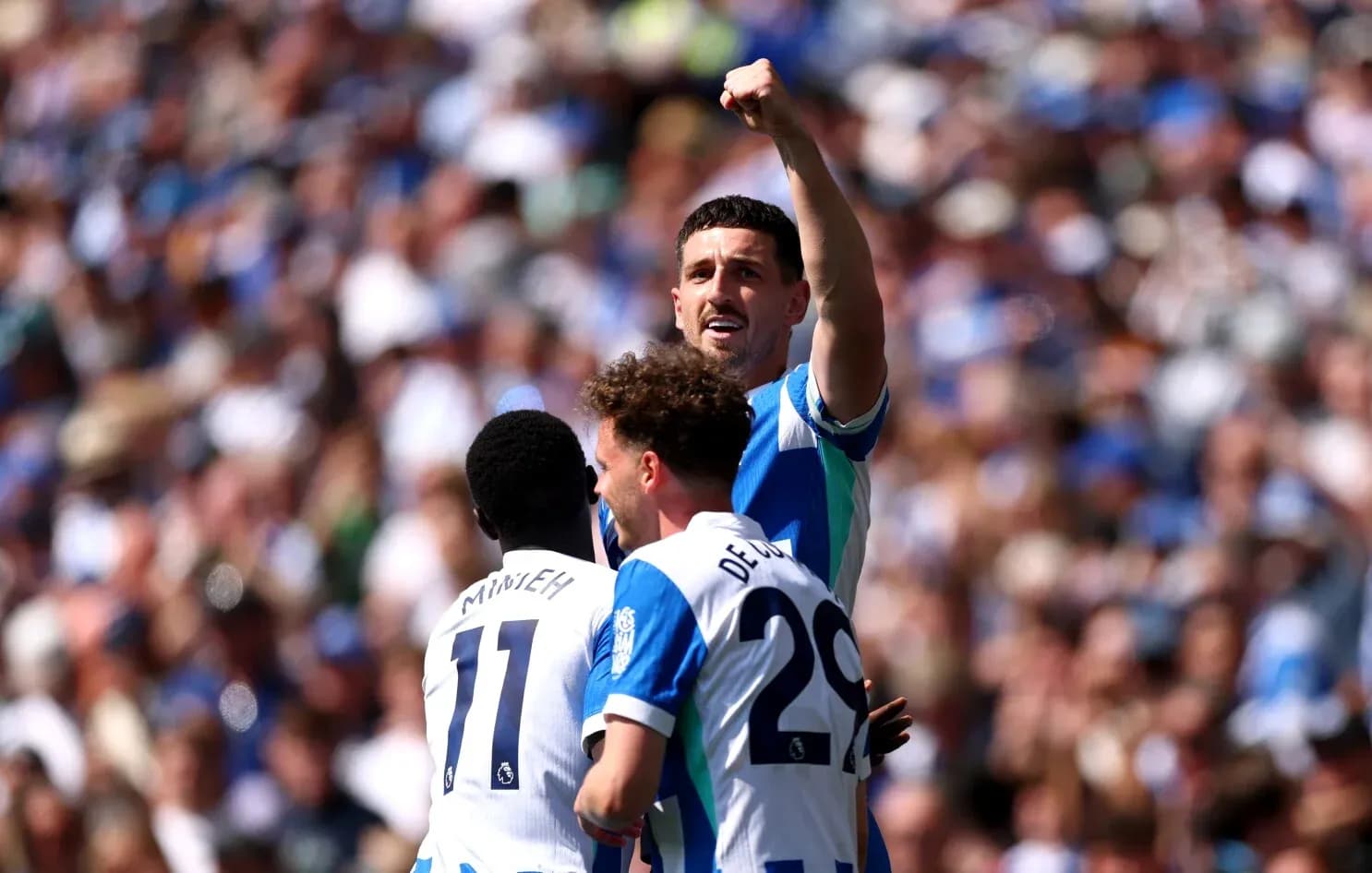
The scoring sequence set the tactical tone. At 1', Jack Hinshelwood finished a flowing Brighton move, assisted by Maxim De Cuyper, immediately rewarding Brighton’s aggressive high start and midfield occupation. Just four minutes later at 5', Lewis Dunk made it 2–0, again assisted by De Cuyper, underlining how Brighton’s set-up allowed the left-back to step into advanced zones and deliver from wide areas with minimal pressure.
Discipline
Discipline was relatively controlled but still tactically relevant. The card log is:
- 24' Kaoru Mitoma (Brighton) — Foul
- 49' Hwang Hee-chan (Wolves) — Foul
- 68' André (Wolves) — Foul
Those three yellows (Brighton: 1, Wolves: 2, Total: 3) reflected Wolves’ increasing desperation to disrupt Brighton’s rhythm and Brighton’s occasional overcommitment in counter-pressing.
Substitutions
Substitutions were used to manage intensity and adjust structures rather than to chase the game for Brighton. Wolves made the first move at 46', with David Møller Wolfe (IN) coming on for Hugo Bueno (OUT), a like-for-like change that slightly freshened the left side but did not alter the overall shape. At 58', Joël Veltman (IN) came on for Kaoru Mitoma (OUT), allowing Brighton to tilt towards a more secure right flank and potentially slide between back four and back five dynamics in possession.
Wolves then attempted a more aggressive reset at 67', when Rodrigo Gomes (IN) came on for Pedro Lima (OUT) and Jean-Ricner Bellegarde (IN) came on for Mateus Mané (OUT). Those twin changes aimed to inject more ball-carrying and creativity, but the structural issues in progressing through Brighton’s block remained. At 68', André’s yellow card for “Foul” encapsulated Wolves’ struggle to regain control in midfield once they lost the ball.
Hurzeler’s game management phase arrived on 76', with Yasin Ayari (IN) for Carlos Baleba (OUT) and Georginio Rutter (IN) for Danny Welbeck (OUT). Ayari added fresh legs and press resistance in central areas, while Rutter’s movement between the lines helped Brighton maintain an attacking threat without overextending. The third goal at 86' from Yankuba Minteh, unassisted, crowned Brighton’s control and punished Wolves’ increasingly stretched structure.
Finally, at 88', Charalampos Kostoulas (IN) replaced Jack Hinshelwood (OUT) and Solly March (IN) replaced Maxim De Cuyper (OUT), further rotating key roles and protecting influential contributors. Wolves’ late double switch at 89' — Angel Gomes (IN) for Hwang Hee-chan (OUT) and Tolu Arokodare (IN) for João Gomes (OUT) — arrived too late to influence the pattern of play.
Tactical Analysis
Tactically, Brighton’s dominance was rooted in their use of the ball and their occupation of central and half-space zones. With 578 total passes at 86% accuracy, they built systematically from Bart Verbruggen, who needed to make only 1 save. The low save count was not a product of passivity but of Brighton’s territorial control and counter-pressing; Wolves simply struggled to construct sustained attacks to test him.
The back line of Ferdi Kadıoğlu, Jan Paul van Hecke, Lewis Dunk and Maxim De Cuyper functioned as an expansive platform. Dunk’s early goal highlighted his threat on set plays, but his tactical role was primarily as a distributor and organiser, stepping into midfield when space allowed. De Cuyper’s two assists underline how often he advanced into high left zones; his combinations with Mitoma and then later March, plus the interior support from Pascal Groß and Hinshelwood, created consistent overloads on Wolves’ right.
In midfield, Carlos Baleba and Pascal Groß provided balance between ball-winning and progression. Baleba’s presence allowed Groß to operate higher and wider at times, connecting with Yankuba Minteh and Hinshelwood between the lines. Hinshelwood, starting as a nominal midfielder, frequently arrived in the box, as seen with his 1' goal, a clear pattern of third-man runs from deep that Wolves never fully tracked.
In the final third, Danny Welbeck’s movement was crucial despite not scoring. He occupied centre-backs Santiago Bueno and Toti Gomes, opening lanes for runners like Minteh and Mitoma. Minteh’s late goal at 86' reflected Brighton’s continued willingness to commit numbers forward even at 2–0, trusting their rest defence and counter-press to prevent transitions.
Wolves’ Structure
Wolves’ structure, by contrast, remained reactive. With only 225 passes at 68% accuracy and 28% possession, they were largely confined to low and mid-block defending. Daniel Bentley’s 3 saves indicate that while Brighton’s xG (1.62) was not astronomically high, the quality of their chances and their efficiency in front of goal were decisive. Wolves’ own xG of 0.49, from just five shots, underscores how rarely they reached high-value shooting positions. Hwang Hee-chan’s yellow card on 49' and André’s on 68' both stemmed from attempts to break up Brighton’s circulation, but they did little to shift the tactical dynamic.
Statistically, the verdict matches the eye test: Brighton’s 14 total shots (6 on target) to Wolves’ 5 (1 on target), a 7–1 corner advantage, and superior passing volume and accuracy reflect a side in control of both territory and tempo. The equal goals prevented figures (0.25 for each goalkeeper) highlight that neither side allowed many clear one-on-ones; Brighton simply turned their sustained pressure into early goals that shaped the rest of the match.