.svg&w=384&q=75 "GoalGist logo")
Atalanta vs Bologna: Serie A Season Finale Analysis
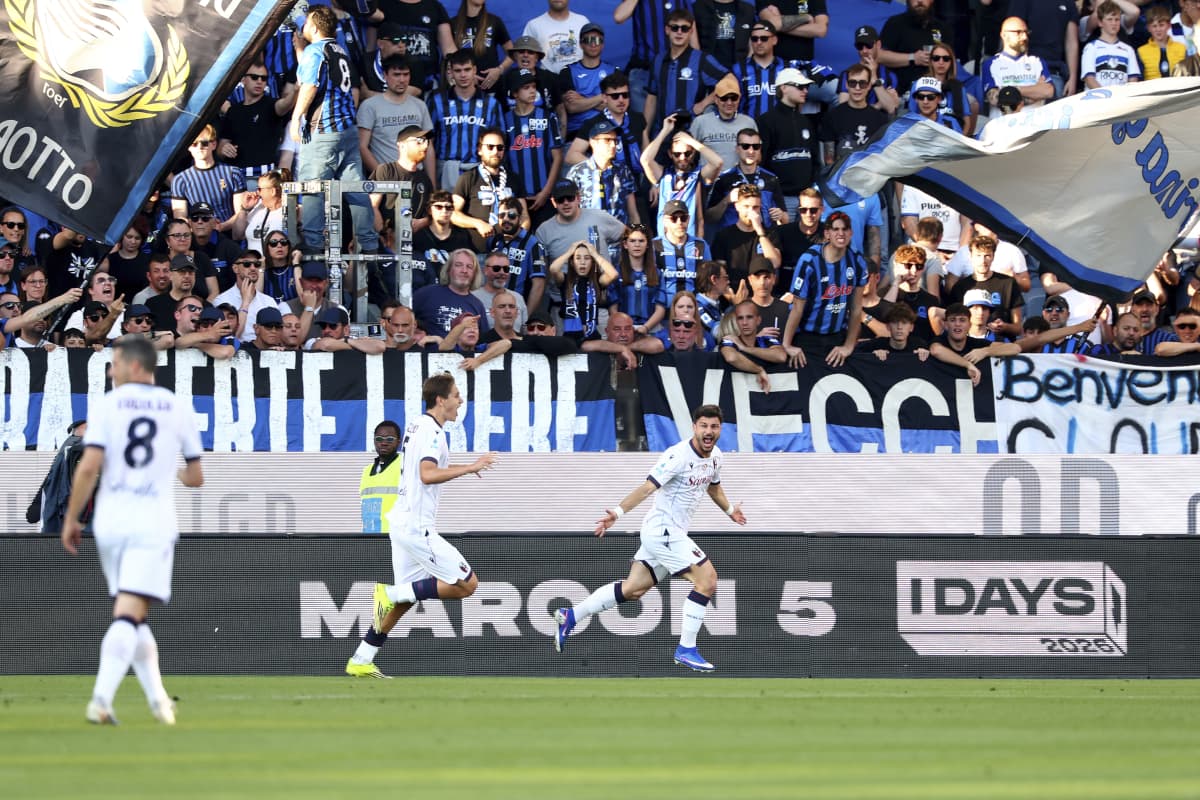
The New Balance Arena closed its Serie A season in subdued fashion: a 1–0 defeat for Atalanta against Bologna that tightened, rather than clarified, the race for European places. Following this result, Atalanta sit 7th on 58 points with a goal difference of +15 (50 scored, 35 conceded), while Bologna’s away-day punch has them right on their heels in 8th with 55 points and a goal difference of +3 (46 scored, 43 conceded) after 37 matches.
I. The Big Picture – Clash of Identities
This was a meeting of contrasting seasonal profiles. Atalanta have built their campaign on controlled aggression and structural stability. Overall they average 1.4 goals for and 0.9 against per game, with a particularly solid record at home: 25 goals scored and only 15 conceded in 19 matches, an average of 1.3 for and 0.8 against. Bologna, by contrast, have been far more explosive on their travels. Away from home they have scored 30 goals and conceded 23 in 19 games, averaging 1.6 for and 1.2 against, underlining a willingness to open the game up when they leave Emilia-Romagna.
The lineups reflected those identities. Raffaele Palladino stayed loyal to Atalanta’s season-long backbone, the 3-4-2-1 that has started 33 league matches. Gian Marco Carnesecchi was protected by a back three of Giorgio Scalvini, Berat Djimsiti and H. Ahanor. The wing lanes were entrusted to Davide Zappacosta and Nicola Zalewski, with Marten De Roon and Ederson forming the double pivot. Ahead of them, Charles De Ketelaere and Giacomo Raspadori floated behind lone striker Nikola Krstovic.
Vincenzo Italiano, meanwhile, opted for a more aggressive 4-3-3 than Bologna’s usual 4-2-3-1 template. Lukasz Skorupski started in goal behind a back four of Joao Mario, E. Fauske Helland, Tomas Heggem and Juan Miranda. In midfield, Lewis Ferguson, Remo Freuler and Tommaso Pobega gave Bologna a blend of running, control and late-box threat. The front three of Federico Bernardeschi, S. Castro and J. Rowe was built to stretch Atalanta’s back line horizontally and vertically.
II. Tactical Voids – Absences and Discipline
Both sides were forced into structural compromises by absences. Atalanta were without L. Bernasconi (knee injury), I. Hien (suspension for yellow cards) and O. Kossounou (thigh injury). The loss of Hien and Kossounou in particular stripped Palladino of two important one‑v‑one defenders, pushing Ahanor into a high-responsibility role on the right of the back three and limiting Atalanta’s ability to switch between back-three and back-four mid-game.
Bologna’s defensive core was equally patched up. K. Bonifazi (inactive), N. Cambiaghi (muscle injury), N. Casale (calf injury), Jhon Lucumi (suspension) and M. Vitik (ankle injury) were all missing. Without Lucumi and Vitik, Italiano had to lean on Heggem and Fauske Helland as the central pairing, a duo less tested at this level and more vulnerable to the physical and aerial presence of players like Krstovic and, from the bench, Gianluca Scamacca.
Disciplinary trends framed the risk profile. Over the season, Atalanta’s yellow cards peak late: 24.14% of their bookings arrive between 76–90 minutes, with another 22.41% between 61–75. Bologna mirror that volatility, with 26.87% of their yellows between 61–75 and 25.37% between 76–90. Both teams, in other words, tend to fray as fatigue sets in, and this match followed that familiar pattern of rising tension as the clock ticked down, even if the card details themselves are not listed here.
III. Key Matchups – Hunter vs Shield, Engine Room Battles
The headline duel was always going to be Bologna’s away attack against Atalanta’s home defence. On their travels this campaign, Bologna’s 30 goals from 19 matches speak to a side comfortable attacking space, especially in transition. Atalanta, however, have allowed just 15 goals at home in 19 games, a defensive record built on compact spacing and the screening work of De Roon and Ederson.
Within that, the “Hunter vs Shield” narrative centred on the forwards and the collective defensive units rather than a single duel. Krstovic entered the fixture as Atalanta’s joint-top league scorer with 10 goals and 5 assists overall, a striker who thrives on attacking crosses and second balls. Up against a makeshift Bologna centre-back pairing, he was theoretically primed to exploit aerial mismatches and channel runs between full-back and centre-back. Yet Bologna’s defensive line, anchored by Fauske Helland and Heggem, held firm, compressing the central lane and forcing Atalanta to circulate wide without consistent penetration.
On the other side, Bologna’s threat was distributed. Bernardeschi’s left-footed incursions from the right, Rowe’s direct running and Castro’s movement across the front line collectively probed the channels around Scalvini and Ahanor. Atalanta’s home record – only 0.8 goals conceded per game – is usually underpinned by Scalvini’s anticipation and Djimsiti’s duels; here, though, Bologna found enough half-spaces to manufacture the game’s decisive moment.
In the “Engine Room”, the battle between De Roon–Ederson and Freuler–Ferguson–Pobega defined the match’s rhythm. De Roon and Ederson are the platform for Atalanta’s 3-4-2-1, recycling possession and protecting rest defence. Ferguson and Pobega, however, offered surging runs beyond the ball, while Freuler’s positional intelligence – honed in his own Atalanta past – allowed Bologna to disrupt Palladino’s usual central overloads. De Ketelaere, one of Serie A’s most influential creators this season with 5 assists and 62 key passes overall, was repeatedly forced to receive with his back to goal, limiting his ability to turn and drive at the back four.
IV. Statistical Prognosis – What the Numbers Say About the 1–0
Following this result, the underlying season profiles help explain how a single goal was enough to tilt the contest. Atalanta, despite a strong overall goal difference of +15, have failed to score in 8 league matches in total, including 6 at home. When their positional play stalls and the wing-backs cannot create high-quality cut-backs, they can drift into sterile dominance. Bologna, conversely, have kept 5 away clean sheets overall and failed to score away only 3 times; they are accustomed to tight, opportunistic away wins.
Bologna’s away scoring average of 1.6 goals per game suggests that, on another day, they might have added to their tally. Yet their broader season balance – 43 conceded overall, 23 away – underlines that this 1–0 at the New Balance Arena was as much about improved defensive concentration as attacking verve.
From an xG perspective – even without explicit values here – the patterns are clear. Atalanta’s structure is designed to generate steady, medium-quality chances through volume and territory, but Bologna’s compact 4-3-3, with Freuler screening and full-backs tucked in, successfully pushed those attempts into less dangerous zones. At the other end, Bologna’s travelling efficiency, reflected in 30 away goals from 19 games, translated into a decisive moment of quality rather than a barrage.
The verdict: this was a match where Bologna’s away identity – disciplined, vertical, ruthless in moments – outperformed Atalanta’s usually reliable home platform. The 1–0 scoreline fits the season-long statistical contours: a narrow margin, but one entirely consistent with a Bologna side that has made a habit of punching above its weight on the road, and an Atalanta team that, for all its structural sophistication, can still be made to look blunt when denied central access to Krstovic and De Ketelaere.