.svg&w=384&q=75 "GoalGist logo")
Tottenham's Tactical Mastery in 1-0 Win Over Everton
Tottenham’s 1-0 win over Everton at Tottenham Hotspur Stadium was a controlled, system-faithful performance built on Roberto De Zerbi’s 4-2-3-1 structure and a clear territorial plan, rather than sheer shot quality. With both sides finishing on 50% possession and almost identical passing volumes (Tottenham 373 passes, Everton 377), the difference lay in how Tottenham used their spells on the ball to pin Everton back, generate volume in the box, and protect their single-goal edge.
Tottenham’s shape was textbook: A. Kinsky in goal behind a back four of P. Porro, K. Danso, M. van de Ven and D. Udogie; R. Bentancur and J. Palhinha as the double pivot; D. Spence, C. Gallagher and M. Tel supporting Richarlison as the lone striker. The structure allowed Tottenham to dominate field position and shot territory. They produced 20 total shots to Everton’s 9, with a heavy skew towards the penalty area: 15 shots inside the box versus Everton’s 7. That volume translated into a modest xG of 0.99, indicating many of those looks were pressured or from less-than-ideal angles, but the sustained pressure defined the tactical story.
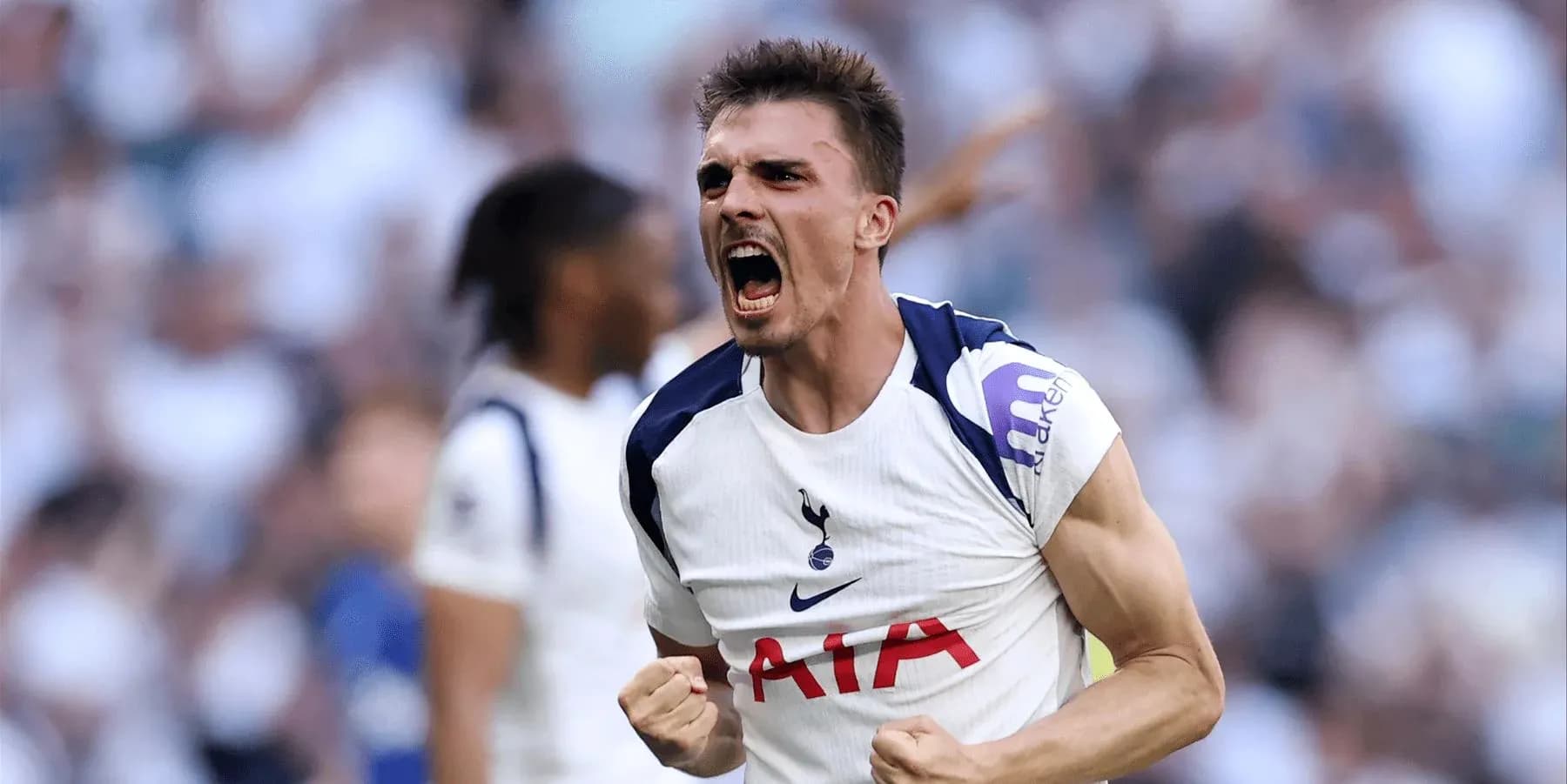
The decisive moment came on 43 minutes, when J. Palhinha stepped forward from the pivot to score the only goal for Tottenham. The lack of an assist in the data underlines how the goal was more about second-phase positioning and Tottenham’s ability to keep Everton penned in than about a single incisive pass. Palhinha’s later yellow card for Handball at 87’ also reflected his active, high-contact role in central areas as Spurs tried to disrupt transitions and kill Everton’s late momentum.
Out of possession, Tottenham’s press and rest-defence were efficient rather than frantic. They committed 15 fouls to Everton’s 18, signalling that they were prepared to break up play but did not descend into chaos. With 9 blocked shots, Tottenham’s back line and midfield shield repeatedly got bodies in the way, compensating for a relatively quiet afternoon for A. Kinsky (Tottenham), who was required to make only 1 save. The goals prevented metric of -0.32 for Tottenham suggests that, on the rare occasions Everton did threaten, the finishing or defending allowed slightly more than expected from those chances, but the low Everton xG of 0.34 shows that these moments were scarce.
In build-up, Porro and Udogie provided width from full-back, allowing Spence and Tel to drift into more interior pockets. Gallagher, operating between the lines, helped Tottenham link the double pivot to the front line, and the 85% passing accuracy (373 passes, 317 accurate) illustrates a side comfortable circulating the ball under pressure. The 7 corner kicks Tottenham earned, matching Everton’s 7, underline how frequently they forced the visitors back into their own third, even if they did not convert set-piece pressure into further goals.
The substitution pattern from De Zerbi was clearly about refreshing the front half of the structure while keeping the defensive spine intact. On 73’, R. Kolo Muani (IN) came on for Richarlison (OUT), and P. M. Sarr (IN) replaced M. Tel (OUT), injecting fresh running and pressing energy at centre-forward and in the attacking midfield band. At 82’, A. Gray (IN) came on for R. Bentancur (OUT) and J. Maddison (IN) replaced C. Gallagher (OUT), rebalancing the midfield from a double pivot towards more ball-carrying and control as Spurs tried to manage the lead rather than chase a second goal. Finally, at 90’, R. Dragusin (IN) came on for D. Udogie (OUT), a late defensive reinforcement to close out the match.
Everton, also in a 4-2-3-1 under Leighton Baines, set up with J. Pickford in goal; a back four of J. O’Brien, J. Tarkowski, M. Keane and V. Mykolenko; J. Garner and T. Iroegbunam as the double pivot; M. Rohl, I. Ndiaye and K. Dewsbury-Hall behind striker T. Barry. Their tactical plan was more reactive. With only 9 shots (3 blocked) and 1 shot on goal, they struggled to convert possession into threat. The xG of 0.34 quantifies that lack of incision: Everton circulated reasonably well (377 passes, 314 accurate, 83%) but rarely progressed into truly dangerous zones.
Defensively, Everton’s approach was aggressive and at times desperate. They conceded 18 fouls and received two yellow cards: at 13’, Jake O’Brien (Everton) — Foul, and at 89’, James Tarkowski (Everton) — Foul. Both cards reflect defenders being forced into corrective actions as Tottenham’s front line and advanced midfielders repeatedly attacked the channels and half-spaces. Everton’s 1 recorded save for J. Pickford (Everton), combined with Tottenham’s 2 shots on goal, suggests that many of Spurs’ 20 attempts were either off target or blocked before reaching the keeper, which is consistent with Everton’s back line often defending deep in their own box.
Baines’ substitutions were an attempt to add energy and attacking impetus without losing structural integrity. At 62’, T. George (IN) came on for M. Rohl (OUT) and H. Armstrong (IN) replaced J. O’Brien (OUT), indicating a shift towards more attacking profiles in wide and advanced midfield zones. On 84’, Beto (IN) came on for T. Barry (OUT), C. Alcaraz (IN) replaced K. Dewsbury-Hall (OUT), and S. Coleman (IN) entered for T. Iroegbunam (OUT), a triple change that simultaneously freshened the front line and added experience at full-back. However, with Tottenham’s block compact and disciplined, these changes did not translate into clear chances.
Discipline was a notable subplot. Alongside Everton’s two yellows, Tottenham collected two of their own: at 80’, Pape Matar Sarr (Tottenham) — Simulation, and at 87’, João Palhinha (Tottenham) — Handball. Sarr’s booking for Simulation hints at Spurs’ attempts to draw fouls and slow the game in the final phase, while Palhinha’s Handball points to a last-ditch defensive action as Everton pushed late.
Statistically, the match was finely balanced in possession and passing but decisively tilted in shot volume and territory. Tottenham’s 20 shots, 9 blocked efforts and 15 attempts inside the box, combined with a near-1.0 xG, portray a side that repeatedly reached the final third and the penalty area, even if they lacked clinical edge. Everton’s 9 shots and 0.34 xG confirm that their attacks were more sporadic and lower quality.
From a goalkeeper perspective, both A. Kinsky (Tottenham) and J. Pickford (Everton) were largely protected by their defensive structures, each registering 1 save. The identical goals prevented values of -0.32 for both teams underline that neither keeper dramatically outperformed or underperformed the expected threat; the match was decided further up the pitch.
Ultimately, Tottenham’s tactical superiority lay in their ability to translate a 50-50 share of the ball into territorial dominance, shot volume, and a controlled defensive platform. Everton matched them in effort and discipline but lacked the mechanisms to turn possession into genuine danger, and in a low-xG contest, Palhinha’s first-half strike was enough to separate the sides.