.svg&w=384&q=75 "GoalGist logo")
Burnley and Wolves: A Season of Relegation Reflected in Final Draw
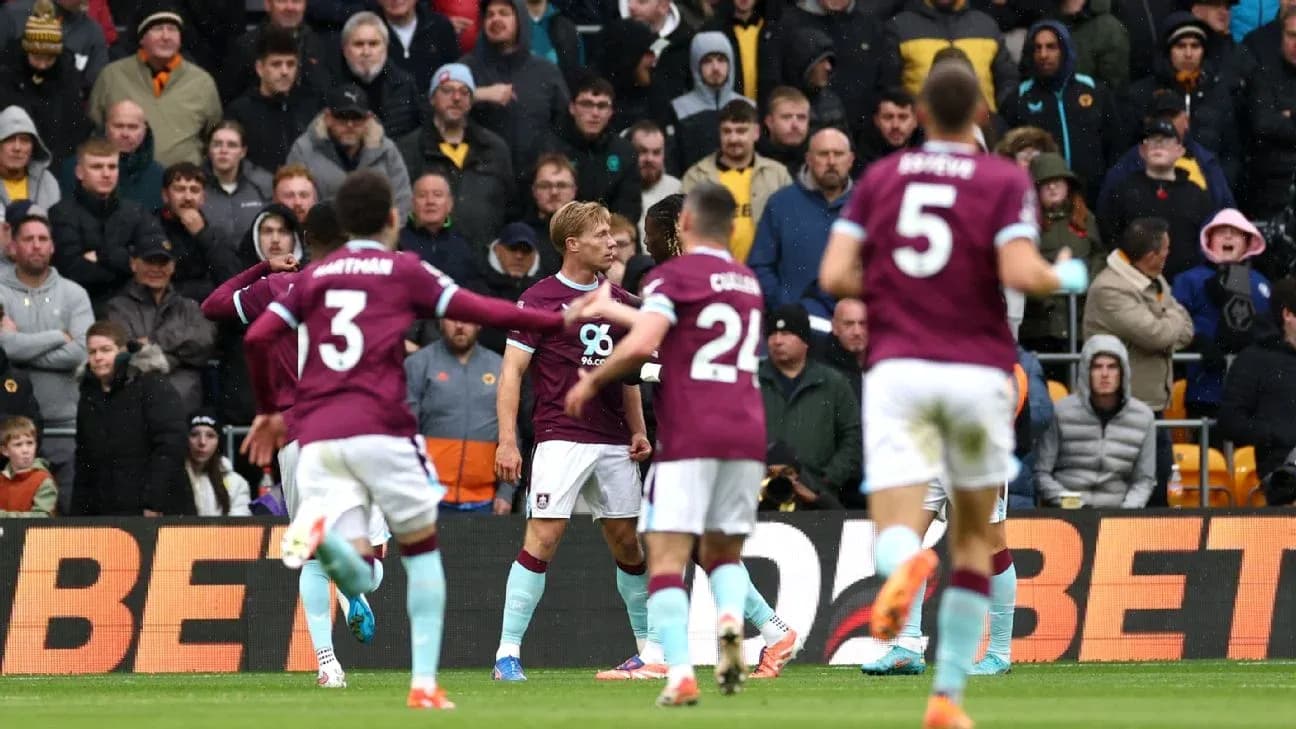
Turf Moor’s final act of the 2025–26 Premier League season ended with parity and resignation: Burnley 1–1 Wolves, two relegated sides sharing points that could no longer save them. Yet within that stalemate lay a clear snapshot of each squad’s identity, their tactical compromises, and the fault lines that defined their seasons.
I. The Big Picture – Two Relegated Identities Collide
Following this result, the table tells a stark story. Burnley finish 19th on 22 points with a goal difference of -37, built from 38 goals scored and 75 conceded overall. Wolves end bottom in 20th on 20 points, their goal difference of -41 the product of just 27 goals for and 68 against. Both are consigned to the Championship, but they arrived at this finale with very different attacking and defensive profiles.
At home this campaign, Burnley have been marginally more enterprising: 18 goals scored at Turf Moor at an average of 0.9 per match, against 29 conceded at 1.5 per game. Wolves, on their travels, have been toothless – only 8 away goals at an average of 0.4, while conceding 34 at 1.8 per match. The 1–1 draw sits almost exactly on those seasonal rails: Burnley find a goal but cannot keep the back door shut; Wolves nick something but never truly overwhelm.
Mike Jackson stayed loyal to Burnley’s most-used structure, a 4-2-3-1 that has been deployed 13 times this season. Rob Edwards, in turn, leaned into Wolves’ three-at-the-back DNA, sending out a 3-4-2-1 – their most frequent shape with 12 league uses. It set up a clear tactical duel: Burnley’s single striker supported by a creative band of three against Wolves’ compact back three and industrious midfield box.
II. Tactical Voids – Absences and Discipline
Both sides arrived weakened. Burnley were again without J. Beyer (hamstring) and J. Cullen (knee), two players whose absence has repeatedly stripped Jackson of defensive stability and midfield control. Without Beyer, the back line leaned on A. Tuanzebe and B. Humphreys to anchor the centre, with Lucas Pires and K. Walker at full-back. Cullen’s absence pushed more responsibility onto Florentino and L. Ugochukwu as the double pivot, both asked to screen and build in equal measure.
Wolves’ list of absentees was longer and arguably more structurally disruptive. L. Chiwome (knee), M. Doherty (muscle), E. Gonzalez (knee) and S. Johnstone (knock) were all missing. Without Doherty’s versatility and Gonzalez’s presence, Edwards doubled down on a youthful, mobile wing-back/midfield line, using R. Gomes and D. M. Wolfe wide with Andre and A. Gomes inside. The lack of alternative profiles on the bench narrowed Wolves’ in-game options.
Disciplinary trends framed the tone. Across the season, Burnley have lived on the edge. Their yellow card distribution spikes late: 19.70% of their yellows arrive between 16–30 minutes, 18.18% between 76–90, and another 19.70% between 91–105. Red cards are evenly split across 31–45, 76–90 and 91–105, each with 33.33%. That pattern speaks of a side that starts emotionally, then grows increasingly desperate as matches slip away.
Wolves, by contrast, are most combustible just after half-time: 27.50% of their yellows come between 46–60 minutes, with 20.00% between 61–75 and 18.75% from 76–90. Their three reds are spread across 31–45, 46–60 and 61–75. This is a team that often loses control as the second half opens, particularly when chasing games.
III. Key Matchups – Hunter vs Shield, Engine Room Battles
The headline “Hunter vs Shield” duel revolved around Burnley’s top scorer Z. Flemming and Wolves’ defensive structure. Flemming, listed as a forward here but used throughout the season as an advanced midfielder, has been Burnley’s primary goal threat: 11 goals in 29 appearances, 38 shots with 21 on target, and 2 penalties scored from 2 taken. His physical profile (185cm, 84kg) and numbers underline a hybrid role – part target, part late-arriving runner, part presser. He also blocked 5 shots this season, a testament to his work rate without the ball.
Against Wolves’ back three of Y. Mosquera, S. Bueno and L. Krejci, Flemming’s movement between the lines was crucial. Mosquera, who has blocked 17 shots this season and committed 34 fouls, is an aggressive front-foot defender. That made the inside channels between Mosquera and his wing-back a key battleground. Flemming’s duels total of 274 (114 won) shows he relishes contact; here, he looked to pin and spin off the Colombian, forcing Wolves’ line to drop and creating space for the trio behind him.
In the “Engine Room”, the clash was defined by Andre and A. Gomes for Wolves against Florentino, Ugochukwu and H. Mejbri for Burnley. Andre has been a metronome and enforcer: 1306 passes at 91% accuracy, 82 tackles and 13 blocks, plus 12 yellow cards – a classic deep-lying controller who is not afraid to foul. His opposite numbers had complementary traits. Florentino sat deepest, recycling possession and shielding the centre-backs; Ugochukwu offered vertical power, driving forward from the double pivot.
Mejbri, starting as the central No. 10, was Burnley’s connector. Over the season he has 4 assists, 21 key passes and 34 dribble attempts with 20 successful, alongside 10 yellow cards that underline his combative edge. His role was to find pockets behind Andre, forcing the Brazilian to choose between holding shape or stepping out and risking space behind.
Out wide, J. Anthony and L. Tchaouna tried to stretch Wolves’ wing-backs. Anthony’s left-sided running pinned R. Gomes back, while Tchaouna’s starting position high on the right line asked questions of D. M. Wolfe’s defensive instincts. Behind them, Walker’s overlapping threat and defensive reliability – 56 tackles, 10 successful blocks and 45 interceptions – gave Burnley a platform to squeeze Wolves into their own third, especially as the game wore on.
For Wolves, the front three of Hwang Hee-Chan, M. Mane and A. Armstrong were tasked with exploiting Burnley’s season-long defensive fragility. Overall, Burnley have conceded 2.0 goals per match, with 46 of their 75 goals against coming away from home, but even at Turf Moor they allow 1.5 per game. The idea was clear: use Hwang’s diagonal runs and Armstrong’s movement to isolate Humphreys or Pires, while Mane drifted between the lines.
IV. Statistical Prognosis – xG Logic in a Dead Rubber
If we project from seasonal trends, this fixture always looked like a low-scoring, attritional contest. Burnley’s overall scoring rate of 1.0 goals per match against Wolves’ overall concession rate of 1.8 suggests the hosts could reasonably expect to create around 1.0–1.3 xG at home. Wolves’ anaemic away attack – 0.4 goals per game – facing a Burnley defence conceding 1.5 at Turf Moor hints at an away xG in the 0.5–0.8 range.
Overlay that with Wolves’ tendency to unravel just after half-time and Burnley’s late-card, late-chaos profile, and the probability matrix leans towards a tight game that opens up in the final half-hour rather than a free-flowing shootout. The 1–1 scoreline fits that model: Burnley do just enough to find a goal, Wolves find a rare away strike, and neither side has the quality or confidence to push decisively beyond parity.
In tactical terms, Burnley’s 4-2-3-1 offered more structure and individual upside in advanced areas – especially with Flemming and Mejbri – but their season-long defensive issues and emotional volatility kept Wolves interested. Wolves’ 3-4-2-1 brought solidity and work rate through Andre, A. Gomes and Mosquera, yet their chronic lack of cutting edge away from home capped their ceiling.
Following this result, both clubs step into the Championship with clear blueprints and clear flaws. Burnley have a creative spine in Flemming and Mejbri, plus a seasoned operator in Walker, but must harden their defensive core and manage their discipline. Wolves carry a robust midfield axis in Andre and A. Gomes and a committed, blocking machine in Mosquera, yet desperately need goals and greater composure in those key second-half windows.
At Turf Moor, the narrative closed with symmetry: two sides who had spent a season chasing solidity and goals, meeting in a game that gave them just enough of each to underline why they are going down – and what must change if they are to come back up.