.svg&w=384&q=75 "GoalGist logo")
Tottenham Ends Season with Narrow Win Over Everton
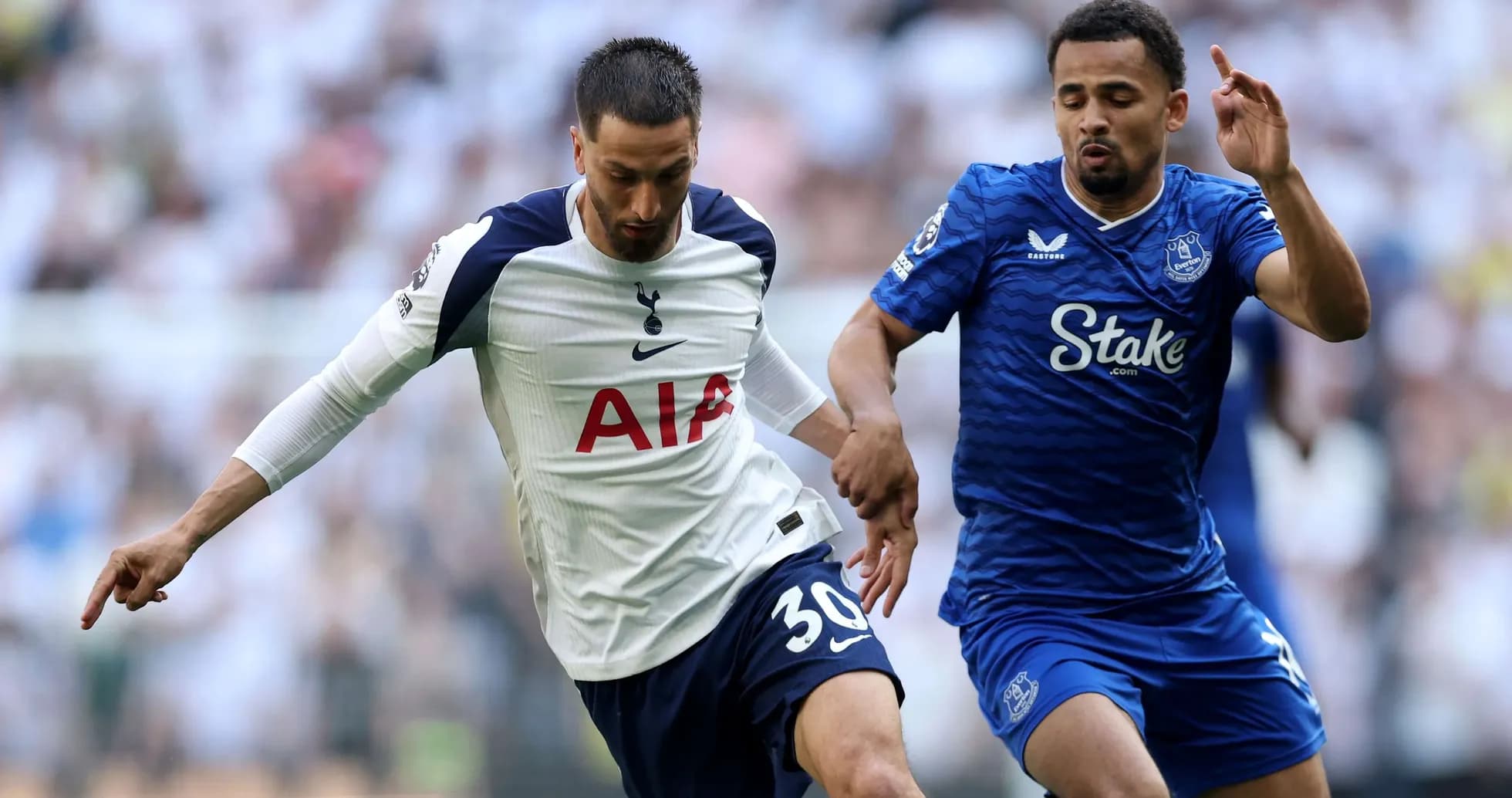
Under a grey London sky at Tottenham Hotspur Stadium, a fraught season for Tottenham ended with a narrow 1–0 win over Everton, a scoreline that neatly encapsulated both sides’ 2025–26 identities. Following this result, Tottenham closed the campaign 17th in the Premier League on 41 points, their overall goal difference at -9 from 48 goals scored and 57 conceded. Everton, safer in mid-table at 13th with 49 points and a goal difference of -3 (47 for, 50 against), left north London beaten but broadly reflective of a season built on structure rather than sparkle.
I. The Big Picture – De Zerbi’s compromise, Baines’ blueprint
Both teams lined up in a mirrored 4-2-3-1, but the shapes carried very different intentions.
For Tottenham, Roberto De Zerbi’s selection felt like a pragmatic end-of-season compromise. The numbers heading into this game were stark: at home they had played 19, winning only 3, drawing 6 and losing 10, with 22 goals for and 31 against. An average of 1.2 goals scored at home and 1.6 conceded underlined why safety had come late and nervy. On their travels, Everton had been more balanced: 19 away games, 7 wins, 5 draws, 7 losses, scoring 21 and conceding 23, averaging 1.1 goals for and 1.2 against.
In that context, the 1–0 felt like Tottenham deliberately shrinking the chaos. A. Kinsky in goal behind a back four of P. Porro, K. Danso, M. van de Ven and D. Udogie offered a blend of ball progression and recovery pace, but without the usual high-wire aggression of the missing C. Romero. The double pivot of R. Bentancur and J. Palhinha was the clearest statement: control first, risk later. Ahead of them, D. Spence, C. Gallagher and M. Tel worked as a fluid band of three behind Richarlison, the season’s standout finisher with 11 league goals and 4 assists in total.
Leighton Baines, meanwhile, leaned into continuity. Everton had used 4-2-3-1 in 37 of 38 league matches, and this was no exception. J. Pickford anchored a back four of J. O’Brien, J. Tarkowski, M. Keane and V. Mykolenko. In front, J. Garner and T. Iroegbunam formed the screen, with M. Rohl, I. Ndiaye and K. Dewsbury-Hall supporting T. Barry up top. Without the creativity of the injured J. Grealish and the defensive nous of J. Branthwaite and I. Gueye, Everton’s structure remained, but their ceiling was lowered.
II. Tactical Voids – The weight of absences and the card landscape
Tottenham’s absentees shaped the match as much as those on the pitch. C. Romero, X. Simons, D. Kulusevski, M. Kudus, W. Odobert and B. Davies all missed out, several through knee issues and Davies with an ankle injury. That stripped De Zerbi of ball-carrying from deep (Simons), one‑v‑one wing threat (Kulusevski, Kudus, Odobert) and his most combative centre-back (Romero).
The result was a Spurs side less explosive but more compact. Van de Ven, who in total this campaign blocked 22 shots and took a red card in the league, became the quiet anchor of the back line, his recovery pace allowing Porro to step higher. Yet without Romero’s front-foot defending, Tottenham were less inclined to hold a high line for long spells, instead compressing the middle third and trusting Bentancur and Palhinha to suffocate Everton’s build-up.
Everton’s missing trio had an equally obvious tactical cost. Branthwaite’s absence pushed M. Keane into the XI, sacrificing some mobility and left-footed balance. Without Gueye’s screening presence, Iroegbunam had to cover larger defensive spaces, particularly when Garner stepped out to press. Grealish’s injury removed a key ball-progressor and foul-winner – his 58 fouls drawn in the league had often been Everton’s pressure valve.
From a disciplinary perspective, both squads carried a season-long edge into this fixture. Tottenham’s card data showed a yellow-card peak between 61–75 minutes at 24.75%, hinting at a side that often lost composure as games became stretched. Everton’s yellows surged late, with 21.62% coming between 76–90 minutes and a further 16.22% in added time. Their red-card profile was even more volatile: 25.00% of reds in 0–15 minutes and 50.00% between 76–90, a pattern of early and late lapses. That volatility never fully boiled over here, but it framed the match as one where a single rash decision could tilt the balance.
III. Key Matchups – Hunter vs Shield, Engine Room battles
The “Hunter vs Shield” narrative centred on Richarlison against Everton’s defensive core. Across the season, Tottenham averaged 1.3 goals per game overall, while Everton conceded 1.3 overall; this was a meeting of a stuttering attack and a mid-table defence. Richarlison’s 47 total shots, 26 on target, underlined his volume and threat, but it was the supply line that mattered.
Porro, with 56 key passes in the league, and Gallagher, operating as a high-energy No. 10, repeatedly tried to drag Tarkowski and Keane into uncomfortable zones. O’Brien’s profile – 317 duels in total, 194 won, plus 16 blocked shots – marked him as Everton’s aerial and blocking specialist, and he spent much of the afternoon funnelling crosses away from Barry’s zone to protect transitions.
The true heart of the contest, though, was the “Engine Room”: Bentancur and Palhinha against Garner and Iroegbunam. Garner arrived as one of the league’s standout all‑rounders: 1792 passes at 87% accuracy, 56 key passes, 120 tackles and 57 interceptions, plus 12 yellow cards that spoke to his willingness to live on the edge. Here, he was tasked with both initiating Everton’s build and disrupting Tottenham’s.
Palhinha’s presence, however, meant Everton rarely had clean central progression. Spurs’ double pivot pinched space around Ndiaye, forcing Everton to circulate via full-backs and long diagonals. Every time Garner stepped higher to create, the risk of counters through Tel and Spence increased, especially against an Everton back line missing Branthwaite’s pace.
IV. Statistical Prognosis – A narrow win in line with the numbers
Following this result, the numbers tell a coherent story. Tottenham’s overall defensive record of 57 goals conceded in 38 games (1.5 per match) painted a side too often open; yet here, with Kinsky protected by a more conservative block and Van de Ven’s 22 successful blocks emblematic of their last-ditch resilience, they held Everton to zero.
Everton’s attack, averaging 1.2 goals per game overall and only 1.1 away, lacked the extra layer of invention without Grealish. Their season-long clean-sheet tally of 11, including 5 away, showed they were capable of shutting games down, but the fine margins at Tottenham Hotspur Stadium turned against them. One moment of quality in the final third, likely involving the vertical runs of Tel or the penalty-box instincts of Richarlison, proved decisive.
In xG terms, this felt like a low‑to‑mid event game edging toward Tottenham: a side with modest attacking averages at home but a clear desperation to end a bruising season with a statement of solidity. Everton, structurally sound but short of cutting edge, played into that script.
The 1–0 does not disguise the broader issues – Tottenham’s home fragility and Everton’s disciplinary volatility remain season-long themes – but it does offer a fitting coda. De Zerbi’s side finally found a way to win ugly in front of their own crowd; Baines’ Everton, organised and industrious, discovered the limits of structure when the final pass is missing.