.svg&w=384&q=75 "GoalGist logo")
Brighton vs Manchester United: A Season Finale Analysis
The Amex Stadium’s season finale unfolded under a sharp south‑coast light, but by full time the picture was brutally clear. Following this result, Brighton’s 0–3 home defeat to Manchester United closed a campaign that had promised European nuance and ended with a lesson in top‑end ruthlessness. Eighth in the Premier League table with 53 points and a goal difference of 6 (52 scored, 46 conceded overall), Brighton ran into a side that finished third on 71 points, their own goal difference a more muscular 19 (69 scored, 50 conceded overall).
Both coaches mirrored each other on the tactics board, sending their sides out in a 4‑2‑3‑1. From there, though, the interpretations diverged sharply.
I. The Big Picture – Structures and Seasonal DNA
Brighton’s season has been defined by controlled possession and a willingness to build from deep. Heading into this game they had averaged 1.6 goals at home and only 1.1 conceded, a solid Amex profile built on patient circulation from Lewis Dunk and B. Verbruggen’s comfort with the ball at his feet. Fabian Hurzeler doubled down on that identity: Dunk and J. P. van Hecke as the central hinge, M. Wieffer and F. Kadioglu as aggressive full‑backs, P. Gross and J. Milner the double pivot tasked with knitting phases together.
Manchester United arrived with a different kind of authority. On their travels they had scored 30 and conceded 26, a 1.6 goals‑for and 1.4 goals‑against profile that speaks to high‑risk, high‑reward football. Michael Carrick’s 4‑2‑3‑1 was tilted forward: K. Mainoo and M. Mount as the base, A. Diallo and P. Dorgu wide, Bruno Fernandes floating between the lines, and B. Mbeumo leading the line with vertical menace.
The first half’s 0–2 scoreline told the tactical story. United’s pressing triggers – especially when Verbruggen played into Milner or Gross with their backs turned – repeatedly forced Brighton to play faster than their structure allowed.
II. Tactical Voids – Absences and Their Shadows
The team sheets carried their own subtext. Brighton were without K. Mitoma, S. Tzimas and A. Webster, all listed as Missing Fixture. Mitoma’s absence stripped Hurzeler of his most direct left‑side runner, forcing M. De Cuyper into a more creative, inside‑left role rather than a pure touchline winger. Without Webster, Dunk and van Hecke had to shoulder every phase of build‑up under pressure, reducing Brighton’s margin for error against a United press that smells panic.
United’s omissions were just as telling. Casemiro, B. Šeško and M. de Ligt all missed out. Without Casemiro, Carrick had to trust Mainoo and Mount to protect transitions. That could have been a vulnerability, but Brighton never consistently exposed the half‑spaces behind United’s full‑backs. The absence of Šeško removed a pure penalty‑box reference point, yet Mbeumo’s mobility and willingness to drift wide arguably suited this away‑day, drawing Dunk into uncomfortable channels.
Discipline hovered in the background. Across the season, Brighton’s yellow cards have clustered most heavily in the 46‑60 minute window (27.91%), while United’s peak in the same phase is 21.88%, with a late‑game surge of 20.31% between 76‑90. In a different game state, that might have foreshadowed a scrappy, card‑laden second half. Here, United’s control of the scoreboard meant they could manage tempo rather than chase it, and the contest never descended into chaos.
III. Key Matchups – Hunter vs Shield, Engine Room vs Enforcer
Hunter vs Shield was written in bold: D. Welbeck against a United defence that, on their travels, had still leaked 26 goals. Welbeck’s season – 13 goals in total, 46 shots with 28 on target – has been built on intelligent movement rather than sheer volume. But without Mitoma stretching the left and with De Cuyper and J. Hinshelwood still learning the rhythms of Premier League final‑third play, Welbeck was often isolated, forced to drop into pockets that should have belonged to Brighton’s No.10.
At the other end, B. Mbeumo embodied United’s edge. Eleven league goals in total, underpinned by 59 shots and 32 on target, he constantly probed the channels between Kadioglu and van Hecke, then between Wieffer and Dunk when Brighton’s full‑backs inverted. His duel numbers – 265 total duels with 86 won – speak to a forward who relishes physical contact. Here, his pressing from the front was as important as anything he did in the box, preventing Gross from dictating rhythm.
In midfield, the “Engine Room” was a fascinating contrast. For Brighton, Gross and Milner offered guile and experience. Gross remains the quiet metronome, while Milner’s role was to stabilise transitions. But against them stood Mainoo and Mount, whose athleticism and willingness to step out of the double pivot repeatedly disrupted Brighton’s preferred passing lanes into Hinshelwood and D. Gomez.
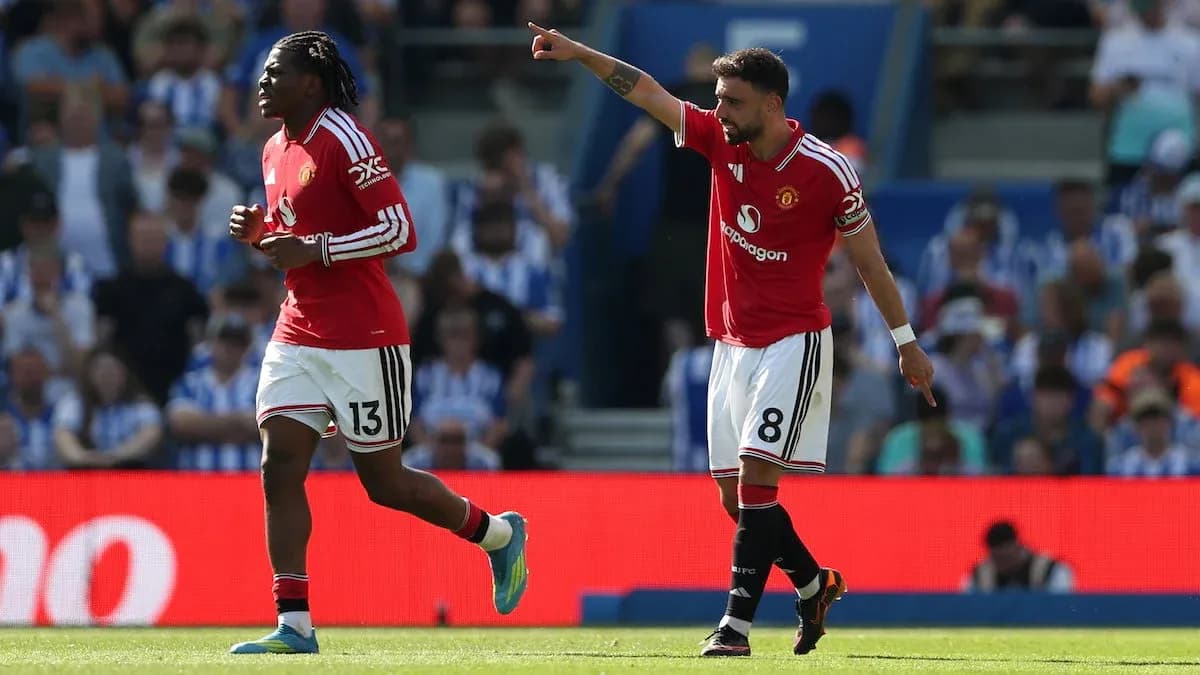
Above them all hovered Bruno Fernandes. Heading into this game he had 21 assists and 9 goals in total, with 137 key passes and 1,994 total passes at 82% accuracy. This is a player who doesn’t just see spaces; he creates them with his body orientation and timing. Time and again he found the half‑pockets behind Milner and to the side of Gross, forcing Dunk to step out and leaving van Hecke exposed to third‑man runs.
Without Casemiro, there was no classic “enforcer” to pit against him. Brighton’s most combative figure, Dunk, carried his own disciplinary history – 10 yellow cards in total – but could not follow Fernandes into midfield without tearing his own defensive line apart. The result was a zone of United superiority in the inside‑right channel that set the tone for the game.
IV. Statistical Prognosis – xG Shadows and Defensive Solidity
We are not given explicit xG numbers, but the season‑long profiles allow a reasoned reading. United’s total scoring rate of 1.8 goals per game and Brighton’s total concession rate of 1.2 suggest that, on an average day, United would be expected to edge the chance quality. Overlay United’s away average of 1.6 scored with Brighton’s home concession of 1.1, and a narrow United win feels like the statistical baseline.
Instead, United stretched the gap to three goals, hinting at a performance where their finishing significantly outstripped Brighton’s shot quality, and where Brighton’s own attacking output underperformed their usual Amex standard of 1.6 goals for. Welbeck’s penalty record this season – 1 scored but 2 missed – also underlines a broader theme: Brighton have not been ruthless in their high‑leverage moments.
Defensively, Brighton’s 10 clean sheets overall speak of a side capable of organisation, but United’s layered attack – Bruno between the lines, Diallo and Dorgu wide, Mbeumo darting in behind – asked more complex questions than Hurzeler’s reshuffled back line could answer without Webster’s depth and Mitoma’s outlet.
Following this result, the narrative is stark. Brighton close the campaign as a technically refined, structurally brave side that still needs sharper teeth and greater defensive resilience against elite counter‑punchers. Manchester United, with their 20 wins in 38 and a third‑place finish, leave the Amex looking every inch a Champions League team: not flawless at the back, but devastating whenever the game opens up and their creative core is allowed to breathe.