.svg&w=384&q=75 "GoalGist logo")
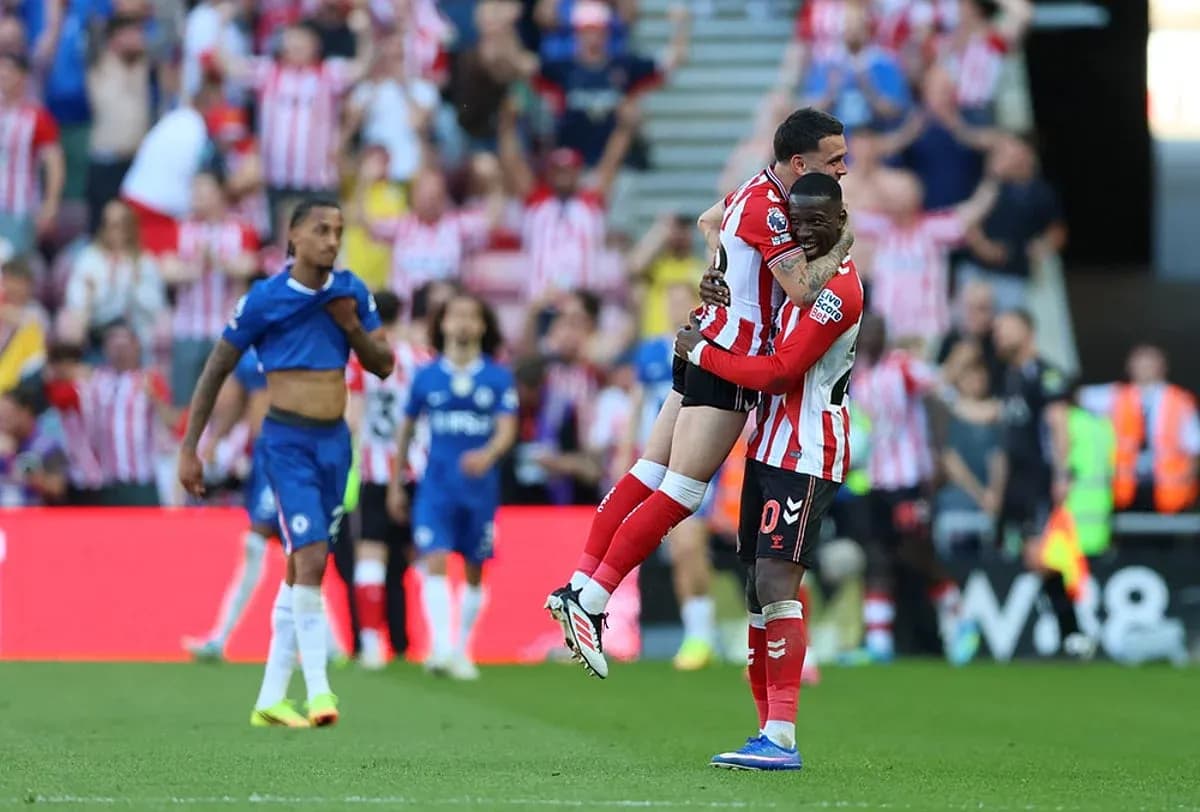
Sunderland's Tactical Masterclass in 2-1 Victory Over Chelsea
Sunderland’s 2-1 win over Chelsea at Stadium of Light was built on a clear structural plan: a compact 4-2-3-1 from Regis Le Bris against Calum McFarlane’s 3-4-1-2, with the home side accepting a possession deficit (45% to 55%) to dominate territory, shot volume and penalty-box presence.
Out of possession, Sunderland’s back four of Lutsharel Geertruida, Nordi Mukiele, Luke O’Nien and Reinildo Mandava held a relatively narrow line, with Noah Sadiki and Granit Xhaka screening in front. The double pivot was crucial: Xhaka anchored centrally, stepping out to engage Enzo Fernández and Moisés Caicedo, while Sadiki shuttled laterally to close Chelsea’s half-spaces, especially around Cole Palmer. This structure limited Chelsea to just 8 total shots and only 4 from inside the box, a very modest return for a side with more of the ball.
Higher up, the three of Trai Hume, Enzo Le Fée and Nilson Angulo operated aggressively between Chelsea’s lines. Sunderland’s pressing trigger was typically a backward or square pass into the Chelsea back three. Hume and Angulo jumped onto the wide centre-backs and wing-backs, while Le Fée stepped onto Fernández. Behind them, Xhaka and Sadiki held their positions to prevent Palmer receiving freely between the lines. This staggered press forced Chelsea into more direct or rushed progression, explaining why their territorial control did not translate into sustained pressure or shot volume.
In attack, Sunderland’s 21 total shots, including 16 inside the box, underline how well they exploited Chelsea’s three-at-the-back structure. The main pattern saw O’Nien and Mandava supporting early diagonals into the channels for Brian Brobbey, with Hume and Angulo arriving from the second line. The first goal at 25 minutes, finished by Hume and assisted by O’Nien, encapsulated this: Sunderland overloaded the right side, dragged Chelsea’s line across, and Hume attacked the space vacated in the half-space, arriving from midfield rather than starting high. That kind of late run from the second line was a repeated theme.
Brobbey’s role as a lone forward was to pin Levi Colwill and Wesley Fofana, allowing the three attacking midfielders to rotate freely. Le Fée often dropped into the left half-space to help progression, effectively creating a situational 4-3-3 in build-up, while Angulo drifted inside to form a box midfield with Sadiki, Xhaka and Le Fée. This numerical superiority through the middle helped Sunderland circulate under pressure despite completing fewer passes (341 to Chelsea’s 426), and their 83% passing accuracy matched Chelsea’s, showing their possession was controlled rather than chaotic.
The second Sunderland goal, an own goal by Malo Gusto at 50 minutes, came from precisely the kind of sustained pressure this structure generated. Sunderland’s ability to keep attacks alive through second balls and counter-pressing around the box forced Chelsea’s back line to defend facing their own goal, increasing the risk of defensive errors. With 7 blocked shots and 6 corners, Sunderland repeatedly recycled attacks, hemming Chelsea in.
Chelsea’s 3-4-1-2 was designed to get Palmer between the lines behind Joao Pedro and Pedro Neto, with Gusto and Marc Cucurella providing width. In theory, this should have stretched Sunderland’s back four, but in practice Palmer was often isolated. With Sunderland’s double pivot disciplined and the back line narrow, Chelsea’s wing-backs received mainly in front of the block, not behind it. The visitors’ best moment came on the transition that led to Palmer’s 56-minute goal, assisted by Neto: Chelsea finally broke Sunderland’s counter-press, Palmer received in space and attacked a retreating defence rather than a set block. That their only goal came this way underlines how rarely they were able to dismantle Sunderland’s structure in settled play.
The turning point in the match’s tactical balance was the disciplinary collapse around Wesley Fofana. Already booked for a foul at 54 minutes, Fofana received a second yellow for foul and then a red card at 62 minutes. Down to ten men, Chelsea were forced to reconfigure: Reece James had already come on for Jorrel Hato at 53 minutes, and later Trevoh Chalobah replaced Neto at 65 minutes, followed by Liam Delap for Caicedo and Josh Acheampong for Gusto at 85 minutes. These changes reflected a shift towards damage limitation and direct play rather than controlled buildup. Palmer’s later yellow card for argument and Joao Pedro’s for foul in stoppage time further illustrated a side increasingly chasing the game emotionally rather than structurally.
Sunderland’s substitutions were more about energy management and preserving their pressing intensity. Habib Diarra (IN) came on for Angulo (OUT) at 61 minutes, adding fresh legs and defensive work in the line of three, while W. Isidor (IN) replaced Brobbey (OUT) at the same minute to continue stretching Chelsea’s depleted back line. Later, Chris Rigg (IN) came on for Le Fée (OUT) at 90+8 minutes to add extra running and ball security in the closing stages. The pattern of bookings for Sunderland — Angulo (foul, 42 minutes), Geertruida (yellow card at 52 minutes), Xhaka (foul, 73 minutes), Diarra (foul, 81 minutes) and Sadiki (time wasting, 89 minutes) — reflects a team fully committed to duels and then managing the lead in the final minutes.
In goal, R. Roefs (Sunderland) made 2 saves. With Chelsea managing only 3 shots on target and an xG of 0.9, Sunderland’s defensive block in front of him did much of the work, restricting shot quality and volume so that Roefs was rarely exposed. At the other end, R. Sanchez (Chelsea) made 5 saves but faced 6 shots on target and a Sunderland xG of 1.94. Combined with a goals prevented figure of -1.17 for both goalkeepers, this indicates that both conceded more than the model expected from the chances faced, but Sanchez in particular was repeatedly asked to deal with high-quality looks inside his own box.
The statistical verdict supports the tactical reading: Sunderland’s 21 shots to Chelsea’s 8, and 16 shots inside the box to Chelsea’s 4, show a home side that turned slightly less possession into far more dangerous territory. Both teams completed 83% of their passes, but Sunderland used theirs to progress aggressively and attack the box, while Chelsea’s circulation was more sterile, often in front of Sunderland’s compact 4-2-3-1.
Fouls (15 by Sunderland, 12 by Chelsea) and the card count — Sunderland 5 yellows, Chelsea 4 yellows plus 1 red, total 10 cards — highlight a physically intense contest in which Sunderland accepted defensive risk to keep pressure on the ball. The xG split of 1.94 to 0.9 aligns closely with the 2-1 scoreline: Sunderland created enough to merit two goals, Chelsea produced roughly one goal’s worth of chances and needed a transition moment to find it. Structurally, Le Bris’s side controlled the key zones and adapted better to the game state after the red card, justifying the final outcome.