.svg&w=384&q=75 "GoalGist logo")
Sunderland's Tactical Masterclass Defeats Everton 3-1
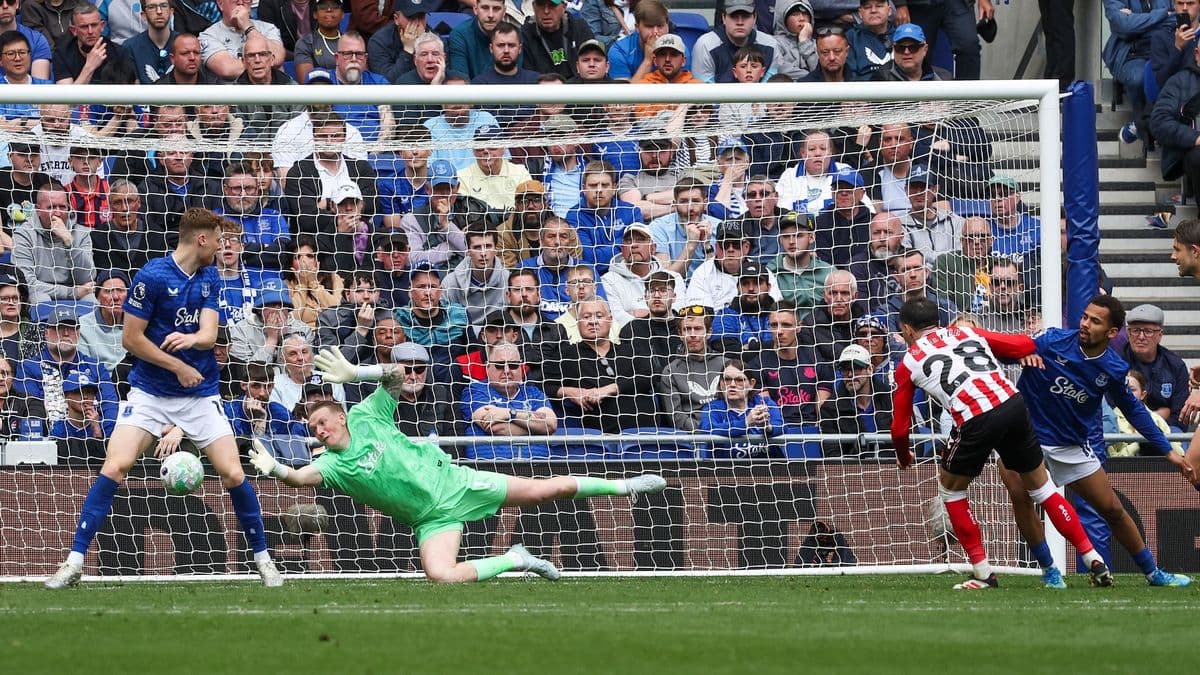
Hill Dickinson Stadium had the feel of a crossroads fixture: Round 37 of the Premier League, a grey Merseyside afternoon, and two clubs whose seasons had converged in the same tactical language – 4-2-3-1 – but with very different emotional trajectories. Following this result, Everton’s 3-1 home defeat to Sunderland crystallised the storylines that had been hinted at in the numbers all year.
Everton came into the game 12th, with 49 points and a goal difference of -2, a profile of balance without conviction. Overall they had scored 47 and conceded 49 across 37 matches, their averages locked at 1.3 goals for and 1.3 against per game. At home, the picture was similarly symmetrical: 26 scored, 27 conceded, both at an average of 1.4. Sunderland, in 9th on 51 points with a goal difference of -7 (40 scored, 47 conceded), were more volatile: sturdier at home but fragile on their travels, where they had allowed 28 goals and scored only 17, an away average of 0.9 for and 1.5 against.
That is what made this result so jarring. Sunderland, an away side that had often laboured to create and protect leads, walked out of Liverpool with three goals and the sense of a tactical plan executed with ruthless clarity.
Both coaches doubled down on 4-2-3-1. Leighton Baines’ Everton used J. Pickford behind a back four of J. O'Brien, J. Tarkowski, M. Keane and V. Mykolenko. In front of them, J. Garner and T. Iroegbunam formed the double pivot, with M. Rohl, K. Dewsbury-Hall and I. Ndiaye supporting lone forward Beto. Regis Le Bris mirrored the structure: R. Roefs in goal, a back line of L. Geertruida, N. Mukiele, O. Alderete and R. Mandava; G. Xhaka and N. Sadiki sitting, with T. Hume, E. Le Fée and N. Angulo behind B. Brobbey.
The tactical voids were clear before a ball was kicked. Everton were without J. Branthwaite, J. Grealish and I. Gueye – three different forms of control stripped from the spine. Branthwaite’s absence removed a front-foot defender; Gueye’s injury deprived them of a natural destroyer; Grealish’s creativity and ball-carrying were missing between the lines. Sunderland, for their part, travelled without D. Ballard (suspended after a red card), S. Moore, R. Mundle and B. Traore. Ballard’s suspension was particularly significant: he had combined aerial dominance with 24 blocked shots this season, and his absence forced Le Bris to trust Mukiele and Alderete as the central pairing.
If the absences suggested fragility, Sunderland instead found structure. Xhaka, who has quietly been one of the league’s most complete midfielders, brought his season-long profile into sharp focus. Across the campaign he has made 1,753 passes with 34 key passes at an 83% accuracy, while winning 155 of 255 duels and blocking 20 shots. Here, he anchored Sunderland’s press and progression, stepping into half-spaces to suffocate Everton’s attempts to build through Garner and Dewsbury-Hall.
Garner himself remains Everton’s paradox. Officially listed as a defender in the season data but operating as a deep midfielder, he has been both their creative hub and their disciplinary risk. Heading into this game he led the league in yellow cards with 12, yet also sat among the top assist providers with 7. His 1,736 completed passes and 52 key passes, at an 87% accuracy, tell of a player constantly at the heart of Everton’s possession. But that same intensity, reflected in 116 tackles and 39 fouls committed, often drags him into the kind of high-contact contests that break rhythm rather than create it. Against Sunderland’s compact mid-block, his passing lanes were crowded, and without Gueye beside him, his defensive load grew heavier and less precise.
Everton’s season-long card profile hinted at the emotional arc of this match. Their yellow cards spike in the 46-60 and 76-90 minute windows, each carrying 20.83% of their cautions, a pattern of second-half frustration and late-game desperation. Sunderland’s own discipline is similarly backloaded, with 23.38% of their yellows arriving between 46-60 minutes and 16.88% between 76-90. This was always likely to be a contest that frayed after the break, and Sunderland were better at weaponising that chaos.
The “Hunter vs Shield” duel lay up front. Sunderland, who on their travels had averaged only 0.9 goals per game and failed to score in 8 away matches, asked B. Brobbey to stretch a back line that had conceded 27 times at home. Everton’s home defence, conceding at an average of 1.4 per game, has been solid but not impermeable; Sunderland’s three-goal haul here was an outlier against their season pattern, but it was built on clear triggers: early balls into the channels behind Mykolenko and O'Brien, and quick combinations around Keane and Tarkowski once the defensive line was forced to turn.
In the “Engine Room” battle, Xhaka and Le Fée outmanoeuvred Garner and Iroegbunam. Le Fée’s season numbers – 6 assists, 5 goals, 49 key passes and 85 tackles – frame him as a hybrid 8/10, and he played exactly that role: dropping alongside Xhaka to help Sunderland evade Everton’s first line, then surging into the pockets between Keane and Mykolenko to connect with Angulo and Hume. His season penalty record, with 3 scored and 1 missed, underscores his willingness to take responsibility in decisive moments; that same mentality shaped his risk-taking in possession here.
Sunderland’s wide structure was also defined by risk and edge. Hume, one of the league’s most-booked players with 9 yellow cards, again walked the tightrope. His 64 tackles and 31 fouls committed this season speak to an aggressive front-foot defender; against Everton he pressed high on Mykolenko and Dewsbury-Hall, compressing the left flank and forcing Everton to circulate slowly across their back line, where Sunderland’s press could reset.
From a statistical prognosis, the result bends the season-long xG narratives without breaking them. Everton’s overall averages of 1.3 for and 1.3 against suggest a side that lives on fine margins; their 11 clean sheets are balanced by 9 matches without scoring. Sunderland, with 1.1 goals for and 1.3 against overall, plus 11 clean sheets and 13 games failing to score, are similarly knife-edge. A 3-1 away win is an outlier against Sunderland’s usual away output, but not against the structural weaknesses Everton carried into this match: missing their best defensive organiser, their most natural ball-winner, and a primary creator.
Following this result, the league table tightens around them. Sunderland, already above Everton, reinforce their status as the more upwardly mobile project, their flexible use of 4-2-3-1 validated by a performance that married discipline with incision. Everton, rooted in their near-constant 4-2-3-1 (36 of 37 league games), are left with a question: is structural stability enough when the individuals that give it bite – Branthwaite, Gueye, Grealish – are missing?
On this evidence, the answer was written across the scoreboard. Sunderland bent their season-long numbers upwards; Everton’s remained stubbornly, painfully on script.