.svg&w=384&q=75 "GoalGist logo")
Manchester United Dominates Brighton with Tactical Mastery
Manchester United’s 3-0 win at Amex Stadium was built on a ruthlessly efficient 4-2-3-1 that outperformed its underlying numbers and exposed structural issues in Brighton’s own 4-2-3-1. Despite Brighton edging possession 51–49 and generating 13 total shots to United’s 11, the visitors controlled the key zones, defended the box with far greater discipline, and transitioned with clarity around a highly influential attacking midfield triangle.
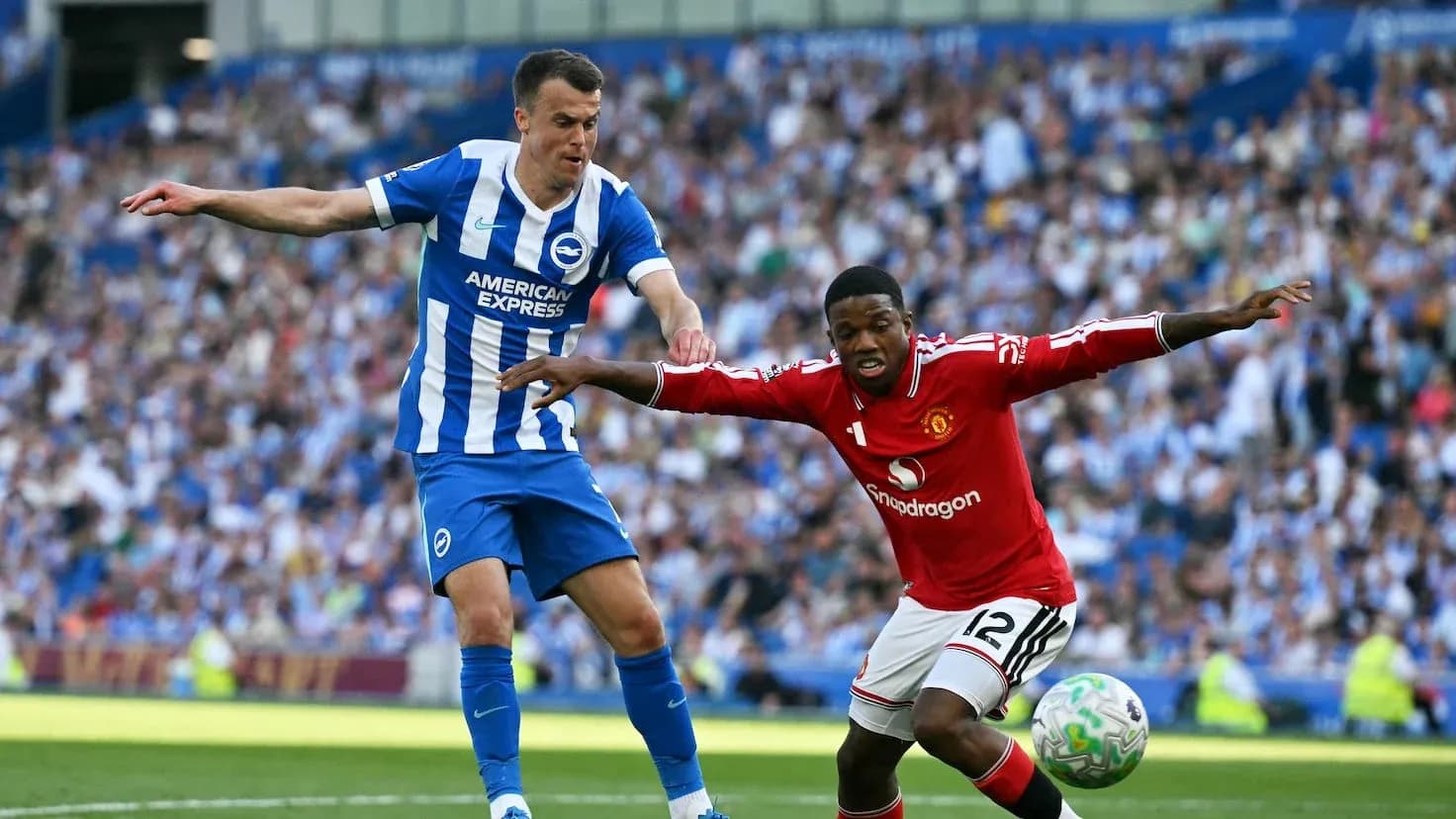
Out of possession, Brighton’s structure was recognisable but fragile. With P. Gross and J. Milner as the double pivot ahead of a back four, Brighton tried to press United’s first line by pushing J. Hinshelwood and D. Gomez high to lock onto United’s full-backs and wide midfielders, leaving D. Welbeck to screen the centre-backs. The problem was the spacing between lines: when the front four jumped, Gross and Milner were often left covering large horizontal spaces against M. Mount and Kobbie Mainoo, while the back four sat slightly deeper to protect the channels. United repeatedly exploited this with simple vertical connections from the double pivot into B. Fernandes between the lines.
Opening Goal
The opening goal on 33 minutes encapsulated that pattern. United’s 4-2-3-1 morphed into a 2-3-5 in possession, with N. Mazraoui and L. Shaw stepping high and Mount–Mainoo forming a stabilising platform behind Fernandes, A. Diallo and P. Dorgu. As Brighton’s wide midfielders jumped to the full-backs, Fernandes received in the half-space without pressure and combined with Dorgu, whose advanced positioning on the left pinned M. Wieffer and J. P. van Hecke. The final action – P. Dorgu finishing from a B. Fernandes assist – was the product of that repeated overload on Brighton’s right, where the full-back and near-side pivot were constantly asked to defend two or three options.
Second Goal
United’s second goal just before the break, B. Mbeumo on 44 minutes from an A. Diallo assist, came from another transition sequence that highlighted the asymmetry between the sides. Brighton’s 0 corner kicks and single offside underline how rarely they managed to pin United deep or break beyond the last line. By contrast, United’s front four were constantly positioned to spring forward once possession was regained. Diallo’s starting position wide right stretched F. Kadioglu and Lewis Dunk, and when Brighton’s midfield lost their rest-defence shape, United could find Mbeumo attacking the spaces behind the full-backs. The 2-0 half-time scoreline reflected United’s superior box occupation more than sheer volume of chances.
Third Goal
The third goal, B. Fernandes on 48 minutes from a P. Dorgu assist and then confirmed by VAR at 50 minutes, effectively ended the contest and showcased United’s confidence in circulating through the left side. With Brighton already chasing the game, their back four had to push higher, but the double pivot could not compress space quickly enough. Dorgu’s advanced role as a nominal left midfielder but de facto wide playmaker allowed United to create a numerical superiority against Wieffer and van Hecke, and Fernandes arrived from the second line to finish. The VAR confirmation did not change the tactical story: Brighton’s rest defence was once again exposed by late runners and poor protection of zone 14.
Defensive Compactness
From a defensive standpoint, United’s 4-2-3-1 was notably more compact. Mainoo’s yellow card in first-half added time (45+3' Kobbie Mainoo (Manchester United) — Foul) was a direct by-product of his aggressive role in screening central lanes; he and Mount consistently dropped to form a narrow box with Maguire and L. Martinez, forcing Brighton to circulate wide. Brighton’s 9 shots inside the box suggest they did find entries, but many were under pressure or from crowded situations, reflected in their 5 blocked shots. United were happy to concede low-quality territory, relying on that compactness and the penalty-box defending of their centre-backs.
In goal, B. Verbruggen (Brighton) made 5 saves and, with goals prevented at 0.32, actually kept the scoreline from becoming heavier. His shot-stopping underlined how clean United’s looks at goal often were: when Brighton’s block was broken, chances tended to be central and clear. At the other end, S. Lammens (Manchester United) needed only 2 saves, a testament to how well United protected their six-yard box and how rarely Brighton converted possession into truly dangerous, on-target efforts.
Substitution Patterns
The substitution pattern told its own tactical story. Brighton’s early second-half change at 46 minutes – Y. Minteh (IN) came on for M. De Cuyper (OUT) – was an attempt to inject directness on the flank and threaten United’s full-backs in behind. The triple change on 59 minutes – S. March (IN) came on for D. Gomez (OUT), C. Baleba (IN) came on for J. Milner (OUT), and C. Kostoulas (IN) came on for D. Welbeck (OUT) – was a wholesale reshaping of the attacking structure, with fresh legs and more vertical profiles introduced. Yet United’s block, already 3-0 up, could now sit even deeper and compress the central spaces that Brighton were trying to attack through.
Michael Carrick’s side managed their own energy and structure with a controlled set of changes. At 62 minutes S. Lacey (IN) came on for P. Dorgu (OUT), allowing United to maintain width while resting one of their key creators. The 74-minute triple switch – J. Zirkzee (IN) came on for B. Mbeumo (OUT), L. Yoro (IN) came on for N. Mazraoui (OUT), and T. Fletcher (IN) came on for M. Mount (OUT) – rebalanced the team, adding fresh legs up front, reinforcing the right side of defence, and preserving the integrity of the double pivot. Finally, T. Malacia (IN) came on for L. Shaw (OUT) at 82 minutes to lock down the left flank and see out the game without sacrificing the back-four structure.
Statistical Overview
Statistically, the match underlined United’s efficiency. Brighton’s xG of 0.81 against United’s 1.82 aligns closely with the 0-3 scoreline: United created fewer shots but better chances, while Brighton’s possession and passing superiority – 463 passes, 397 accurate (86%) versus United’s 447 passes, 369 accurate (83%) – did not translate into high-quality opportunities. Brighton’s 11 fouls to United’s 8 and the card count (Brighton 0, Manchester United 1, Total 1) show that United could defend aggressively in key moments without losing control of discipline.
Ultimately, this was a tactical contest decided in the spaces between Brighton’s midfield and defence. United’s 4-2-3-1, with its clear roles for the double pivot and attacking midfield line, consistently exploited those gaps, while Brighton’s mirrored shape lacked the compactness, counter-pressing intensity, and penalty-box protection to turn territorial control into a competitive scoreline.