.svg&w=384&q=75 "GoalGist logo")
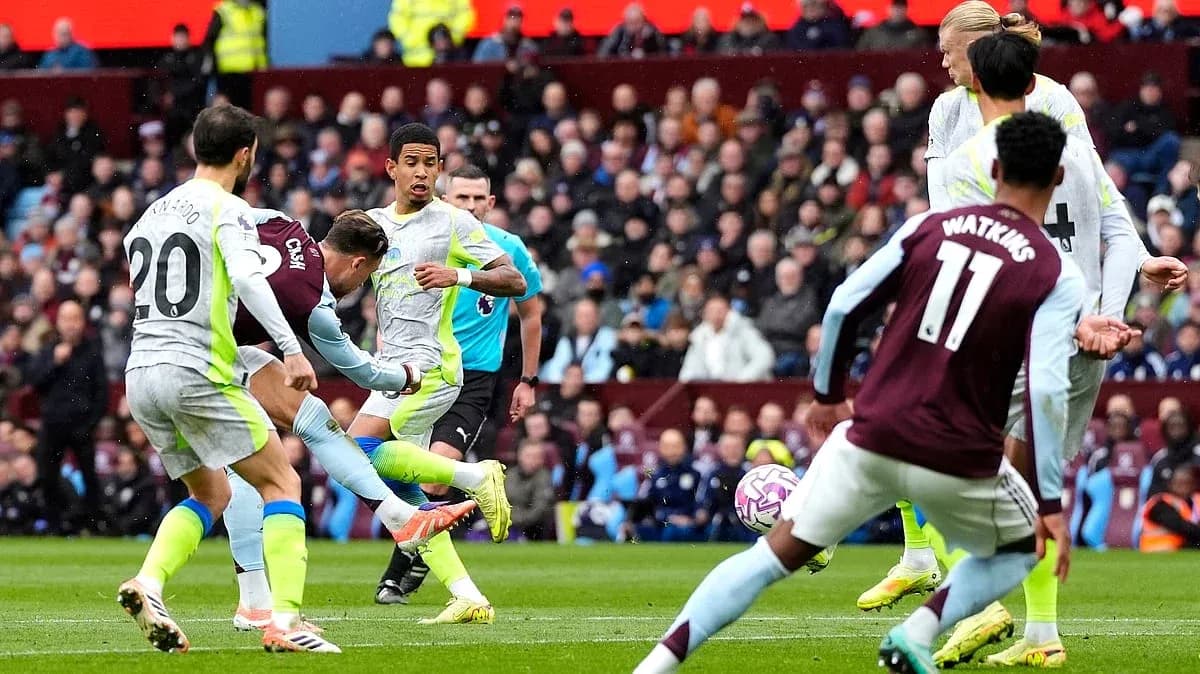
Manchester City vs Aston Villa: A Premier League Showdown
Etihad Stadium’s final act of the 2025–26 Premier League season ended in a twist: Manchester City, chasing perfection at home, fell 2–1 to Aston Villa despite leading at half-time. Following this result, City close the campaign in 2nd on 78 points, their overall goal difference of 42 built on 77 goals for and 35 against. Villa, hardened by a season of controlled chaos, finish 4th with 65 points and an overall goal difference of 7, their 56 goals for offset by 49 conceded.
I. The Big Picture – Two Identities Colliding
Across the season, City at home have been a machine: 14 wins from 19, with 45 goals scored and only 14 conceded. An average of 2.4 goals at home against 0.7 conceded underpins their dominance at the Etihad. Aston Villa, by contrast, have lived on a knife-edge on their travels: 7 away wins, 6 draws, 6 defeats, scoring 24 and conceding 27. Their away profile – 1.3 goals scored and 1.4 conceded per game – suggests openness, risk and a willingness to trade punches.
Yet here, in the final round, it was Villa who imposed their narrative. Unai Emery’s 4-2-3-1, a structure he has leaned on in 34 league matches, arrived in Manchester with clear intent: survive City’s early waves, then drag the contest into the transitional chaos where Ollie Watkins and Leon Bailey thrive.
Pep Guardiola, intriguingly, went away from his most-used shapes. While City’s season has been built primarily on a 4-1-4-1 and 4-3-2-1, he set them up in a 4-2-2-2. It was a final-day experiment that tilted the balance of control.
II. Tactical Voids – Absences and Discipline
The most significant void belonged to Villa: no Emiliano Martinez, no Boubacar Kamara, and no Alysson, all listed as Missing Fixture. Martinez’s finger injury forced M. Bizot into goal, altering Villa’s build-up and penalty-box authority. Kamara’s knee injury removed a natural shield in front of the back four, leaving Douglas Luiz and L. Bogarde to manage City’s central overloads.
Emery compensated by tightening his double pivot and relying on structural discipline. Villa’s season-long card profile shows a clear pattern: 29.31% of their yellow cards arrive between 46–60 minutes, with another 17.24% in the 61–75 window. This is a team that often lives on the edge right after half-time, when intensity spikes and defensive distances stretch. Here, that period became a tactical hinge, not a collapse.
City’s own disciplinary rhythm over the season is different. Their yellows surge late: 20.90% between 76–90 minutes and 19.40% between 46–60. It reflects a side that often chases games to the final whistle, pressing high and taking tactical fouls when transitions threaten. Bernardo Silva, with 10 yellow cards in the league, embodies that edge – a playmaker who doubles as City’s first defender.
III. Key Matchups – Hunter vs Shield, Engine Room vs Enforcer
The headline duel was always going to be the “Hunter vs Shield” confrontation: Erling Haaland’s season against Villa’s defensive record. Haaland’s campaign – 27 goals and 8 assists in 35 league appearances, from 102 shots and 59 on target – is the statistical embodiment of inevitability. In total this campaign, City have averaged 2.0 goals per game overall, and Haaland is the sharpest edge of that number.
Villa’s overall defensive record – 49 goals conceded in 38 matches, 1.3 per game – suggests vulnerability. On their travels, they concede 1.4 goals per match. Yet Emery’s back four at the Etihad, with V. Lindelof and T. Mings centrally and I. Maatsen and A. Garcia wide, found ways to compress the box and deny Haaland the high-value touches he usually thrives on. The absence of Martinez might have been a psychological blow, but structurally Villa’s shield held when it mattered.
The “Engine Room” duel was layered. For City, the creative axis ran through B. Silva, Nico and the advanced pair of A. Semenyo and Savinho, with P. Foden stepping inside from the front line. Bernardo’s season numbers – 2 goals, 4 assists, 2196 passes at 90% accuracy, 53 tackles and 6 blocked shots – speak to a hybrid role: tempo-setter and defensive metronome. He is both scalpel and safety net.
Villa’s counterweight came from Douglas Luiz and Bogarde in the pivot, but also from the more advanced trio of Bailey, R. Barkley and E. Buendia behind Watkins. This is where Aston Villa’s season-long creativity lives, even if the pure assist numbers are led by players like M. Rogers and L. Digne who did not start here. Bailey’s pace stretched City’s high line, Barkley offered vertical carries, and Buendia operated in the half-spaces, constantly testing the communication between R. Dias, J. Stones and the full-backs R. Lewis and N. Ake.
Up front, Watkins arrived as Villa’s proven Premier League hunter: 16 league goals and 3 assists from 37 appearances, with 60 shots and 38 on target. His duel with Dias and Stones was less about volume of touches and more about timing. Every long ball, every counter, turned into a race where one misjudged step could flip the match.
IV. Statistical Prognosis and Tactical Verdict
Across the season, the numbers point to City as the side more likely to control xG: 77 goals from a team averaging 2.0 goals overall and conceding only 0.9 per game. At home, their defensive record – just 14 goals conceded in 19 – is elite. Villa’s profile, with 56 scored and 49 conceded, is that of a high-variance side whose xG both for and against tend to be inflated by open games and transitions.
Yet this match underlined the limits of pure probability. City’s penalty record – 3 scored from 3 in total this campaign, with no misses in league play – shows a side usually ruthless from the spot, but they never forced that scenario here. Haaland’s season includes 1 missed penalty, a reminder that even their spearhead is not flawless.
From a tactical lens, Villa’s win can be read as a triumph of structure and timing over volume. Emery’s 4-2-3-1, drilled all season, met a City side experimenting with a 4-2-2-2 that occasionally left their double pivot exposed to counters. Where City’s late-game yellow-card surge often accompanies desperate pressure, here it signalled frustration as Villa managed the final phases with composure.
If we map tendencies to an xG-based prognosis, City would typically be projected to generate the higher quality chances, especially at the Etihad. Their clean sheet count – 16 overall, 9 at home – and just 4 matches in total where they failed to score underline a baseline of control. Villa, with only 9 clean sheets and 10 matches where they failed to score, usually live closer to the margins.
But football’s tactical truth lives in matchups, not just aggregates. Villa’s defensive line, compact and well-screened, blunted City’s central threat and forced more low-percentage crosses and shots. Watkins and Bailey turned rare transitions into decisive moments, tilting both the scoreboard and the xG ledger enough to justify a 2–1 away triumph.
Following this result, the season closes with City statistically superior over 38 games, but Villa carrying the psychological edge of a statement win at the Etihad. The data still marks City as the more sustainable xG machine; the night, however, belonged to Emery’s pragmatists, who bent the probabilities just far enough to escape Manchester with all three points.