.svg&w=384&q=75 "GoalGist logo")
Liverpool vs Brentford: Tactical Analysis of the 2025–26 Premier League Draw
On the final afternoon of the 2025–26 Premier League season, Anfield staged a contest that neatly encapsulated the campaigns of both sides. Liverpool, under Arne Slot, came in as a high‑variance, attacking heavyweight: 5th in the table with 60 points, a goal difference of +10 built from 63 goals scored and 53 conceded in total. Brentford, guided by Keith Andrews, arrived as one of the division’s most awkward opponents, finishing 9th with 53 points and a total goal difference of +3, their 55 goals for and 52 against reflecting a side that rarely dies wondering.
Heading into this game, Liverpool’s seasonal DNA at home was clear. Across 19 league matches at Anfield they scored 34 times, averaging 1.8 goals at home while conceding 20 at an average of 1.1. The 4‑2‑3‑1 that Slot leaned on in 34 league fixtures was again his weapon of choice, with Alisson behind a back four of C. Jones, Ibrahima Konaté, Virgil van Dijk and Andrew Robertson. Ahead of them, Alexis Mac Allister and Ryan Gravenberch formed the double pivot, with a high‑creativity band of three — Mohamed Salah, Dominik Szoboszlai and the young R. Ngumoha — supporting Cody Gakpo as the nominal centre‑forward.
Brentford mirrored the 4‑2‑3‑1 structure. Caoimhín Kelleher, back at Anfield in different colours, marshalled a defence of M. Kayode, Sepp van den Berg, Nathan Collins and K. Lewis‑Potter. In front, the industrious pairing of J. Henderson and Vitaly Janelt anchored a line of D. Ouattara, M. Jensen and Kevin Schade, all servicing the league’s breakout No. 9: Igor Thiago. Across 38 appearances Thiago had produced 22 goals and 1 assist, the purest cutting edge in a side that averaged 1.2 away goals and conceded 1.6 on their travels.
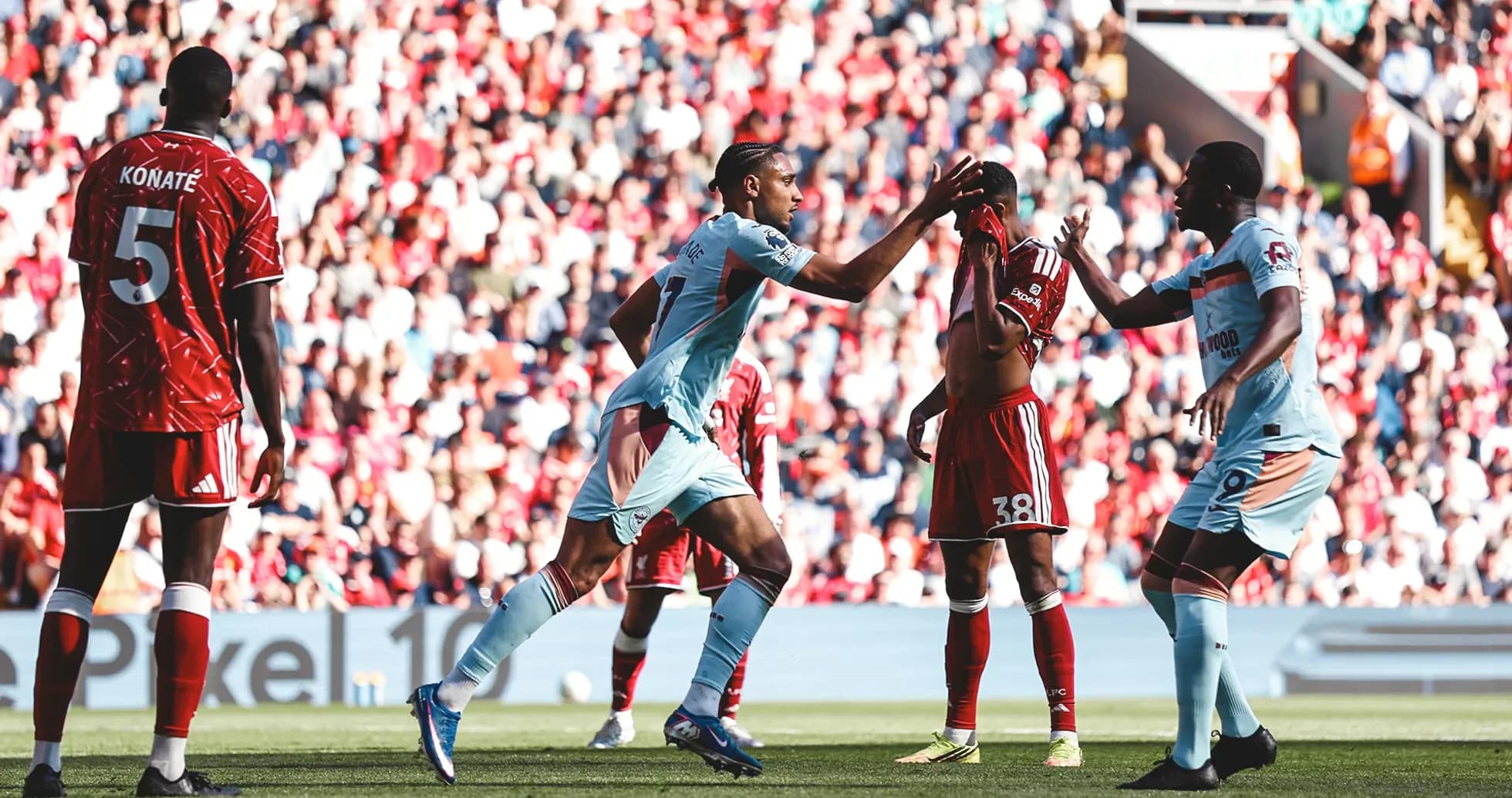
The match finished 1–1, a scoreline that felt like a negotiated truce between Liverpool’s home aggression and Brentford’s stubborn resilience.
Tactical Voids and Selection Choices
Both managers had to navigate important absences. Liverpool were without S. Bajcetic (hamstring), C. Bradley (knee), H. Ekitike (Achilles) and G. Leoni (knee). The loss of Ekitike, who had contributed 11 total league goals and 4 assists, removed a vertical, penalty‑box presence from Slot’s bench and made Gakpo’s role as central reference point non‑negotiable. It also heightened the importance of Salah and Szoboszlai as dual creators and scorers: Salah’s 7 total goals and 7 assists, and Szoboszlai’s 6 goals and 7 assists, framed them as the two primary conduits of chance creation.
Brentford’s injury list trimmed their rotation more than their starting XI. Fábio Carvalho (knee), R. Henry (hamstring) and A. Milambo (knee) were all missing, depriving Andrews of a natural left‑back option in Henry and an extra creative link in Carvalho. That context made the selection of K. Lewis‑Potter at left‑back more than a curiosity; it was a necessity that also hinted at Brentford’s willingness to attack in transition down that flank.
Disciplinary trends added another layer. Over the season, Liverpool’s yellow cards clustered late: 31.58% of their bookings came between 76–90 minutes, part of a broader pattern of emotional, high‑tempo finishes. Brentford were similar, with 26.09% of their yellow cards in that same 76–90 window and 21.74% between 61–75. Both sides, then, were conditioned to play on the edge as matches stretched, and this draw was always likely to carry a tense, card‑flecked finale even if the specific bookings are not detailed in the data.
Key Matchups
Hunter vs Shield
The headline duel was always going to be Igor Thiago against Virgil van Dijk and Konaté. Thiago’s 22 total league goals came from a profile that mixed physical dominance with penalty‑box economy: 67 shots, 43 on target, and 8 penalties scored with 1 missed. That single miss underlined that while Brentford were perfect from the spot this season at team level (8 penalties scored, 0 missed in total), Thiago himself had flirted with fallibility from 12 yards.
Liverpool’s central defence, by contrast, anchored a home record of just 20 goals conceded at Anfield, an average of 1.1. Van Dijk’s aerial authority and Konaté’s recovery pace were tasked with containing a striker who had engaged in 524 total duels, winning 202, and who thrives when games become stretched. The 1–1 final score suggests Liverpool kept Thiago from running riot, but not entirely quiet.
Engine Room
In midfield, the game’s rhythm turned on two intersecting triangles. For Liverpool, Mac Allister and Gravenberch were the base, with Szoboszlai stepping forward as the advanced organiser. Szoboszlai’s season numbers — 2,184 passes, 78 key passes, 55 tackles and 8 blocked shots — paint the picture of a true two‑way midfielder. His single red card and 8 yellows also mark him as someone who rides the disciplinary line to maintain Liverpool’s press.
Opposite him, Janelt and Henderson formed Brentford’s shield, with Jensen as the connector. Henderson’s presence at Anfield in Brentford colours carried its own narrative weight, but tactically his role was clear: manage transitions, protect the back four, and help Brentford play through Liverpool’s first press. Jensen, whose creative profile sits between a No. 8 and a No. 10, was tasked with linking to Schade and Ouattara in the half‑spaces.
Out wide, Salah against Lewis‑Potter was a structural fault line. Salah’s 49 key passes and 72 dribble attempts made him Liverpool’s most persistent wide threat, while Lewis‑Potter, a natural winger repurposed as a defender, had to balance overlapping ambition with the risk of leaving space for Salah and Szoboszlai to exploit. On the opposite flank, Schade’s duel with Robertson carried its own edge; Schade’s 8 total goals, 3 assists, 75 dribble attempts and 6 yellow cards plus 1 red tell of a winger who attacks relentlessly and defends combatively, sometimes excessively. His penalty record — 2 won but 1 missed — also underlined that Brentford’s danger in the box comes with moments of waste.
Statistical Prognosis and Narrative Verdict
Across the season, Liverpool’s attack at home (1.8 goals on average) and Brentford’s away output (1.2) converged almost exactly on the 1–1 that unfolded. Defensively, both sides lived in similar statistical neighbourhoods: Liverpool conceded 1.1 at home, Brentford 1.6 away. A marginal xG edge for Liverpool would be a reasonable inference, given their territorial tilt at Anfield and the creative weight of Salah, Szoboszlai and Gakpo, but Brentford’s efficiency through Thiago has been a season‑long equaliser.
Following this result, the draw felt like a fair reflection of two projects at slightly different stages of their evolution. Liverpool, with a 17‑9‑12 overall record and a goal difference of +10, remain a side whose attacking ceiling is Champions League level but whose defensive volatility (53 goals conceded in total) keeps them from a title challenge. Brentford, with 14 wins, 11 draws and 13 defeats and a +3 goal difference, have grown into a top‑half constant, capable of travelling to Anfield and matching fire with fire.
The tactical story of this match — mirrored formations, a duel between an elite No. 9 and an elite centre‑back pairing, and a midfield battle between Szoboszlai’s creative engine and Brentford’s double pivot — ends not with a knockout blow but with mutual acknowledgement. One point each, a 1–1 that fits the numbers, and a final‑day snapshot of two sides who know exactly who they are.