.svg&w=384&q=75 "GoalGist logo")
Liverpool vs Brentford: Tactical Analysis of 1-1 Draw
Liverpool’s 1-1 draw with Brentford at Anfield unfolded as a territorial siege against a compact, counter-punching visitor, with the underlying numbers underlining just how tilted the game state was. Arne Slot’s side dominated possession (60% to 40%), volume (24 total shots to 11) and territory (14 corners to 2), but Keith Andrews’ Brentford executed a low-risk, structurally disciplined 4-2-3-1 that converted limited attacking moments into an efficient equaliser and then protected the point through late-game disruption.
Both teams lined up in mirrored 4-2-3-1 structures, but with very different intentions. Liverpool’s back four of C. Jones, I. Konate, V. van Dijk and A. Robertson pushed high, with A. Mac Allister and R. Gravenberch forming a double pivot to recycle and re-press. The attacking band of R. Ngumoha, D. Szoboszlai and M. Salah operated close to C. Gakpo, effectively turning the shape into a 2-3-5 in settled possession. That structure explains Liverpool’s shot profile: 17 efforts inside the box and 8 blocked shots, evidence of sustained occupation of Brentford’s area and repeated attempts to work shooting lanes through congestion.
Brentford’s 4-2-3-1 was far more conservative. Full-backs M. Kayode and K. Lewis-Potter (before his late withdrawal) rarely overlapped simultaneously, while the double pivot of J. Henderson and V. Janelt sat narrow to deny central access. The three behind I. Thiago – D. Ouattara, M. Jensen and K. Schade – were tasked with shuttling laterally to protect half-spaces first and counter second. The visitors’ 11 shots, 9 of them inside the box, point to a plan built around selective, high-value breaks rather than volume.
Scoring Pattern
The scoring pattern reflects those contrasting approaches. Liverpool’s opener on 58 minutes came from the left-back inversion that defined their build-up. C. Jones, nominally starting as a defender, stepped inside to exploit Brentford’s zonal focus on the more traditional playmakers. His goal, assisted by M. Salah, showcased Liverpool’s capacity to create from unconventional sources: Salah drawing the block towards the right half-space, then releasing the under-loaded far side where Jones arrived untracked.
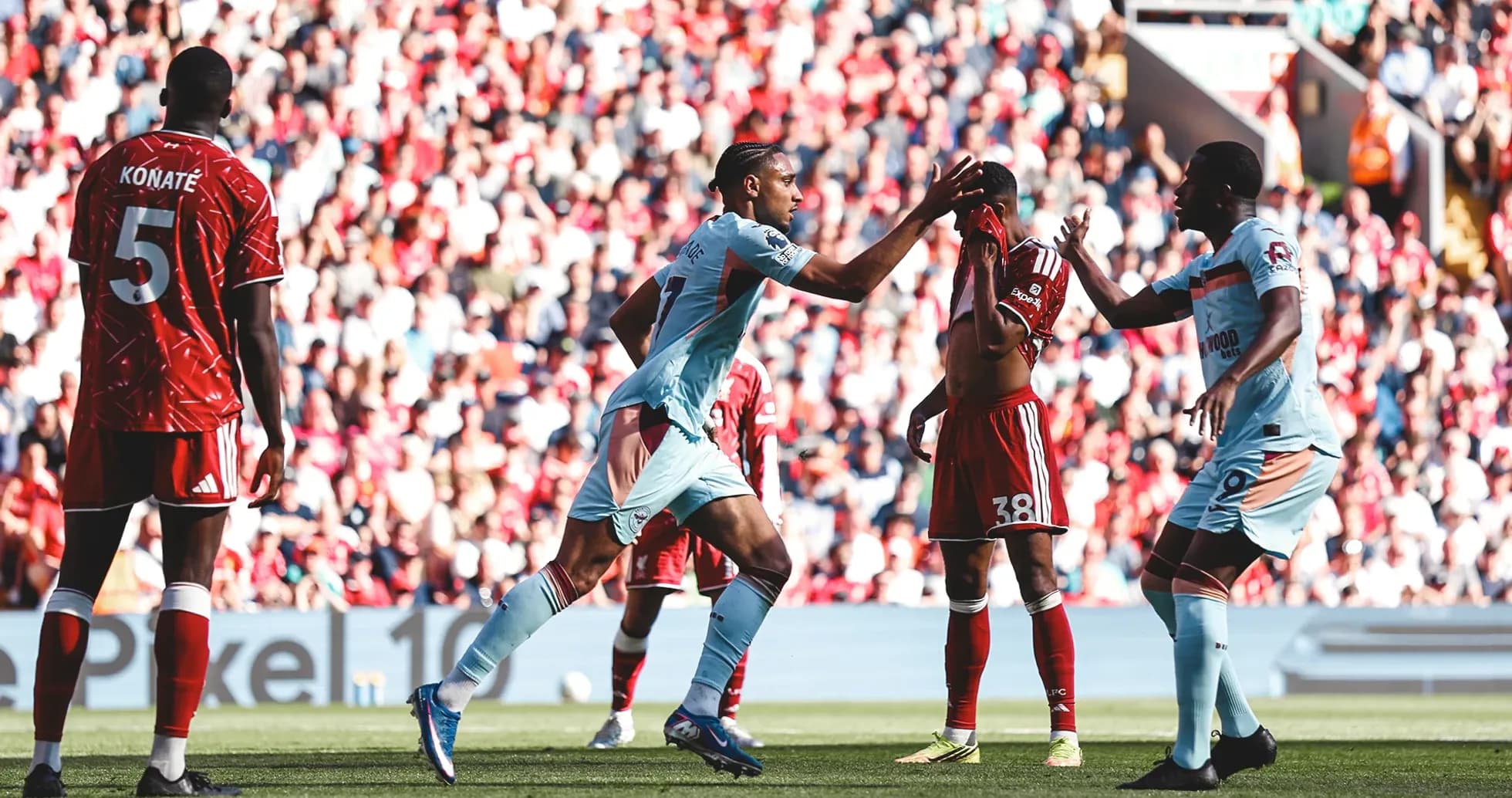
Brentford’s equaliser at 64 minutes, finished by K. Schade, was the logical product of their counter-attacking blueprint. With Liverpool’s full-backs advanced and the double pivot committed to sustaining pressure, Brentford targeted the spaces behind the press. Schade’s goal, unassisted in the data but clearly emerging from that transitional posture, underscored Liverpool’s structural trade-off: total control of territory in exchange for exposure to a small number of high-quality counters, reflected in Brentford’s xG of 1.22 from just 11 attempts.
Goalkeeping and Defensive Performance
In goal, Alisson (Liverpool) was largely a spectator in terms of volume, officially required for only 1 save, but his goals prevented figure of 1.4 indicates the quality of the chances he faced when Brentford did break through. That metric suggests decisive interventions in situations that carried significant threat, even if the raw shot-on-goal count (2 for Brentford) was modest. At the other end, C. Kelleher (Brentford) made 7 saves, directly underpinning the visitors’ resistance as Liverpool racked up 8 shots on target and an xG of 2.9. His own goals prevented metric of 1.4 confirms that this was not merely routine handling; Brentford’s point owed much to his shot-stopping under sustained pressure.
Midfield Dynamics
In midfield, Liverpool’s passing structure was the platform for their dominance. They completed 434 accurate passes from 503 total, an 86% success rate that reflects both technical security and a stable positional framework. The double pivot allowed repeated recycling around Brentford’s low block, with D. Szoboszlai and Salah rotating inside to overload central lanes. Brentford, by contrast, completed 262 of 331 passes (79%), a solid figure given their more direct and transitional intent. Their lower volume and slightly reduced accuracy align with a strategy of playing quicker, riskier passes into forward zones rather than mirroring Liverpool’s patient circulation.
Substitutions
Substitutions from Slot were clearly aimed at refreshing the attacking mechanisms rather than altering the core structure. F. Wirtz (IN) came on for R. Ngumoha (OUT) at 73', adding a more intricate playmaking profile between the lines. One minute later, J. Frimpong (IN) came on for M. Salah (OUT), introducing vertical running and width on the right to stretch a tiring Brentford back line. At 83', M. Kerkez (IN) for A. Robertson (OUT) and T. Nyoni (IN) for R. Gravenberch (OUT) maintained the 4-2-3-1 template but injected energy into the left flank and midfield press. J. Gomez (IN) for I. Konate (OUT) at 89' was a late defensive refresh, likely to guard against counters rather than to chase structural change.
Andrews’ substitutions were more about maintaining defensive integrity and fresh legs in key zones. A. Hickey (IN) came on for J. Henderson (OUT) at 60', nudging the balance slightly towards defensive security in wide areas and allowing some reshuffling in the back line. M. Damsgaard (IN) for M. Jensen (OUT) at 83' provided fresher running and an outlet in transitions, while R. Nelson (IN) for K. Lewis-Potter (OUT) at 89' ensured Brentford retained counter-threat on the flank even as they sank deeper to protect the draw.
Discipline and Tactical Tension
Discipline also tracked the tactical tension. Before kick-off time in the data sequence, Jordan Henderson (Brentford) collected a yellow card for “Argument”, signalling early emotional investment in protecting Brentford’s structure. As Liverpool pushed harder late on, Ibrahima Konaté (Liverpool) was booked on 79' for “Foul”, a by-product of aggressive counter-pressing against Brentford’s breaks. In added time, Alexis Mac Allister (Liverpool) received a yellow at 90+2' for “Foul”, while Brentford’s back line and midfield enforcers joined Henderson on the sheet: Nathan Collins at 90+5' for “Argument” and Vitaly Janelt at 90+4' also for “Argument”. The pattern of late cards underlined Brentford’s willingness to disrupt rhythm and contest decisions as Liverpool chased a winner.
Statistical Summary
Statistically, the verdict is clear: Liverpool created enough to win. Their 24 shots, 17 inside the area, and xG of 2.9 against Brentford’s 1.22 point to a home side that generated both volume and quality. The 14-2 corner advantage illustrates the territorial siege, while parity in fouls (9-9) shows that Liverpool’s aggression was channelled more into pressing and ball recovery than into reckless challenges.
Yet the combination of Brentford’s compact 4-2-3-1, Kelleher’s 7 saves and a disciplined, if increasingly argumentative, defensive unit meant that control did not translate into three points. From a tactical lens, this was a textbook example of how a low-possession side can leverage structure, selective transitions and elite goalkeeping to neutralise a superior xG profile and escape Anfield with a draw.