.svg&w=384&q=75 "GoalGist logo")
Chelsea Defeats Tottenham 2-1: Tactical Breakdown
Chelsea’s 2-1 win over Tottenham at Stamford Bridge was a classic case of the side with less control using structure and transition efficiency to beat a more dominant but blunt possession team. Both lined up in a 4-2-3-1, yet the way those shapes behaved without the ball defined the contest: Chelsea compressed space and protected the central lane, while Tottenham’s higher, more aggressive block left them repeatedly exposed to direct, vertical attacks.
Out of possession, Chelsea’s 4-2-3-1 was compact and conservative. With only 44% possession and 425 passes (355 accurate, 84%), they clearly accepted a lesser share of the ball, prioritising a narrow defensive box in front of the centre-backs. Andrey Santos and Moises Caicedo sat tight in front of Wesley Fofana and Jorrel Hato, often forming a 4-4-2 mid-block as Cole Palmer stepped up alongside Liam Delap to screen Tottenham’s first line. The aim was to deny central progression into Richarlison’s feet and into the pockets occupied by Randal Kolo Muani, Mathys Tel and Conor Gallagher.
This central denial worked: Tottenham completed 538 passes (473 accurate, 88%) and had 56% of the ball, but their shot profile betrays how Chelsea forced them to play. Spurs produced 9 total shots, with a striking 8 coming inside the box and only 1 from range, yet they managed just 3 shots on goal. Chelsea’s back four – James Acheampong, Fofana, Hato and Marc Cucurella – collapsed aggressively around the penalty area, allowing entries but then blocking angles and forcing rushed finishes. Chelsea’s 2 blocked shots to Tottenham’s 1 underline how often the hosts got bodies in front of goal-bound efforts.
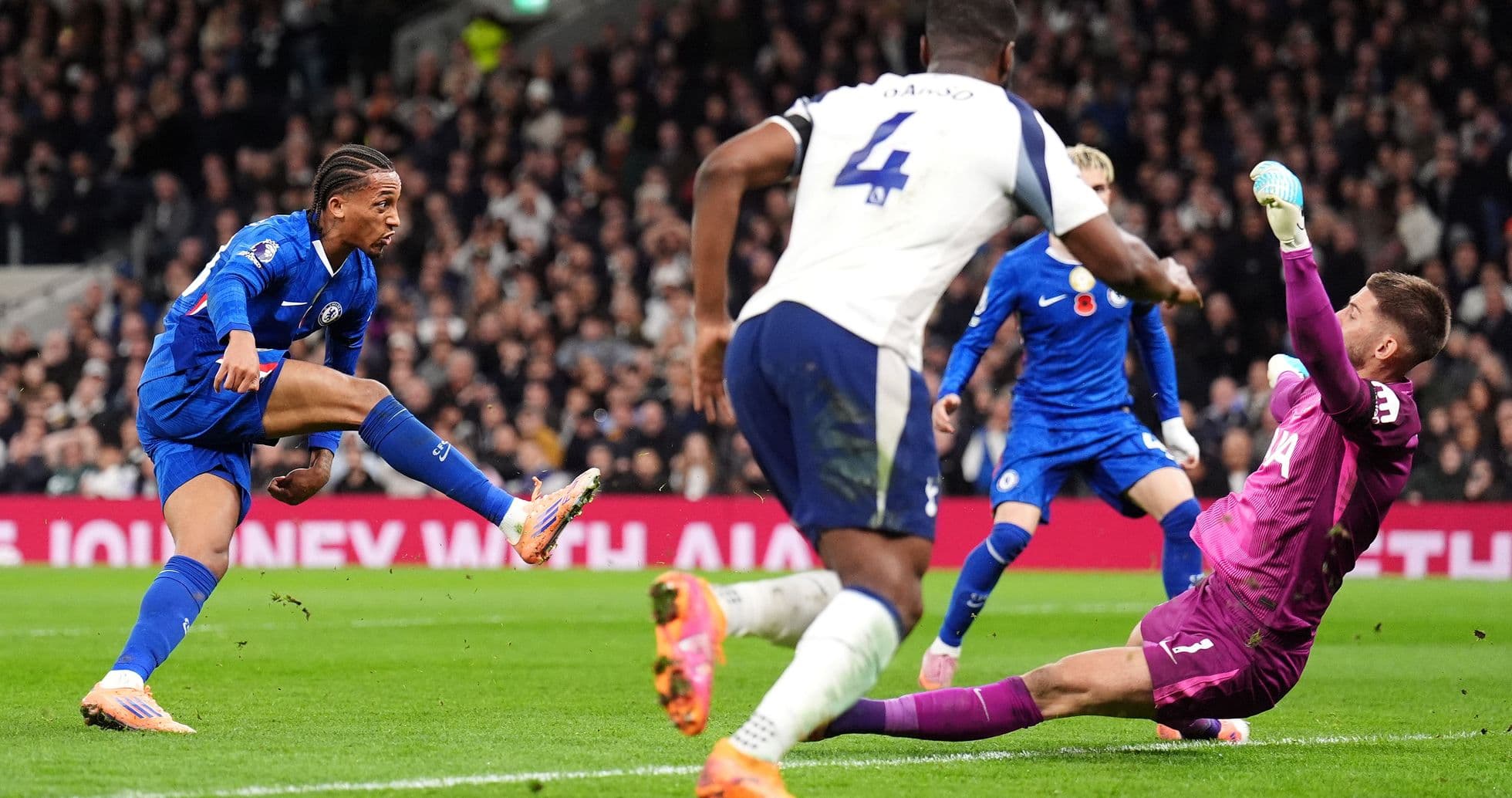
Chelsea’s own attacking plan was far more direct and vertical. Their 9 total shots produced 4 on goal from a relatively modest xG of 0.63, but the key was the speed and clarity of their forward movements. The opening goal on 18 minutes encapsulated the approach: Enzo Fernandez, starting nominally as an advanced midfielder ahead of the double pivot, broke from a central pocket to finish after a supply line involving Pedro Neto. Neto’s role on the right was crucial; he offered immediate outlet runs behind Destiny Udogie and into the half-space, turning Tottenham’s high line and forcing them to defend facing their own goal.
The second Chelsea goal on 67 minutes, scored by Andrey Santos and assisted by Fernandez, highlighted how their midfield staggering hurt Tottenham’s double pivot. With Rodrigo Bentancur and Joao Palhinha often dragged sideways to deal with wide rotations, space opened at the top of the box. Fernandez exploited that by receiving between the lines and then feeding Santos’ forward run. Tottenham’s centre-backs, Kevin Danso and Micky van de Ven, were pinned by Delap and the wide threats, leaving no spare defender to step out to Santos.
Tottenham’s attacking structure, by contrast, had volume but lacked incision relative to their xG of 1.72. They built patiently through Palhinha as the primary distributor and Bentancur as the connector, with full-backs Pedro Porro and Udogie pushing high. However, Chelsea’s narrow block forced Spurs into crowded central zones. Richarlison’s 74th-minute goal, assisted by Pape Matar Sarr after a triple substitution on 69 minutes, came when Tottenham finally managed to add an extra runner from midfield to overload the last line. The introduction of James Maddison and Sarr gave Spurs more vertical passing and late penalty-box arrivals, briefly destabilising Chelsea’s structure.
Even then, Chelsea managed the game largely on their terms through disciplined, sometimes cynical game management. They committed 11 fouls to Tottenham’s 18, but the card profile is revealing: Spurs picked up three yellows for “Foul” (Pedro Porro 28', Micky van de Ven 43', Destiny Udogie 63'), a product of being repeatedly exposed in transition and forced into recovery tackles. Chelsea’s four yellows were more about control and tempo than being outplayed: Jorrel Hato for “Time wasting” at 79', Marc Cucurella for “Argument” at 85', Liam Delap for “Foul” at 87', and Dário Essugo for “Foul” at 90+2'. The late bookings, especially Hato’s Time wasting, underline Chelsea’s shift into pure game-management mode once 2-1 up.
From a pressing perspective, Tottenham tried to impose a higher line and more aggressive counter-press, but Chelsea’s structure with two deeper midfielders and technically secure outlets like Fernandez and Palmer allowed them to bypass the first wave with relatively few turnovers in dangerous zones. Spurs’ 18 fouls and three cards show how often their rest defence was stretched once that first press was broken.
Both goalkeepers were relatively underworked in terms of volume. Robert Sanchez (Chelsea) faced 3 shots on goal and made 2 saves, while A. Kinsky (Tottenham) faced 4 shots on goal and also made 2 saves. The goals prevented metric of -1.08 for each suggests both conceded more than the model expected from the chances faced, hinting that the finishing quality – Fernandez, Santos and Richarlison – outstripped the keeping rather than the keepers making high-value interventions.
The contrast between Tottenham’s higher xG (1.72) and Chelsea’s lower figure (0.63) yet a 2-1 home win speaks to game-state and efficiency. Chelsea converted their limited but well-constructed attacks, particularly through the Fernandez–Santos axis and Neto’s transitional threat, while Tottenham’s possession dominance and box entries did not translate into enough clear, uncontested finishes. In tactical terms, Chelsea’s 4-2-3-1 functioned as a low-variance, compact structure that maximised the value of each attack, whereas Tottenham’s similar base shape was stretched by their own ambition, leaving them vulnerable to the very transitions that ultimately decided the match.