.svg&w=384&q=75 "GoalGist logo")
Burnley vs Wolves: Tactical Battle Ends in 1-1 Draw
Burnley’s 1-1 draw with Wolves at Turf Moor closed their Premier League season with a match that was far more one-sided territorially than the scoreline suggests. Mike Jackson’s side dominated the ball and territory, yet had to come from behind after an early penalty, while Rob Edwards’ Wolves executed a low-possession, transition-heavy game plan and left with a point that their chance quality arguably merited. The tactical story is one of Burnley’s structured 4-2-3-1 against Wolves’ compact 3-4-2-1, and of how control without incision was pitted against a ruthlessly vertical counter-attacking threat.
The scoring sequence immediately reflected Wolves’ plan. A VAR intervention on 4 minutes confirmed a penalty for Wolves after Ladislav Krejčí was involved in the decisive incident, and at 5' Adam Armstrong converted from the spot to make it Burnley 0-1 Wolves. That early lead allowed Wolves to sink deeper into their 3-4-2-1 shell, with the front three of Hwang Hee-Chan, M. Mane and Armstrong primed for counters.
Discipline flickered into view late in the first half. At 41', Hwang Hee-chan (Wolves) was booked — “Off the ball foul” — a sign of Wolves’ willingness to disrupt Burnley’s rhythm even away from the immediate contest for the ball. In first-half added time, at 45+9', Hannibal Mejbri (Burnley) received a yellow card — “Argument” — encapsulating Burnley’s frustration as they went into the interval 0-1 down despite territorial control.
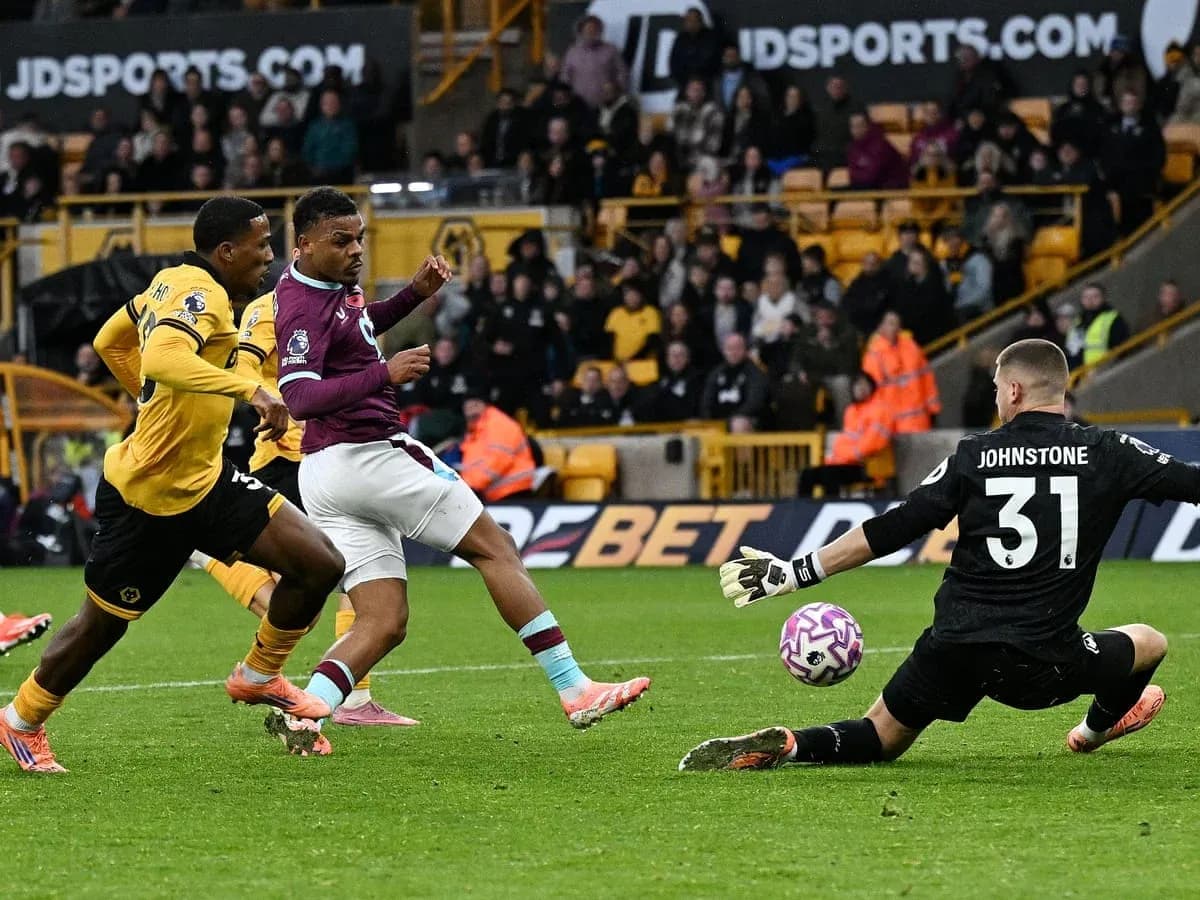
Burnley’s structural dominance finally translated into a breakthrough right after the restart. On 47', Zian Flemming finished a flowing move for 1-1, assisted by Loum Tchaouna, who had been operating between the lines from the left side of the three behind the striker. That goal rebalanced the scoreline and forced Wolves to briefly raise their line before retreating again into a compact mid-block.
The second half became a rolling chess match of substitutions. At 66', Burnley replaced Hannibal Mejbri (OUT) with Zeki Amdouni (IN), adding an extra goal threat between the lines. Simultaneously, Wolves began to refresh their legs and adjust their structure: A. Gomes (OUT) made way for T. Arokodare (IN), and L. Krejci (OUT) was replaced by Toti (IN), allowing Rob Edwards to tweak his back line and attacking reference points without abandoning the 3-4-2-1.
On 74', Wolves doubled down on fresh energy in the front and wide channels: D. M. Wolfe (OUT) was replaced by H. Bueno (IN), and penalty scorer A. Armstrong (OUT) made way for J. Abbey (IN), signalling a desire to maintain counter-attacking threat rather than settle purely for deep defence. Burnley responded on 75' with a more creative and aggressive midfield: L. Ugochukwu (OUT) was replaced by J. Ward-Prowse (IN), adding passing range and set-piece quality, while L. Tchaouna (OUT) gave way to M. Edwards (IN) to provide direct dribbling from wide areas.
The final wave of changes came as both sides chased a decisive moment. On 82', R. Gomes (OUT) was replaced by Pedro Lima (IN) for Wolves, freshening the right flank. At 84', Burnley injected experience and new wide dynamics: Z. Flemming (OUT) was replaced by Ashley Barnes (IN), and J. Anthony (OUT) made way for J. Bruun Larsen (IN), effectively turning the 4-2-3-1 into a more aggressive, striker-plus-inside-forwards configuration.
Late tension was reflected in twin yellow cards at 90+4'. Ashley Barnes (Burnley) was booked — “Argument” — shortly followed by Yerson Mosquera (Wolves), also — “Argument”. The disciplinary ledger closed with Burnley: 2 yellow cards, Wolves: 2 yellow cards, Total: 4, all rooted in emotional flashpoints rather than persistent tactical fouling.
From a structural perspective, Burnley’s 4-2-3-1 was built for territorial control and sustained pressure. The double pivot of Florentino and L. Ugochukwu provided a stable platform in front of the back four of K. Walker, A. Tuanzebe, B. Humphreys and Lucas Pires. With 70% possession and 558 passes, 488 accurate (87%), Burnley circulated the ball methodically, using full-backs high and wide to stretch Wolves’ back three and wing-backs. The attacking band of L. Tchaouna, Hannibal Mejbri and J. Anthony supported Z. Flemming as a roaming forward, constantly seeking pockets between Wolves’ midfield and defence.
Yet the shot profile reveals the limitations of that control. Burnley produced 16 total shots, with 8 on goal and 6 blocked, but their xG of 1.06 indicates that many efforts were from suboptimal locations or under pressure. Wolves’ back three and midfield line were disciplined in protecting the central corridor, forcing Burnley to shoot from distance (9 shots outside the box versus 7 inside). The goal itself, crafted by Tchaouna and finished by Flemming, came from one of the few moments Burnley managed to disorganise Wolves’ last line with quick combination play rather than sterile circulation.
In goal, M. Weiss (Burnley) had a relatively quiet but efficient afternoon, making 3 saves and posting 0.29 goals prevented, consistent with facing only 4 shots on target. Wolves’ attacks were fewer but more incisive: 16 total shots matched Burnley’s volume, but with 10 inside the box and an xG of 2.05, their chances were significantly higher quality. This underlines how Wolves, despite only 223 passes (164 accurate, 74%) and 30% possession, maximised transitions and direct play into central areas, especially early on and after turnovers.
At the other end, José Sá (Wolves) was decisive in preserving the point. He made 7 saves, reflecting Burnley’s 8 shots on goal, and matched Weiss with 0.29 goals prevented. Wolves also blocked 7 shots, one more than Burnley’s 6, illustrating the depth of their defensive commitment around the box. The compact 3-4-2-1, with wide midfielders tracking Burnley’s full-backs, repeatedly forced Burnley into crowded central zones or low-percentage long shots.
Statistically, the draw sits awkwardly between the sides’ performances. Burnley’s dominance of possession, passing and territory supported their comeback and constant pressure, but their xG of 1.06 suggests they did not consistently turn that control into clear chances. Wolves, conversely, underlined a season-long pattern of being dangerous in transition: 2.05 xG from limited ball share and 10 shots inside the area indicate they could easily have scored more than once.
The card count — Burnley 2, Wolves 2 — mirrors the emotional temperature of a tight final-day contest rather than any systemic indiscipline. Tactically, Jackson’s late introduction of Ward-Prowse, Edwards and Barnes tilted Burnley further towards an attacking 4-2-4 in the final phase, while Edwards’ rotation of his front and wide players ensured Wolves retained an out-ball and counter threat. In the end, the 1-1 scoreline encapsulated a classic clash of styles: Burnley’s possession structure versus Wolves’ vertical efficiency, with each side imposing its identity without quite finding a decisive edge.