.svg&w=384&q=75 "GoalGist logo")
Bournemouth vs Manchester City: Tactical Draw Highlights Progress
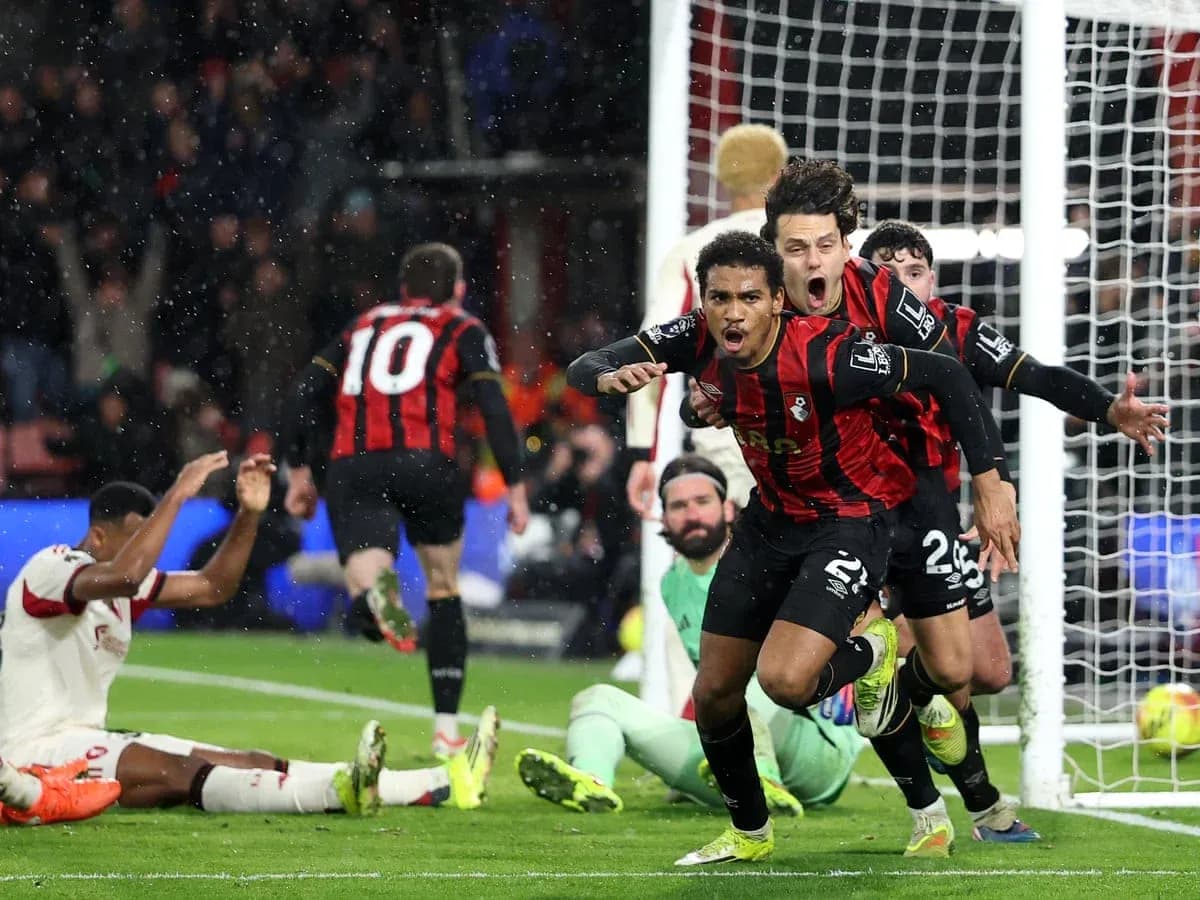
Under the south‑coast lights at Vitality Stadium, Bournemouth and Manchester City played out a 1–1 draw that felt less like a routine late‑season fixture and more like a tactical referendum on how far Andoni Iraola’s side have come. Following this result, the league table underlines the stakes they were both carrying into the evening: Bournemouth sitting 6th on 56 points with a goal difference of 4 (57 scored, 53 conceded), chasing Europa League football; City in 2nd on 78 points with a goal difference of 43 (76 for, 33 against), still demanding perfection in the title chase.
Iraola stayed loyal to Bournemouth’s seasonal DNA with a 4‑2‑3‑1, a shape they have used in 35 of their 37 league matches. It is built around controlled aggression: at home they average 1.5 goals for and 1.1 against, and their league‑wide form line – a long string of draws punctuated by decisive wins – speaks to a side that rarely collapses but often walks the tightrope. Pep Guardiola mirrored his own season’s most trusted structure, the 4‑1‑4‑1 City have deployed 13 times, with Rodri as the single pivot and Erling Haaland as the lone spear.
The first tactical void was visible before a ball was kicked. Bournemouth’s right side was shorn of its usual edge and bite: Álex Jiménez, one of the league’s leading yellow‑card collectors with 10 cautions, was suspended, and Ryan Christie, who carries a red card on his record this campaign, was also missing. Without Jiménez’s 69 tackles, 11 blocked shots and 27 interceptions across the season, Iraola turned to A. Smith at right‑back and J. Hill inside him, trusting experience and compactness over high‑octane overlapping.
Those absences mattered not just in personnel, but in temperament. Bournemouth are a card‑heavy team late on; 26.44% of their yellow cards arrive between 76–90 minutes, with another 21.84% in added time. Their defensive line has lived on the edge all year. Removing Jiménez and Christie trimmed some chaos from the right flank but also took away two players comfortable in the dark arts of slowing City’s rhythm.
City, by contrast, arrived with a cleaner disciplinary slate. Their yellow cards are more evenly spread, with the heaviest clusters at 46–60 minutes and 76–90 minutes (both 19.70%). Bernardo Silva, who leads their booking charts with 10 yellows, started as the right‑sided No. 8 in front of M. Nunes, A. Khusanov and M. Guehi. His industry and willingness to foul in transition are fundamental to Guardiola’s rest‑defence – a subtle shield against Bournemouth’s counters.
From the first whistle, the match became a study in contrasting structures. Bournemouth’s back four – Truffert, Senesi, Hill and Smith – stayed relatively narrow, with Tyler Adams and A. Scott forming a double pivot that slid laterally to plug City’s half‑spaces. In front, the trio of Rayan, E. J. Kroupi and M. Tavernier floated behind Evanilson, offering vertical runs rather than pure possession.
The “Hunter vs Shield” duel was always going to orbit Haaland. Heading into this game he had 27 league goals, 102 shots and 59 on target, with 3 penalties scored but 1 missed – a reminder that even the most ruthless finisher has his fault lines. Bournemouth’s overall defensive record – 53 conceded in 37, or 1.4 goals against on average – suggested vulnerability, especially against an attack that averages 2.1 goals per match overall and 1.7 on their travels. Yet at home, Bournemouth are more parsimonious, conceding just 20 in 19, and that resilience framed D. Petrovic’s night.
Petrovic’s role was not simply to save; it was to command a line that had to live with City’s positional rotations. Doku hugged the left touchline, stretching Smith and forcing Adams to shade across. On the opposite flank, N. O’Reilly’s more conservative role allowed Bernardo to drift inside, forming triangles with Rodri and Kovacic. Every time Haaland pinned Senesi or Hill, City threatened to collapse the Bournemouth block.
But the other hunter on the pitch was wearing red and black. Kroupi, Bournemouth’s leading league scorer with 13 goals, started nominally as a central attacking midfielder but frequently broke beyond Evanilson, attacking the spaces either side of Guehi. His season profile – 31 shots, 21 on target and 21 key passes – paints him as a hybrid finisher‑creator, and Iraola used that duality cleverly. When Bournemouth broke, Kroupi would often be the second runner, arriving late to exploit the gaps left by City’s adventurous full‑backs.
In the “Engine Room” duel, Rodri’s metronomic presence met Adams’s snarling energy. Rodri’s job was to prevent transitions, to smother Kroupi and Rayan between the lines and to feed the four‑man band ahead. Adams, by contrast, existed to disrupt: to step into Haaland’s feet, to foul when necessary, to shield Scott so the younger midfielder could recycle and occasionally step through City’s first line.
As the match wore on, the statistical profiles of the two sides began to assert themselves. City, who have kept 16 clean sheets overall and conceded just 0.9 goals per game, tried to suffocate Bournemouth after falling behind, pushing their line higher, with Kovacic and Bernardo drifting ever closer to Haaland. Bournemouth, a team that has failed to score only 7 times in 37 matches and averages 1.5 goals overall, refused to retreat entirely, continuing to commit Rayan and Tavernier forward on the break.
The late‑game phase was where Bournemouth’s season‑long card pattern loomed. With over 26% of their yellows coming in the final quarter‑hour, every 50–50 around the box felt like a potential turning point. Yet Iraola’s patched‑up right side held its nerve, and City’s own late yellow‑card spikes never boiled over into a red.
From an Expected Goals perspective – even without explicit xG numbers in the data – the underlying trends suggest a narrow City edge in chance volume but a relatively even balance in shot quality. City’s season‑long attacking output, combined with Bournemouth’s solid home defence, points to a game where City likely accumulated more shots and territory, but Bournemouth’s best opportunities were sharp and transition‑driven.
Following this result, the verdict is twofold. For Bournemouth, holding a 2nd‑placed side that scores freely to a single goal reinforces the legitimacy of their European push and the robustness of a 4‑2‑3‑1 that has become their identity. For City, the draw is a reminder that even a side with Haaland’s firepower and Rodri’s control can be blunted by a disciplined mid‑block and a front four willing to run themselves into the ground.
On a tactical level, this was less about one team out‑thinking the other and more about two coherent structures colliding at full tilt – Bournemouth’s compact, hard‑running 4‑2‑3‑1 against City’s shape‑shifting 4‑1‑4‑1. The 1–1 scoreline felt, in the end, like the purest expression of that balance.