.svg&w=384&q=75 "GoalGist logo")
Bournemouth vs Manchester City: Tactical Breakdown of 1-1 Draw
Bournemouth’s 1-1 draw with Manchester City at Vitality Stadium was a high-discipline, high-concentration performance built on a compact 4-2-3-1 against City’s 4-1-4-1. The home side accepted a 45% share of the ball and lower passing volume (431 passes, 346 accurate at 80%) but traded it for territorial control in key moments and sharp transitions, reflected in a slightly higher xG of 1.99 to City’s 1.68. City’s structure and 55% possession, with 527 passes and 458 accurate (87%), eventually produced Erling Haaland’s late equaliser, but Bournemouth’s defensive organisation and work without the ball dictated the game’s tactical story.
I. Executive Summary
Andoni Iraola set Bournemouth up to compress central spaces and spring quickly through the line of E. J. Kroupi, Rayan and M. Tavernier behind Evanilson. Pep Guardiola’s Manchester City, with Rodri as the single pivot and M. Kovacic and B. Silva ahead, sought to dominate through the middle and overload wide zones with J. Doku and A. Semenyo. Bournemouth’s first-half execution was superior: they limited City’s clean entries and converted one of their six shots inside the box into the 39th-minute opener. City, however, used their bench aggressively on 56 minutes to change the game’s rhythm, eventually forcing parity at 90 minutes.
II. Scoring Sequence & Disciplinary Log
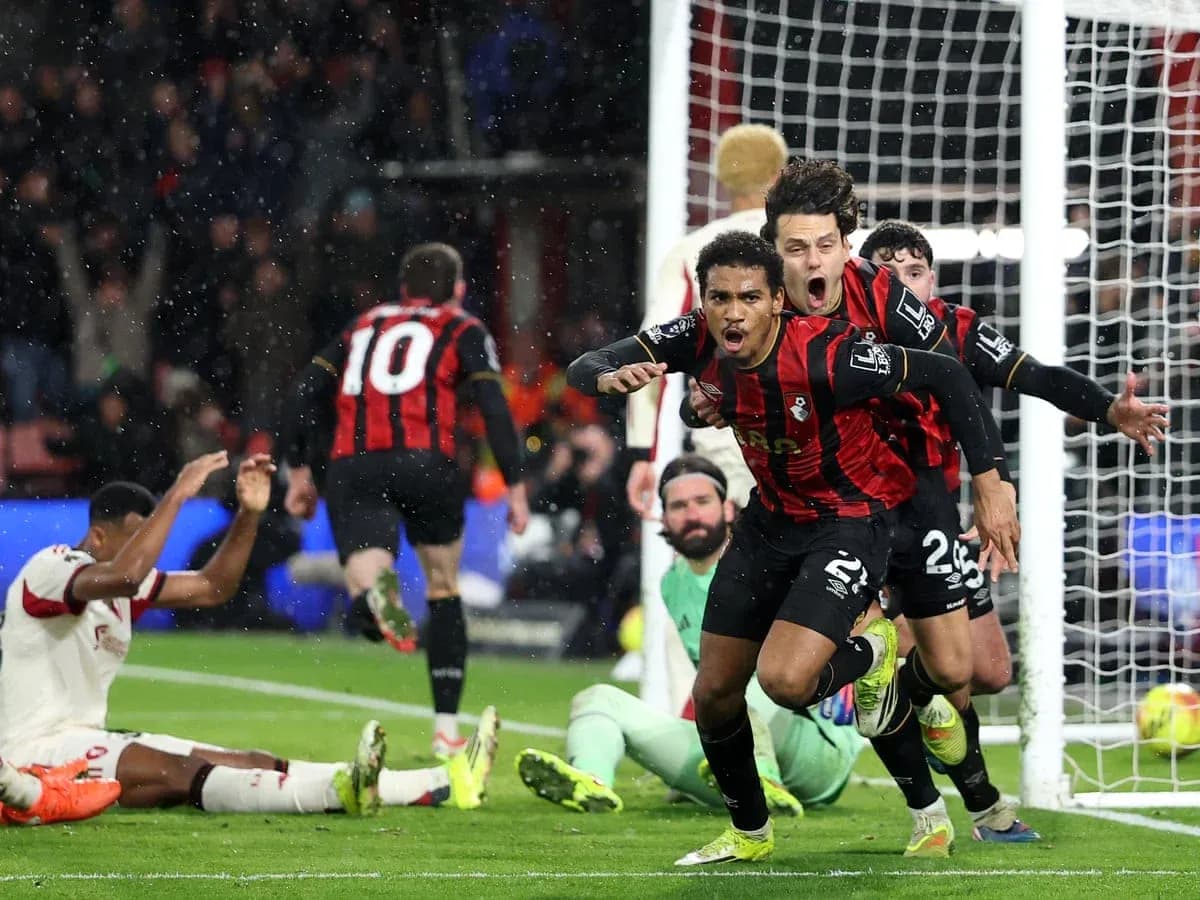
The scoring opened in the 39th minute: E. J. Kroupi (Bournemouth) finished a well-constructed move, assisted by A. Truffert, to give the hosts a 1-0 lead. That advantage held until half-time, with the score 1-0 at the break.
Manchester City’s pressure finally told at 90 minutes, when E. Haaland (Manchester City) struck a late equaliser with a close-range finish, unassisted, for 1-1. No goals came in added time beyond that moment.
Disciplinary incidents were significant, particularly for Bournemouth. All cards, in chronological order:
- 37' Tyler Adams (Bournemouth) — Argument
- 59' James Hill (Bournemouth) — Foul
- 90+3' Justin Kluivert (Bournemouth) — Argument
- 90+3' Rodri (Manchester City) — Argument
- 90+6' Adrien Truffert (Bournemouth) — Foul
Totals: Bournemouth 4 yellow cards, Manchester City 1 yellow card, 5 cards overall. The pattern underscores Bournemouth’s increasingly reactive and combative defensive stance as they tried to protect the lead into added time, while City’s single booking came as emotions spiked during their late push.
III. Tactical Breakdown & Personnel
Bournemouth: 4-2-3-1 out of possession, vertical transitions
With D. Petrovic in goal and a back four of A. Smith, James Hill, M. Senesi and A. Truffert, Bournemouth built a narrow, vertically compact block. Tyler Adams and A. Scott screened in front, forming a double pivot tasked with closing passing lanes into Haaland’s feet and disrupting Rodri’s rhythm. Petrovic’s 3 goalkeeper saves and 0.29 goals prevented quantify a solid, if not spectacular, performance: he matched Donnarumma’s shot-stopping level and ensured City’s xG edge never materialised on the scoreboard.
Bournemouth allowed 14 total shots but only 5 on target and 10 inside the box, using aggressive duels and timely blocks (3 blocked shots) to reduce shot quality. Their 16 fouls and four yellow cards reflect a tactical choice: accept defensive risk and physicality to prevent City from playing through the central corridor. Adams’s early yellow for Argument at 37' did not change his role as a combative screen; instead, Bournemouth managed the risk with collective shifting and cover.
In possession, Bournemouth’s 431 passes at 80% accuracy show a clear intent to be direct rather than circulate endlessly. The key was the second line: Rayan, Kroupi and Tavernier supporting Evanilson. Kroupi’s goal on 39' from Truffert’s assist came from exploiting the left channel, where Truffert advanced beyond the full-back line. The full-back’s late yellow at 90+6' for Foul was the flip side of that adventurous role: he had to defend wide spaces under fatigue as City chased the equaliser.
Iraola’s substitutions were game-state driven. At 76', J. Kluivert (IN) came on for E. J. Kroupi (OUT), adding fresh legs and pressing intensity on the flank. At 84', D. Brooks (IN) replaced Rayan (OUT), introducing more ball security and counter-attacking threat. At 89', E. Unal (IN) came on for Evanilson (OUT), a like-for-like change to maintain a central outlet. Finally, at 90', L. Cook (IN) came on for A. Smith (OUT), effectively reinforcing central protection and game management as Bournemouth tried to close out the win. Kluivert’s late yellow for Argument at 90+3' underlined the emotional edge of those final minutes.
Manchester City: 4-1-4-1 control, structural tweaks
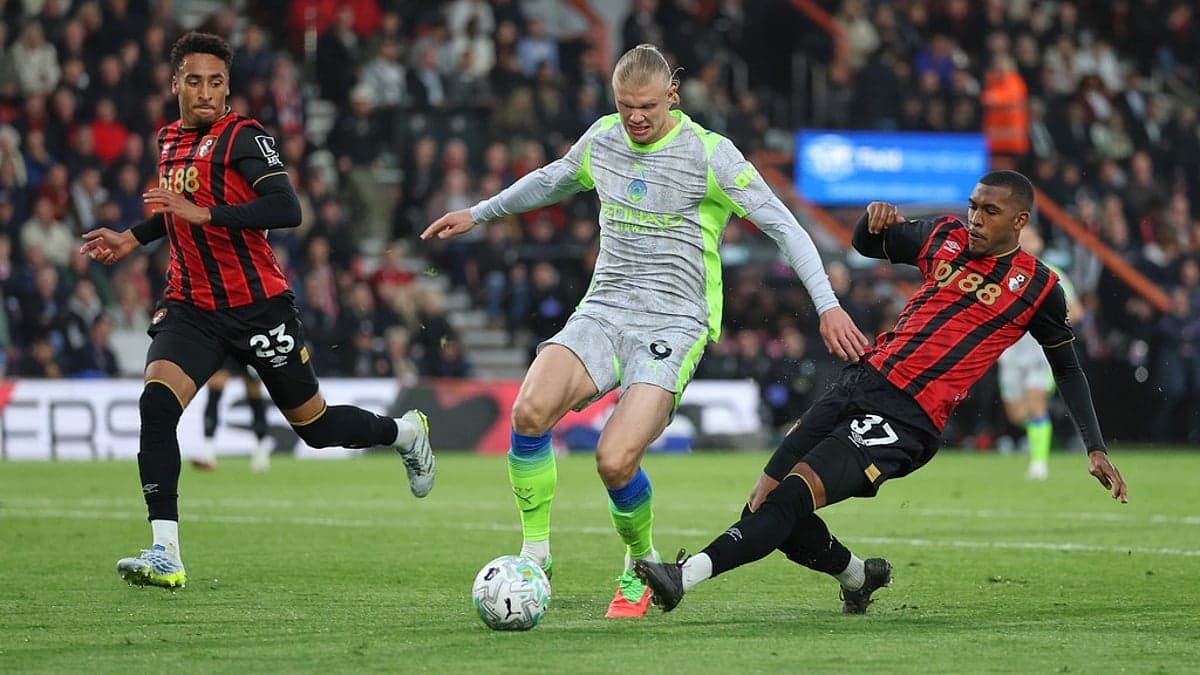
City’s 4-1-4-1 hinged on Rodri as the lone pivot, with Kovacic and B. Silva between the lines and Doku and A. Semenyo wide. The structure produced 55% possession, 527 passes and an 87% accuracy, consistent with a team aiming to control territory and tempo. Their 14 shots (5 on target, 6 blocked) and xG of 1.68 show that, while they did create, Bournemouth’s block forced many efforts into congested zones.
G. Donnarumma’s 2 goalkeeper saves and 0.29 goals prevented reflect a relatively quiet but efficient evening; Bournemouth’s 10 shots included only 2 on target, a testament to City’s box protection and ability to limit clear looks despite conceding a higher xG.
Guardiola’s triple substitution on 56 minutes was the key tactical pivot:
- 56' P. Foden (IN) came on for M. Kovacic (OUT)
- 56' R. Cherki (IN) came on for B. Silva (OUT)
- 56' Savinho (IN) came on for A. Semenyo (OUT)
This reshaped the attacking line behind Haaland, adding more direct dribbling (Savinho), half-space creativity (Cherki) and dynamic movement (Foden). The effect was to pin Bournemouth deeper, increase box entries and sustain pressure. Later, at 76', O. Marmoush (IN) came on for J. Doku (OUT), providing fresh running and an additional penalty-box presence from wide areas.
Rodri’s yellow for Argument at 90+3' came as City flooded forward and emotions spiked; tactically, he continued to hold the rest-defense line, recycling possession and preventing Bournemouth counters.
Haaland’s 90th-minute goal was the logical outcome of City’s structural pressure: with Bournemouth’s block collapsing deeper and legs tiring, the Norwegian finally found separation in the box to convert, ensuring City’s territorial and possession dominance translated into at least a point.
IV. The Statistical Verdict
The underlying numbers paint a balanced, high-level tactical contest. Bournemouth edged xG 1.99 to 1.68, despite fewer total shots (10 to 14) and less possession (45% to 55%), suggesting their attacking phases produced slightly higher-quality chances when they did break through. City, by contrast, generated volume and territory but ran into a disciplined, compact block that forced them into lower-value attempts and six blocked shots.
Passing profiles underline the stylistic contrast: Bournemouth’s 431 passes, 346 accurate (80%), were functional and vertical, focused on progression and transition rather than sterile circulation. City’s 527 passes, 458 accurate (87%), reflect their control-first approach, using Rodri as the hub and the advanced midfield line to probe repeatedly.
Discipline was asymmetrical: Bournemouth’s 16 fouls and four yellows versus City’s 7 fouls and one yellow show how much defensive work the hosts invested to preserve their lead. Yet both goalkeepers posted identical goals prevented (0.29), underscoring that neither side was able to completely overwhelm the other’s last line.
Tactically, Bournemouth executed a near-perfect underdog game plan, only undone by City’s depth and late structural pressure. City, for their part, demonstrated the value of in-game tactical adjustments and bench quality to rescue a result when the initial plan struggled to break a well-organised defensive block.