.svg&w=384&q=75 "GoalGist logo")
Arsenal Controls Game in 1-0 Victory Over Burnley
Arsenal’s 1-0 win over Burnley at Emirates Stadium was a controlled, possession-heavy performance built on structure more than volume of chances. Mikel Arteta’s 4-3-3 dominated territory and tempo, while Mike Jackson’s 4-2-3-1 tried to compress central spaces and play for transitions. The match settled into a pattern of Arsenal circulation against a deep, increasingly physical Burnley block, with the home side’s superior technical level and spacing reflected in both the scoreline and the underlying numbers.
Executive Summary
Across 90 minutes, Arsenal posted 61% possession, 13 total shots and an xG of 1.03 against Burnley’s 39% possession, 5 shots and 0.21 xG. The single decisive action came on 37 minutes, but the tactical story was Arsenal’s control without over-commitment: 510 passes at 86% accuracy versus Burnley’s 325 at 78%, and just 7 fouls conceded compared to Burnley’s 16. Defensively, Arsenal allowed no shots on goal, turning the game into a low-event contest where their superior structure made a one-goal margin feel secure rather than fragile.
Scoring Sequence & Disciplinary Log
The only goal arrived in the 37th minute: Kai Havertz (Arsenal) finished a move assisted by Bukayo Saka, a sequence that encapsulated Arsenal’s wide overloads feeding the central forward. That strike established the 1-0 scoreline at half-time and ultimately at full-time.
- 28' Hannibal Mejbri (Burnley) — Time wasting
- 67' Kai Havertz (Arsenal) — Foul
- 90+1' Zian Flemming (Burnley) — Foul
- 90+4' Lucas Pires (Burnley) — Foul
In total: Arsenal 1 yellow, Burnley 3 yellows, for 4 cards overall. The late bookings for Zian Flemming and Lucas Pires reflected Burnley’s frustration as they chased the game with limited attacking structure.
Substitutions also followed the game’s tactical arc. For Burnley: Zeki Amdouni (IN) came on for Hannibal Mejbri (OUT) at 70', J. Laurent (IN) for L. Ugochukwu (OUT) at 71', J. Ward-Prowse (IN) for Florentino (OUT) at 78', J. Bruun Larsen (IN) for L. Tchaouna (OUT) at 82', and B. Humphreys (IN) for M. Esteve (OUT) also at 82'. For Arsenal: Piero Hincapie (IN) came on for Riccardo Calafiori (OUT) at 72', Viktor Gyökeres (IN) for K. Havertz (OUT) at 73', Myles Lewis-Skelly (IN) for Eberechi Eze (OUT) at 73', Gabriel Martinelli (IN) for Leandro Trossard (OUT) at 90+3', and M. Zubimendi (IN) for Martin Odegaard (OUT) at 90+3'.
Tactical Breakdown & Personnel
Arsenal’s 4-3-3 was textbook Arteta: D. Raya behind a back four of C. Mosquera, William Saliba, Gabriel and Riccardo Calafiori, with Declan Rice anchoring midfield between Martin Odegaard and Eberechi Eze. Ahead, Saka and Leandro Trossard flanked Havertz. The structure produced a clear passing dominance: 510 passes, 440 accurate (86%), enabling sustained occupation of Burnley’s half.
In possession, Arsenal built with Rice dropping to connect the centre-backs, full-backs positioned relatively narrow to secure rest defence, and the advanced midfielders rotating into half-spaces. Saka’s assist for Havertz stemmed from this pattern: wide isolation on the right, a diagonal delivery into the inside channel, and Havertz attacking the central lane. The xG of 1.03 on 13 shots (3 on goal, 3 blocked) suggests Arsenal prioritised control over risk, choosing to protect their structure rather than overload the box.
Out of possession, Arsenal were impressively secure. Burnley did not register a single shot on goal, finishing with 5 shots in total (2 inside the box, 3 from outside). Arsenal’s foul count of just 7 underscores how often they defended with numbers behind the ball rather than last-ditch interventions. D. Raya recorded 0 goalkeeper saves, but his goals prevented figure of 0.85 indicates he dealt effectively with potential danger through positioning and command of his area rather than shot-stopping volume.
Burnley’s 4-2-3-1, with M. Weiss in goal behind K. Walker, A. Tuanzebe, M. Esteve and Lucas Pires, plus a double pivot of Florentino and L. Ugochukwu, was designed to congest central zones. Ahead of them, L. Tchaouna, Hannibal Mejbri and J. Anthony supported Zian Flemming. However, with only 39% possession and 325 passes (254 accurate, 78%), Burnley struggled to progress the ball. Their xG of 0.21 reflects a lack of penetration; they forced 3 corners but failed to convert them into on-target attempts.
Weiss, with 2 goalkeeper saves and 0.85 goals prevented, kept Burnley in the game, particularly against Arsenal’s 3 shots on target. His interventions and Burnley’s compact block ensured the scoreline remained narrow despite the territorial imbalance. Yet the defensive workload showed in discipline: 16 fouls and 3 yellow cards, with late bookings for Flemming and Lucas Pires as Burnley resorted to stopping transitions and breaking Arsenal’s rhythm.
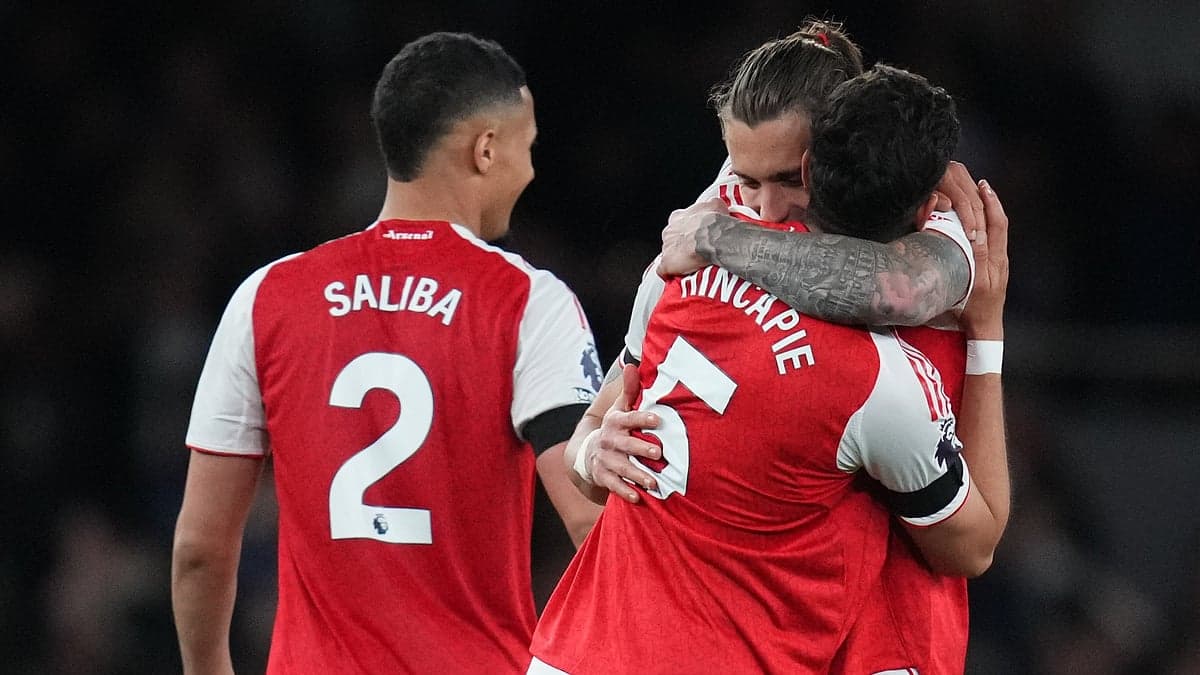
Arteta’s substitutions were clearly aimed at game management. Introducing Piero Hincapie for Calafiori and M. Lewis-Skelly plus M. Zubimendi later allowed Arsenal to refresh legs in the back line and midfield while maintaining structural integrity. Viktor Gyökeres for Havertz at 73' preserved the pressing profile up front after Havertz’s booking for “Foul” at 67', reducing the risk of a second yellow in a duel-heavy role.
On the opposite bench, Jackson’s changes — J. Ward-Prowse, J. Laurent, J. Bruun Larsen, B. Humphreys and Zeki Amdouni — tilted Burnley towards more attacking profiles, but without altering the fundamental dynamic. Arsenal’s control of central zones and calm possession under pressure meant Burnley’s extra forwards rarely received the ball in advanced, stable situations.
The Statistical Verdict
The numbers align closely with the tactical impression. Arsenal’s 61% possession, superior passing volume and accuracy, and 1.03 xG versus 0.21 xG illustrate a side in control, even if they did not translate dominance into a larger scoreline. Thirteen shots to five, and a 3–0 edge in shots on goal, underline their attacking superiority, while allowing zero shots on target speaks to an excellent Defensive Index on the day.
Burnley’s 16 fouls and 3 yellow cards, compared to Arsenal’s 7 fouls and 1 yellow, highlight the strain their defensive shape came under. Yet, with M. Weiss preventing 0.85 goals and Burnley blocking 1 shot, they avoided collapse. The match ultimately reads as a classic late-season, controlled home win: Arsenal used structure, ball retention and intelligent game management to secure a 1-0 result that the underlying data fully justifies.