.svg&w=384&q=75 "GoalGist logo")
USA vs Belgium: Tactical Analysis of Round of 16 Defeat
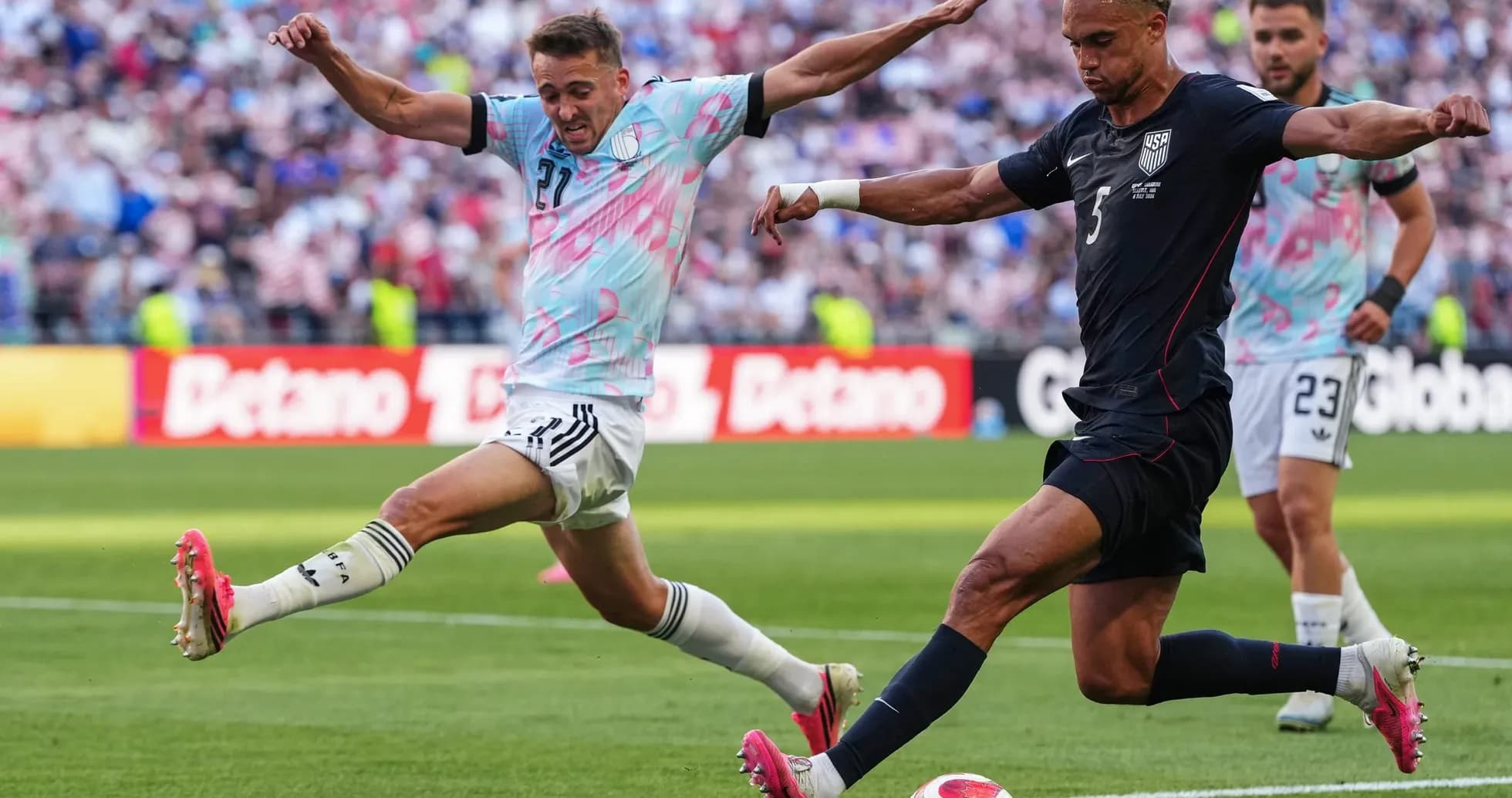
USA’s Round of 16 defeat to Belgium at Lumen Field was defined less by possession and structure, and more by the contrast in penalty-box quality and individual execution. Mauricio Pochettino’s side had 56% of the ball, completed 527 passes at 87% accuracy, and set up in a 4-3-3 that was designed to control central zones. Yet Belgium, in a 4-2-3-1 under Rudi Garcia, accepted the territorial deficit, attacked with purpose, and repeatedly accessed the most dangerous spaces, turning 44% possession and 410 passes (81% accuracy) into a 4-1 scoreline and a clear xG edge of 2.15 to 0.67.
USA’s Structure
Structurally, USA’s 4-3-3 placed Tyler Adams as the single pivot with Weston McKennie and Malik Tillman as advanced interiors. On paper, this should have allowed USA to dominate second balls and sustain pressure, and the numbers reflect that control: more passes, better passing accuracy, and more of the game played with the ball. However, the front line of Sergiño Dest high on the right, Christian Pulišić from the left, and Folarin Balogun centrally struggled to convert that structure into clean final-third penetrations. USA produced only 7 total shots, 2 on goal, and generated just 0.67 xG despite 5 efforts from inside the box. The lack of blocked shots (0) underlines how rarely USA forced Belgium into emergency defending in front of goal; Belgium’s back line was generally able to shepherd attacks into low-probability areas or force rushed finishes.
Belgium’s Approach
Belgium’s 4-2-3-1 was more direct and vertically aligned. Nicolas Raskin and Amadou Onana started as the double pivot, with Dodi Lukebakio and Leandro Trossard flanking Youri Tielemans behind Charles De Ketelaere. This structure prioritized quick progression into the half-spaces and early service to De Ketelaere, and it showed in the shot profile: 15 total attempts, 10 from inside the box, and 7 on target. Belgium’s 4 blocked shots also indicate that they were consistently getting into shooting positions that demanded last-ditch interventions from USA, a mirror image of the hosts’ sterile dominance.
Goalkeeping Performance
In goal, Matthew Freese (USA) had a difficult evening. He made 3 saves but conceded 4, with his goals prevented figure at -0.69, pointing to underperformance relative to the quality of shots faced. Belgium consistently found high-value chances, and while Freese did make some routine stops, he was unable to alter the trajectory of the game with a big intervention. At the other end, Thibaut Courtois (Belgium) faced only 2 shots on goal and made 1 save. Belgium’s defensive structure in front of him, rather than shot-stopping heroics, was the primary reason USA’s possession did not translate into real jeopardy.
Midfield Battle
The midfield battle was decisive. Adams’ role as the lone pivot left USA vulnerable to quick Belgian combinations around him. Tielemans and Raskin repeatedly found pockets between the lines, especially when McKennie and Tillman stepped high to press. The early 9' strike from Charles De Ketelaere, assisted by Raskin, encapsulated this dynamic: Belgium broke through USA’s first line, exploited the space in front of the back four, and attacked the box with numbers. When USA equalized through Tillman at 31', it came more from individual initiative than from a sustained pattern of chance creation.
Belgium’s Fluidity
Belgium’s response at 33', again via De Ketelaere (this time fed by Trossard), highlighted their superior fluidity in the final third. The 4-2-3-1 morphed into a 4-4-2 without the ball, but in possession, Trossard drifted inside, Tielemans advanced into the right half-space, and De Ketelaere occupied both centre-backs. USA’s back four—Alexander Freeman, Chris Richards, Tim Ream, and Antonee Robinson—were repeatedly forced into reactive defending, with minimal protection once Belgium broke the first press.
In-Game Adjustments
Pochettino’s in-game adjustments did not fundamentally change the tactical picture. The 46' substitution, with Giovanni Reyna (IN) coming on for Sergiño Dest (OUT), suggested a desire for more ball progression and creativity between the lines, but USA’s shot volume and xG remained modest. Later attacking changes—Sebastian Berhalter (IN) for Christian Pulišić (OUT) at 59', Ricardo Pepi (IN) for Tyler Adams (OUT) at 72', Haji Wright (IN) for Folarin Balogun (OUT) at 90+2', and Maximilian Arfsten (IN) for Antonee Robinson (OUT) also at 90+2'—came against a backdrop of Belgium already firmly in control. The substitutions shifted USA towards a more direct, striker-heavy setup, but by then Belgium were managing the game, compressing space centrally and accepting crosses and speculative efforts.
Belgium’s Changes
Belgium’s own changes were more about refreshing the attacking edge than altering structure. Hans Vanaken (IN) for Amadou Onana (OUT) at 21' added an extra creative presence from deeper zones, and he later scored at 57' from a move involving De Ketelaere, further underlining Belgium’s capacity to overload central channels. The double change at 67'—Jérémy Doku (IN) for Dodi Lukebakio (OUT) and Romelu Lukaku (IN) for De Ketelaere (OUT)—maintained the same 4-2-3-1 shape but introduced fresh pace and physicality against a tiring USA back line. Late, like-for-like switches (Alexis Saelemaekers for Trossard and Axel Witsel for Raskin at 89') were game-management moves, locking down central areas and preserving the defensive block.
Discipline and Statistics
Discipline also played a subtle role in disrupting USA’s rhythm. USA committed 11 fouls to Belgium’s 9 and collected both yellow cards in the match: Weston McKennie at 35' for “Tripping” and Malik Tillman at 69', also for “Tripping”. These moments broke up potential counter-pressing opportunities and reflected USA’s increasing desperation as Belgium’s lead grew. Belgium, by contrast, maintained composure and avoided bookings, enabling them to press selectively without fear of suspensions or a numerical disadvantage.
Statistically, the verdict is stark. USA’s higher possession and passing volume did not yield territorial dominance in dangerous zones. Their 5 shots inside the box produced only 2 efforts on goal and 1 actual strike, aligning with the low xG of 0.67. Belgium’s 10 shots inside the box, 7 on target, and xG of 2.15 are consistent with a side that repeatedly accessed premium shooting locations and finished efficiently. Both goalkeepers are credited with -0.69 goals prevented, but the context differs: Freese (USA) was exposed by the volume and quality of Belgian entries, while Courtois (Belgium) benefited from a compact block that limited USA to low-threat looks.
Ultimately, this was a tactical lesson in the difference between control and incision. USA’s 4-3-3 offered structure and possession but lacked mechanisms to destabilize Belgium’s back four. Belgium’s 4-2-3-1, by contrast, was built around verticality, half-space occupation, and intelligent rotations in the attacking band, turning fewer passes into far more decisive actions and a place in the next round.