.svg&w=384&q=75 "GoalGist logo")
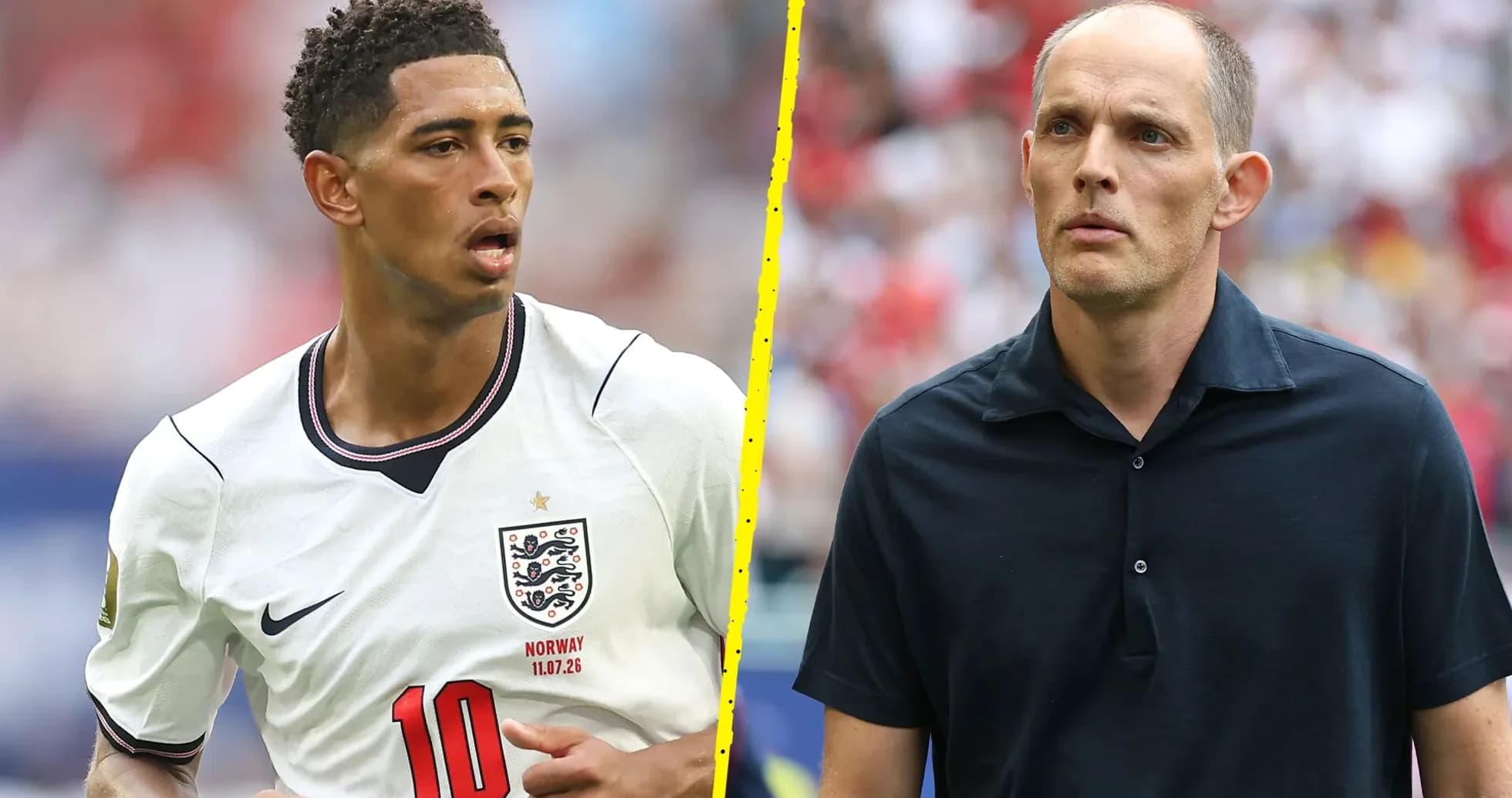
Thomas Tuchel Defends Jude Bellingham Amid Media Rift Claims
Thomas Tuchel did not so much address the Jude Bellingham “rift” story as smash it to pieces.
Days after England’s fraught, 120–minute quarter-final win over Norway, the national coach has accused sections of the media of trying to “create cracks where no cracks are” between him and his star midfielder, insisting the relationship is as strong as ever.
The noise began in the flashpoint of a post-match tunnel. Tuchel, speaking to ITV’s Gabriel Clarke, had admitted he was “not happy” with England’s overall display, while stressing his side’s mentality was not the problem. Clarke then relayed only the critical part of that assessment to Bellingham, who had just scored both goals in extra-time, and the 21-year-old snapped back with a terse: “Yeah, well, whatever.”
One word. One raised eyebrow. One storm.
The clip raced around social media, the response framed as a dig at his manager, a sign of tension inside the England camp. Pundits piled in. Some, including Simon Jordan, defended Bellingham and questioned the line of questioning from Clarke. The story grew legs.
Tuchel has now gone on the offensive.
“I wonder who blows these things up,” he told talkSPORT, making it abundantly clear who he believes fanned the flames. “So there is nothing to blow up and if it’s blown up it’s blown up in the media of course.”
He then laid out his frustration with the way the interview was set up, arguing Bellingham had been presented with a distorted version of his comments.
“Like what do you expect of a player that just played 120 minutes and gave literally everything?” Tuchel said. “If you shorten the comment of his coach, if you don’t tell him that he was world-class, if you don’t tell him that he has world-class actions, if you just cut all this and tell him, oh your coach said you were sloppy, what do you expect?
“Of course you get the comment that you get and then you try to blow it up and try to create misunderstandings and cracks where no cracks are.”
This was Tuchel in his natural state: combative, protective, and utterly unapologetic about demanding standards from his players.
“We come from the same place, we come from being competitive and I’m a competitive coach. I push this team to the limit and that was my assessment,” he continued. He even turned the spotlight back on the line of questioning. “I think the question was unfair in this moment of time towards Jude because he cut all the compliments out of my assessment and just asked about the critical points, so I can understand what you expect of a player that just gave everything and stands there in front of a microphone in a flash interview.”
Then came the key line, the one that will matter inside the camp more than any headline outside it.
“That’s just what it is, but we’re close as ever and closer than ever before. You can see that on the field, energy and mentality on campus is excellent through the last days and we’re ready to go for it.”
No olive branches, because in Tuchel’s mind there was no rift to heal. Just a manager closing ranks around his best player and drawing a line under the saga.
From media storm to Messi problem
Tuchel has more pressing concerns than a chopped-up soundbite. England are preparing for a World Cup semi-final against Argentina, their second last-four appearance in three tournaments, with a place in a first final since 1966 on the line.
Standing in their way: Lionel Messi, 39 years old, eight-time Ballon d’Or winner, still the man everything orbits around in sky blue and white.
The numbers from the group stage painted a curious picture. Messi covered less ground than anyone else in the Argentina side, drifting on the fringes of the action, conserving energy. Yet he remains joint leader in the Golden Boot race with Kylian Mbappé on eight goals and continues to bend games to his will with a flick of his left foot or a pass no one else sees.
Tuchel knows exactly what he is up against.
“A lot of people have tried throughout the last decades and not a lot have succeeded,” he said. “You stop the supply to him, you stop passing options for him and still, he’s a magician, he finds his ways, he finds gaps, he sees things just seconds earlier than anyone else.
“I have the feeling it’s a different kind of vision going on. He is one of the all-time greats in this game and he proves it game after game after game in this tournament which is highly impressive.
“But we are here to beat him and to beat his team. So it’s a big ask but we’re up for it.”
That is the tightrope England must walk. Respect the genius, but not be paralysed by it. Cut off the angles, track the runners, deny the space between the lines, and still be brave enough to play their own football when the ball is theirs.
For Bellingham, the stage could hardly be bigger. Fresh from dragging England past Norway with two goals in extra-time, he now goes head-to-head with the player who defined the previous generation. The midfielder Tuchel calls “world-class” against the forward many consider the greatest of all time.
The noise around a throwaway “whatever” will fade. What happens when Messi drifts inside and Bellingham surges the other way will decide whether England finally step back into a World Cup final, or spend another four years wondering how close they really were.

