.svg&w=384&q=75 "GoalGist logo")
France's World Cup Exit: A New Era Begins with Zidane
ARLINGTON, Texas — The end came quietly for France, which somehow made it worse.
A team that arrived at this World Cup as the undisputed favorite, that carried that aura all the way into Tuesday afternoon inside Jerry Jones’ vast Texas monument, finally fell behind for the first time in the tournament. They never got back up. Spain pushed them over the edge, 2-0, and the scoreline flattered France more than it did the winners.
It wasn’t just the end of a campaign. It was the end of an era.
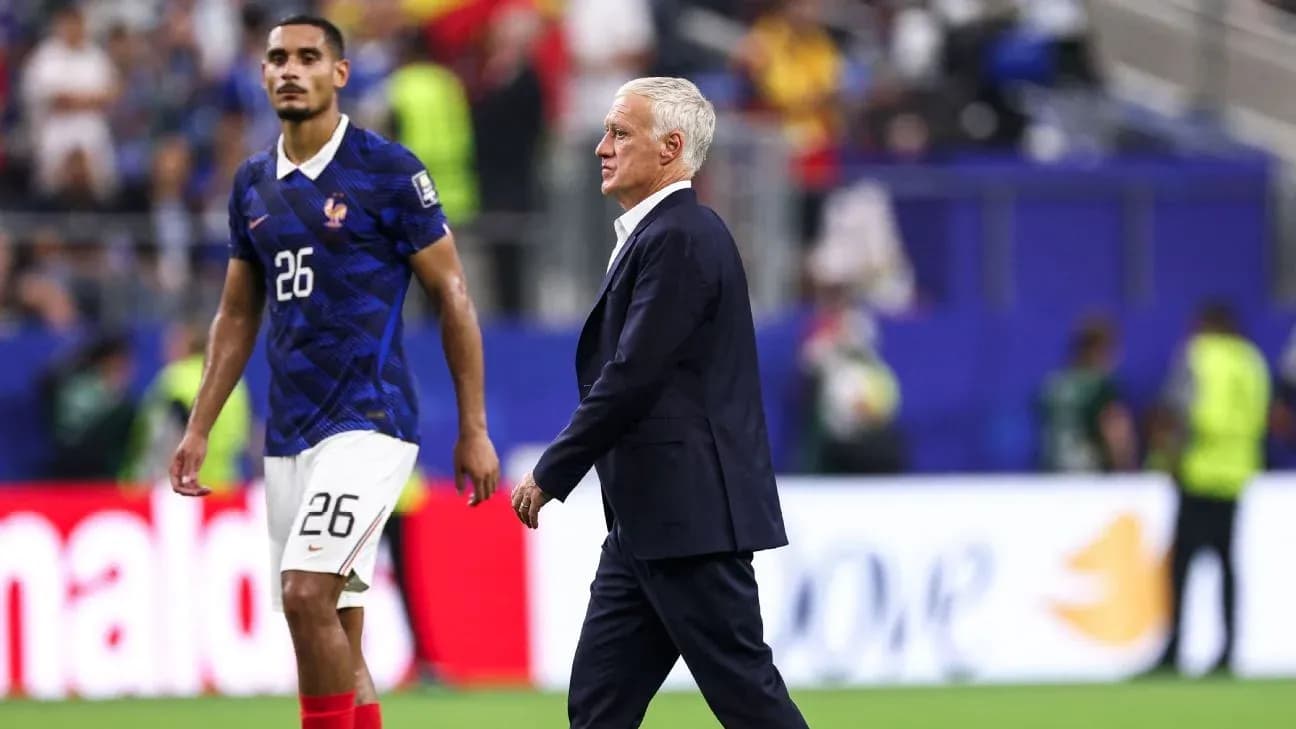
Didier Deschamps walks away after 14 years, 184 games and three major finals — two World Cups, one European Championship — plus a UEFA Nations League title. A résumé that should place him among the great international coaches of any generation now exits the stage on a night when his team produced 0.04 expected goals in the first 64 minutes, his vaunted front four reduced to shadows.
He was a Randal Kolo Muani finish away from becoming only the second coach ever to win two World Cups, adding that to the one he lifted as a player. Now, after this limp, shapeless semifinal, a large portion of France’s support is not mourning his departure. They are impatiently peering toward the next chapter: Zinedine Zidane.
Spain expose a brittle giant
Losing to Spain is no disgrace. This Spain, in particular, is close to France in talent and ahead of almost everyone in cohesion. The problem is how France went out: meek, disjointed, outplayed in every department.
Luis de la Fuente has now beaten Deschamps three times in three years — at Euro 2024, in the 2025 Nations League thriller that ended 5-4 after Spain had led 5-1, and now here, in a World Cup semifinal that never truly felt like a contest once Spain took control. Either De la Fuente is Deschamps’ bald, bearded, bespectacled nemesis, or the France coach simply refused to learn.
The script was familiar long before kickoff. Spain would dominate the ball, stretch the pitch, use possession as a weapon. The question hung over France: adapt or impose? Match Spain in midfield, press them high, adjust the structure? Or trust the stars, trust the system, and dare Spain to cope?
Deschamps chose to be himself. He chose to let Spain worry about France, not the other way around. Spain barely had to.
In theory, when you have the superior individual talent, you dictate terms. In theory, you don’t bend to the opponent. Deschamps has lived by that logic for most of his managerial life, and it has served him spectacularly well.
But football punishes dogma, especially when the other team takes away the two things elite players need most: the ball and space.
Spain did both. They kept possession, starved France’s attackers of touches, then squeezed the pitch when France tried to play out. Without the ball and without room to run, Michael Olise looked only marginally more dangerous than Michael Scott. Kylian Mbappé, marked and boxed in, drifted to the margins of the game. The front four, built to devastate in transition, never found the open field they crave.
That was the moment for adjustment. It never really came.
Deschamps, loyal to the last
Deschamps’ managerial creed has always been simple: keep the dressing room happy, keep the tactics clear, let the talent decide. It worked when he was the water-carrying captain in 1998 alongside Zidane, Patrick Vieira and Thierry Henry. It worked again in 2018 and nearly again in 2022.
In a low-scoring sport, he has long believed that overcomplicating things can do more harm than good. Many coaches share that view. The problem is when the opponent’s plan is sharper, more flexible, more collective — and you stay still.
His substitutions in Arlington felt as predictable as the initial setup. Manu Koné for Adrien Rabiot, Désiré Doué for Bradley Barcola: logical, tidy, almost automated. Like predictive text. On a good day, those like-for-like tweaks preserve balance and continuity. On a night like this, they simply extended the suffering.
His loyalty cut both ways. Rabiot, once again, kept his place despite a season of debate. Olise stayed on long enough for his nightmare to become the defining image of his tournament. These are the same instincts — faith in his men, trust in the familiar — that helped him build one of the most successful international reigns of the modern era. They also hardened into the habits that cost him with his most talented squad.
The tools that built the empire helped bring it down.
Zidane waits in the wings
Now comes the name that has hovered over the job for years: Zidane.
On paper, his credentials are pristine. Three Champions League titles. Two LaLiga crowns. A Real Madrid tenure defined by big nights, big decisions and an ability to manage superstars under the brightest spotlight in club football.
Then the caveats arrive. Zidane has not worked for five years. His last trophy came in 2020. He has only ever coached at Real Madrid, a club unlike any other, with resources and dynamics that simply do not exist at international level.
At Madrid, if a player didn’t fit, he could lean on the club to find a replacement. He saw his squad every day, could shape ideas on the training ground, adjust constantly. None of that exists with a national team, where time is scarce and the player pool is fixed.
Zidane, like Deschamps, did not build his reputation on elaborate tactical schemes. He trusted his stars, set broad frameworks, and excelled at motivation and man-management. That similarity fuels the assumption that he will be a slightly shinier version of the outgoing coach.
That might be enough. It would certainly not be a disaster. But France now need more than a copy.
This World Cup exit offered a blunt lesson: there are nights when you cannot simply send out your best players, tell them to express themselves, and expect talent to overwhelm the opposition. Not when the other side is nearly as gifted and far better drilled.
Balance matters. Structure matters. The fact that the other team is actively trying to stop you — and has a plan to do it — matters.
Zidane knows this as well as anyone. He won a World Cup with Stéphane Guivarc’h as his center forward. Deschamps did too. That France side thrived not because it had the most glamorous No. 9, but because the collective worked.
A new standard for the next era
If Zidane was watching in Arlington, the message could not have been clearer: in modern international football, a cohesive unit can outplay a squad of superior individuals when the technical gap is small.
He will inherit a player pool that most coaches can only dream of, particularly in attack. He will take over a group that has lived deep into tournaments, that understands the demands of knockout football. He will also inherit the expectation that reaching finals is not success in itself, but the minimum standard.
Matching Deschamps’ haul of trophies would be an achievement in its own right. Surpassing it will require something Deschamps never quite embraced: a willingness to bend before the game breaks you.