.svg&w=384&q=75 "GoalGist logo")
Spain's Tactical Mastery in Semi-Final Win Over France
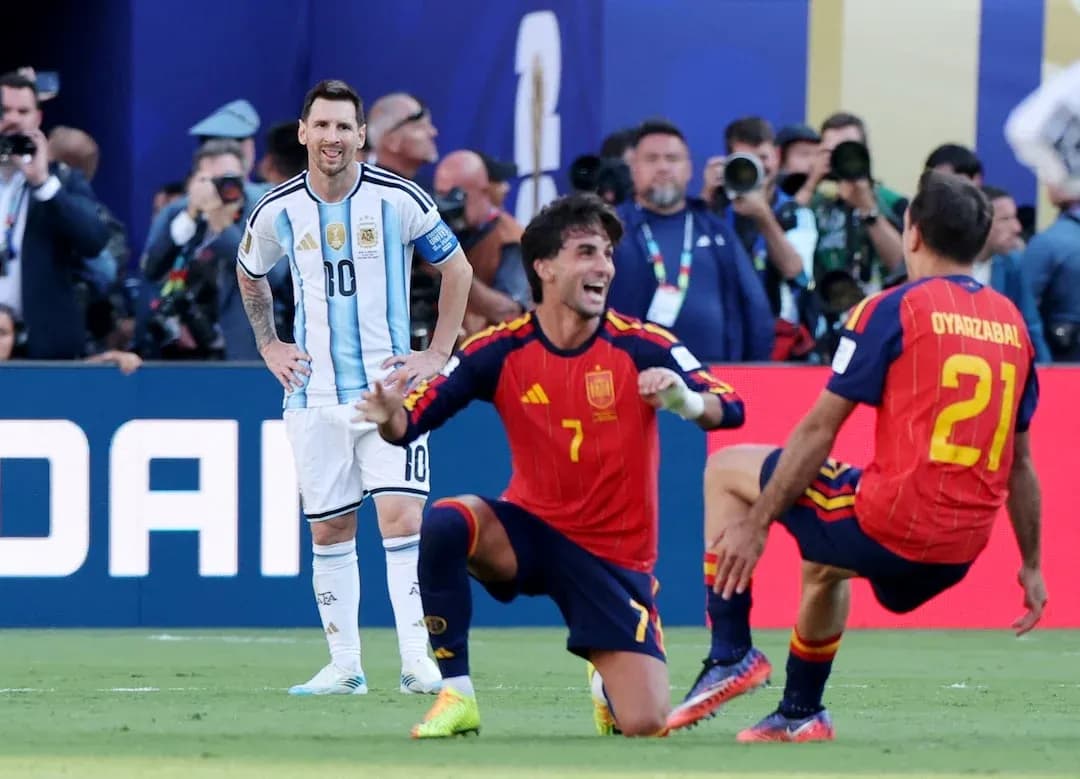
France and Spain mirrored each other structurally in a 4-2-3-1 at Dallas Stadium, but the semi-final was decided by how each side executed that shape in and out of possession. Spain’s 2-0 win, built on marginal territorial control and sharper use of the ball between the lines, was reflected in the statistical edge: 51% possession, 500 passes at 86% accuracy, and a far more threatening attacking profile in terms of xG.
France’s 4-2-3-1 under Didier Deschamps was conservative in its double pivot and heavily reliant on individual progression from wide and from Kylian Mbappé. Aurélien Tchouaméni and Adrien Rabiot formed the base, with Ousmane Dembélé, Michael Olise and Bradley Barcola supporting Mbappé. On paper, this offered multiple ball-carrying outlets, but Spain’s structure denied them clean central routes. France finished with 473 passes, 396 accurate (84%), and 49% of the ball, but those numbers masked how often they were forced to circulate in non-threatening zones and then play into crowded channels.
Spain’s 4-2-3-1 under Luis de la Fuente was more assertive with and without the ball. Rodri and Fabián Ruiz anchored midfield, with Lamine Yamal and Alex Baena flanking Dani Olmo behind Mikel Oyarzabal. The key was the double pivot’s control of central spaces: Rodri consistently positioned himself to screen passes into Mbappé’s feet, while Fabián stepped out to press France’s interior midfielders. This allowed Spain’s back four, particularly Pau Cubarsí and Aymeric Laporte, to hold a relatively high line and compress the pitch. The result was a France attack that managed 10 total shots but only 4 from inside the box and an xG of just 0.3.
Tactical Turning Point
The penalty at 22' to Mikel Oyarzabal was a tactical turning point. With a 1-0 lead, Spain could lean even more into their possession game. They did not overwhelm France in volume of shots (10-10 total), but their shot quality and zones were better: 5 shots inside the box and an xG of 1.63. The second goal at 58', from Pedro Porro assisted by Dani Olmo, underlined how Spain’s full-backs were integrated into the attacking scheme. Porro, starting as the right-back, benefited from the advanced positioning of Lamine Yamal and the interior occupation by Olmo, creating a wide overload that France’s left side struggled to track once legs began to tire.
Defensively, France’s back four had to adjust early. William Saliba went off on 30', with Maxence Lacroix (IN) coming on. That substitution disrupted an already under-pressure defensive line. With Spain circulating confidently, France’s defenders were often defending facing their own goal rather than stepping out. The numbers show Spain’s attacks were not relentless in volume, but they were clean enough that France’s last line could not convert possession into counter-attacking platforms.
Substitutions and Adjustments
On the flanks, Lucas Digne’s withdrawal at 72' for Theo Hernández (IN) was a clear attempt to add more vertical thrust on the left and better overlapping support for Mbappé. Simultaneously, Michael Olise made way for Rayan Cherki (IN), shifting France towards a more improvisational, dribble-heavy approach in the final third. However, Spain’s compactness and intelligent foul management—12 fouls but only one yellow card—prevented those changes from destabilizing their block.
Spain’s in-game management through substitutions was notable. After Oyarzabal’s penalty and Porro’s goal, the forward line and midfield were refreshed in a way that preserved structure. Ferran Torres (IN) for Oyarzabal at 74' maintained a central reference who could press and run channels. Pedri (IN) for Fabián Ruiz and Mikel Merino (IN) for Dani Olmo at 78' re-energized the midfield, with Pedri offering ball retention and Merino adding aerial presence and defensive coverage. Later, Marcos Llorente (IN) for Pedro Porro and Nico Williams (IN) for Alex Baena at 84' injected pace and work rate on the flanks, turning the last minutes into controlled transitions rather than deep defending.
Goalkeeping Battle
The goalkeeping battle was defined less by volume of work and more by context. Mike Maignan (France) registered 0 saves, a stark indicator that Spain’s two shots on target both ended in goals and that the French defensive block did not force Spain into speculative on-target attempts from distance. Conversely, Unai Simón (Spain) made 3 saves, a modest but crucial contribution in preserving the clean sheet when France did manage to break into the box. Spain’s goalkeeper also benefited from the team’s capacity to limit France to 3 shots on goal from 10 attempts, with 2 blocked by the Spanish defensive line.
Discipline and Game-State Management
Discipline and game-state management further tilted the tactical balance. France committed 11 fouls and picked up two yellow cards—Adrien Rabiot for “Foul” at 9' and Mbappé for “Violent conduct” at 86'—which reflected both early struggles to cope with Spain’s circulation and late frustration as the match slipped away. Spain, with 12 fouls but only one yellow (Marc Cucurella for “Foul” at 31'), showed better control of when and where to break play, often halting France’s counters before they could develop into numerical superiority.
Set Pieces
Set pieces and restarts offered a potential route back for France, who had 7 corner kicks to Spain’s 1. Yet Spain’s organization on defensive corners, anchored by Laporte and Cubarsí, meant those situations never translated into high-quality chances. France’s inability to convert dead-ball dominance into xG again underlined a lack of precision in final-third structures.
Statistically, Spain’s 500 passes (428 accurate, 86%) to France’s 473 (396 accurate, 84%) may appear marginal, but the territorial and qualitative edge was decisive. Spain’s higher xG, more shots inside the box, and superior goals prevented figure (0.07 for both sides, but with Spain’s goalkeeper actually making 3 saves) paint a picture of a team that controlled both where the game was played and how dangerous each phase became. France’s 0.3 xG in a World Cup semi-final, despite elite attacking personnel, is the clearest tactical verdict: Spain’s structure and adjustments systematically neutralized their strengths and turned a balanced-looking possession game into a comfortable 2-0 progression.