.svg&w=384&q=75 "GoalGist logo")
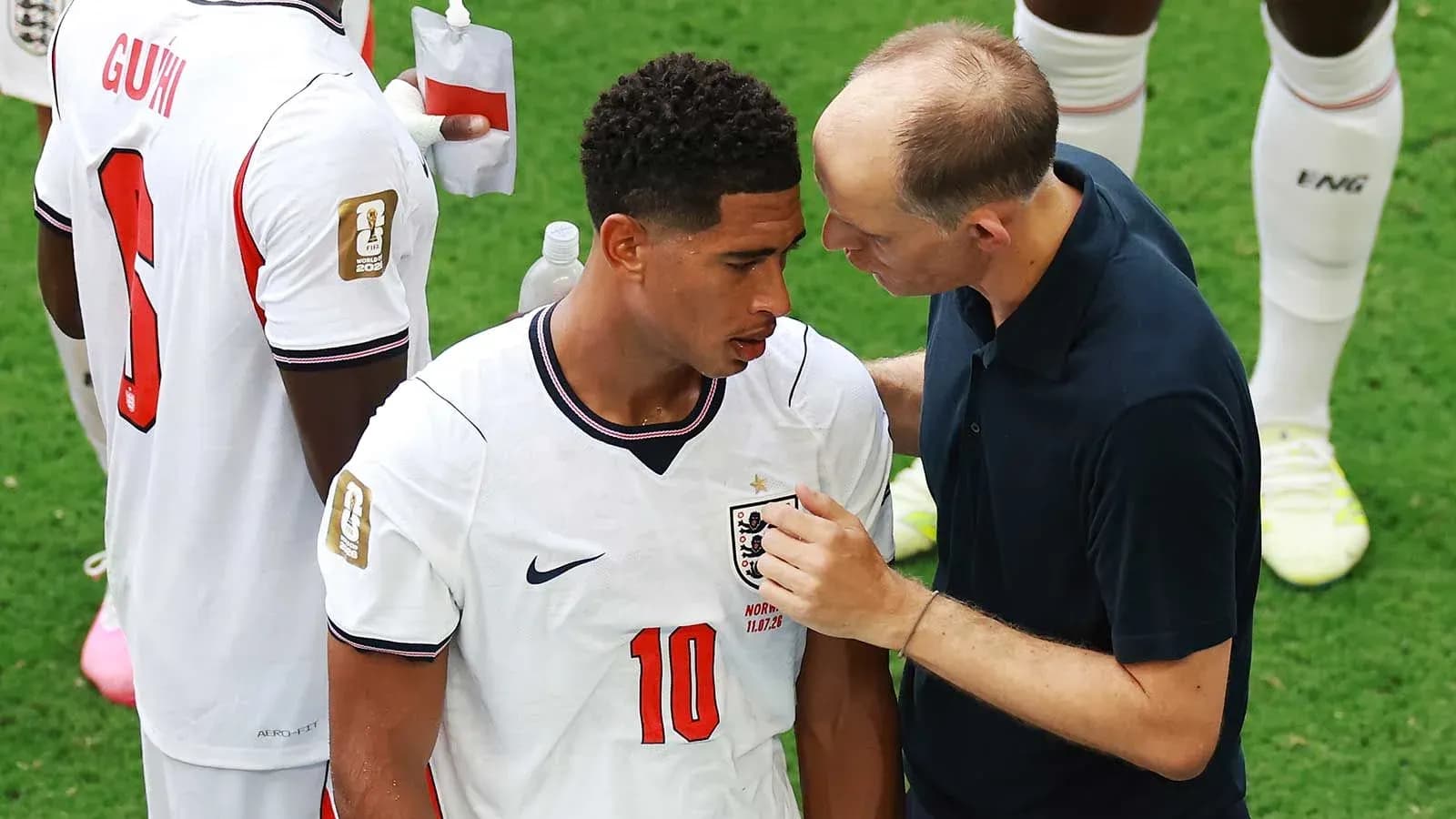
Thomas Tuchel and Jude Bellingham: Navigating Tensions Before Semi-Final
Thomas Tuchel walked into England’s semi-final week with a storm already swirling around him and his star midfielder. Again.
The relationship between the German head coach and Jude Bellingham has been under the microscope ever since last summer, when Tuchel’s mother described some of the midfielder’s on-field behaviour as “repulsive”. An apology followed, the noise died down, and both men moved on. Or so it seemed.
England’s 2-1 extra-time quarter-final win over Norway dragged the story back into the spotlight. The result was there, the performance less so. Tuchel said he was “not happy with the team performance”. Bellingham, emotionally drained and still running hot from 120 minutes of knockout football, pushed back and called for more positivity.
The headlines wrote themselves. Player v coach. Ego v authority. Old wound, new angle.
Tuchel, though, was having none of it.
The following day he gathered his squad and addressed it head-on. No sulking, no passive-aggressive distance. Just a meeting to clear the air before a semi-final against Argentina that will define England’s summer.
“I wonder who blows these things up, eh?” he told talkSPORT. “So, there is nothing to blow up and if it's blown up, it's blown up in the media, of course.”
The Germany-born coach then went to work defending his midfielder as fiercely as he had criticised the team performance.
“What do you expect of a player that just played 120 minutes and gave literally everything,” Tuchel said, outlining how his post-match remarks had been chopped down to the negative soundbites. “If you shorten the comment of his coach, if you don't tell him that ‘he was world class,’ if you don't tell him that ‘he has world class actions’… If you just cut all this and tell him ‘oh, your coach said you were sloppy’ what do you expect?”
That, in Tuchel’s eyes, is where the crack appeared — not between him and Bellingham, but between context and the way it was presented to the player in the flash interview.
“Yeah, of course you get the comment that you get,” he continued. “Then you try to blow it up and people try to create misunderstandings and cracks where no cracks are. We come from the same place. We come from being competitive and I am a competitive coach. I push this team to the limit and that was my assessment.”
The pressure finally told in the mixed zone. Bellingham, still wired from the game, seemed to jab at Tuchel’s modest playing background, suggesting “maybe he doesn't know what it's like to play in those kind of conditions” or to face a striker of Erling Haaland’s level.
For some coaches, that would sting. For Tuchel, it became another line in a long-running discussion about whether elite playing careers are a prerequisite for elite coaching.
He rejected that idea outright. No hint of insecurity, just a clear conviction that his authority does not rest on how many top-flight minutes he once played.
“I think the question was unfair in this moment towards Jude,” he said of the flash-interview exchange, arguing that the player had been fed only the harshest parts of his analysis. “He cut all the compliments out of my assessment and just asked about the critical points, so I can understand. What do you expect of a player that just gave everything and stands there in front of a microphone in a flash interview?”
That empathy matters. It is not the language of a coach at war with his star. It is the language of someone who knows how thin the line is between emotional honesty and perceived insubordination after a draining knockout tie.
Tuchel insists the relationship is not only intact, but thriving.
“It's just what it is but we're as close as ever, and close more than ever before,” he said. “You can see that on the field. The energy and mentality in camp is excellent in the last days and we are ready to go for it tomorrow.”
There is a deeper layer to all this. Tuchel has never hidden the fact that he still carries the perspective of someone who never expected to stand where he stands now: in the England dugout, on the edge of major tournament history.
“I would still like to have a player's career, that was my dream,” the former Chelsea boss admitted. “I never thought about being a coach, never dreamt about being a coach on that kind of level, so I think this is basically the dream. I just feel also on the sideline very humbled, and from time to time it just strikes me on the sideline right before the match ‘I couldn't play here on this occasion.’”
He knows exactly what he wasn’t. He is equally clear about what he is.
“I don't think that you have to play [to be a coach],” Tuchel said, before reaching for a line that sums up his stance. “A funny quote, you don't have to be a horse to be a good jockey!”
The tension with Bellingham, then, sits in that space where modern football so often lives: between emotion and optics, between the rawness of the dressing room and the distortion of the microphone.
On the training pitch, Tuchel sees a 23-year-old driving England forward. On the touchline, Bellingham sees a coach demanding more, always more. Both, by Tuchel’s account, are cut from the same competitive cloth.
The noise will not stop before Argentina. It rarely does at this stage of a tournament. The real test now is simple: when the whistle goes and the stakes spike again, does that shared edge turn England into something ruthless, or rip at the seams they insist are still holding firm?

