.svg&w=384&q=75 "GoalGist logo")
Sunderland's Impressive Victory Over Everton: Match Analysis
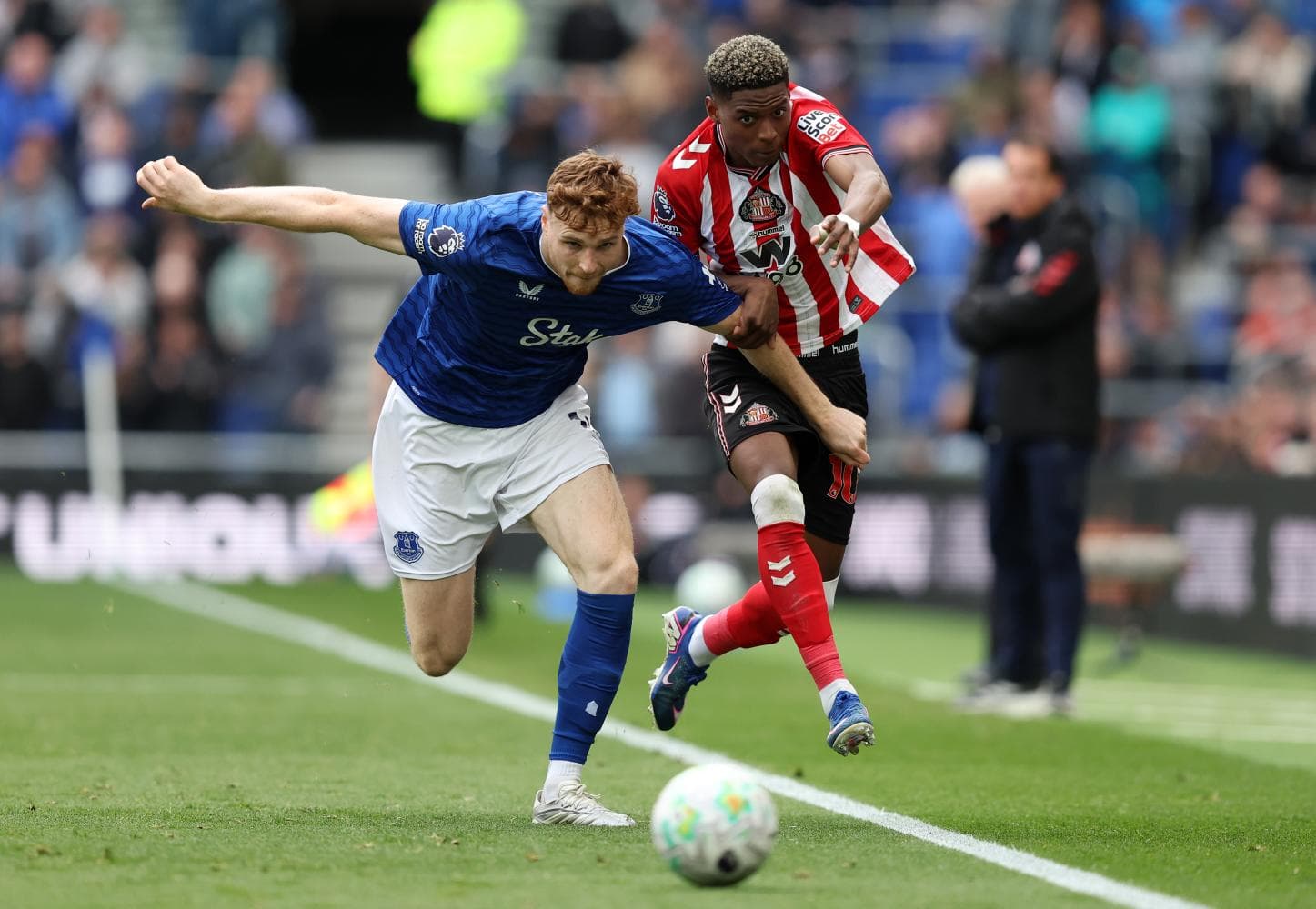
Everton 1–3 Sunderland at Hill Dickinson Stadium, a result that dents Everton’s hopes of a top-half finish while significantly boosting Sunderland’s late push for the upper reaches of the Premier League table. Everton slip further off the European conversation, while Sunderland strengthen their position in the top half with a statement away win.
Everton started the afternoon on the front foot, but the first major intervention came from Sunderland on 23 minutes when Luke O'Nien replaced Omar Alderete, an early defensive reshuffle that hinted at concern over Everton’s early pressure. Two minutes later, Everton’s aggression without the ball was underlined as Tim Iroegbunam collected a yellow card for tripping in midfield on 25 minutes, breaking up a Sunderland transition.
The hosts turned their territorial edge into a lead just before the interval. On 43 minutes, Merlin Röhl struck the opener for Everton, finishing a move that began from the back, with Michael Keane credited for the assist after stepping out of defence and feeding Röhl, who applied the decisive touch. Everton took that 1–0 advantage into half-time.
Early in the second half, the tone shifted. Just two minutes after the restart, at 47 minutes, Jake O'Brien was booked for holding, another yellow card that reflected Everton’s increasing need to disrupt Sunderland’s growing rhythm. The visitors’ pressure told just before the hour: on 59 minutes, Brian Brobbey levelled the match for Sunderland, finishing clinically from a pass by Enzo Le Fée, whose slide-rule ball opened up Everton’s back line.
Sunderland immediately doubled down on their momentum. On 60 minutes, Chemsdine Talbi replaced Trai Hume, adding fresh legs higher up the pitch to press Everton’s build-up. Everton responded with a double change on 73 minutes, seeking to regain control in the final third: Tyrique George came on for the booked Iroegbunam, and Thierno Barry replaced Beto to provide a different profile in attack.
The decisive spell arrived in the final quarter of an hour. Sunderland made a triple substitution on 77 minutes, fully re-energising their attacking structure: Chris Rigg replaced Nilson Angulo, Wilson Isidor came on for goalscorer Brobbey, and Habib Diarra replaced Noah Sadiki. The impact was almost immediate. On 81 minutes, Enzo Le Fée completed the turnaround, scoring Sunderland’s second after combining with Rigg, who provided the assist with a smart pass that Le Fée guided beyond Jordan Pickford.
Everton turned to their bench again on 88 minutes, chasing an equaliser. Dwight McNeil replaced Röhl to add crossing threat from wide areas, while Séamus Coleman came on for O'Brien to offer attacking thrust from full-back. But Sunderland exploited the spaces Everton left behind in stoppage time. In the 90+1 minute, Wilson Isidor added a third for the visitors, finishing off a break after being set up by Habib Diarra, whose forward pass released Isidor to seal the contest.
There was still time for one final disciplinary note: at 90+6 minutes, James Garner was shown a yellow card for tripping, a late sign of Everton’s frustration as Sunderland comfortably saw out a commanding away victory.
Fixture Statistics & Tactical Audit
- xG (Expected Goals): Everton 1.07 vs Sunderland 0.73
- Possession: Everton 49% vs Sunderland 51%
- Shots on Target: Everton 4 vs Sunderland 3
- Goalkeeper Saves: Everton 0 vs Sunderland 3
- Blocked Shots: Everton 2 vs Sunderland 0
The underlying numbers suggest the scoreline slightly flatters Sunderland, but not by a huge margin. Everton edged xG (1.07 vs 0.73) and led in total shots (10 vs 7), indicating they fashioned the marginally better chances but failed to convert pressure into goals with enough efficiency (1 goal from 4 shots on target). Sunderland, by contrast, were markedly more ruthless in front of goal, scoring three times from just three shots on target, a level of clinical finishing underpinned by sharp decision-making in transition (3 goals from 0.73 xG). Possession was virtually even (51% to Sunderland, 49% to Everton), but Sunderland’s slightly higher share came with more control in the decisive phases, while Robin Roefs’ three saves and a compact defensive shape ensured Everton’s pressure rarely translated into clear, repeatable chances.
Standings Update & Seasonal Impact
Everton began the day on 49 points with a goal difference of -2, having scored 47 and conceded 49 across 37 matches. This 1–3 defeat adds one goal to their “for” column and three to their “against”, moving them to 48 goals scored and 52 conceded. Their new goal difference drops to -4, and they remain on 49 points after 38 games. That leaves Everton still in mid-table, with their late-season form (now extending a poor run) effectively ending any faint hopes of pushing into the European places and leaving them looking over their shoulder at rivals closing the gap in the congested middle of the table.
Sunderland came into the fixture on 51 points with a goal difference of -7, having scored 40 and conceded 47 from 37 matches. Scoring three and conceding once at Hill Dickinson Stadium lifts their season totals to 43 goals for and 48 against. Their goal difference improves to -5, and they move up to 54 points after 38 games. That tally consolidates their top-half status and potentially narrows the gap to the European-chasing pack above, keeping alive an outside chance of climbing further depending on other results in the title-race and European qualification picture.
Lineups & Personnel
Everton Actual XI
- GK: Jordan Pickford
- DF: Jake O'Brien, James Tarkowski, Michael Keane, Vitaliy Mykolenko
- MF: James Garner, Tim Iroegbunam, Merlin Röhl, Kiernan Dewsbury-Hall, Iliman Ndiaye
- FW: Beto
Sunderland Actual XI
- GK: Robin Roefs
- DF: Lutsharel Geertruida, Nordi Mukiele, Omar Alderete, Reinildo Mandava
- MF: Granit Xhaka, Noah Sadiki, Trai Hume, Enzo Le Fée, Nilson Angulo
- FW: Brian Brobbey
Expert's Post-Match Verdict
This was a lesson in game management and efficiency from Sunderland. Regis Le Bris set his side up in a compact 4-2-3-1 that accepted Everton’s early pressure but trusted in transition moments, and the data supports that approach: fewer shots but higher conversion (3 goals from 3 shots on target) points to clinical finishing and smart shot selection (0.73 xG turned into 3 goals). His in-game adjustments were decisive; the triple substitution on 77 minutes, introducing Chris Rigg, Wilson Isidor and Habib Diarra, directly influenced the second and third goals, underlining the impact of Sunderland’s bench.
For Leighton Baines and Everton, this felt like a structural rather than purely individual failure. Despite edging xG and total shots (1.07 xG, 10 shots, 4 on target), Everton lacked the cutting edge to turn promising positions into truly high-quality chances, while their defensive line repeatedly struggled with Sunderland’s vertical passes after the break. The late changes, including Tyrique George and Thierno Barry, added energy but did not resolve issues in rest defence, leaving them exposed to counters. Conceding three times from three shots on target, while registering no saves, highlights a defensive collapse at key moments rather than a sustained siege, and leaves Everton with significant questions about their balance between attack and protection heading into the final stretch of the season.