.svg&w=384&q=75 "GoalGist logo")
Spain Dominates Austria 3-0 in World Cup Round of 32
Spain’s 3-0 win over Austria at SoFi Stadium in this World Cup Round of 32 tie was a textbook demonstration of territorial control and structured domination. The scoreline reflected a game in which Spain compressed the pitch, dictated tempo, and systematically dismantled Austria’s defensive block, while never allowing a single shot on target against them.
Spain’s approach was built on a high-possession, positional framework. With 65% of the ball and 629 passes (570 accurate, 91%), Luis de la Fuente’s side circulated relentlessly from the back, using Aymeric Laporte and Pau Cubarsí as secure launch points. The full-backs, Pedro Porro and Marc Cucurella, operated almost as auxiliary playmakers: Porro stretching wide on the right to pin Austria’s wing and Cucurella stepping into the half-space on the left, where he twice combined decisively with Mikel Oyarzabal for goals.
Rodri anchored the midfield as the single pivot, the reference point around which Spain’s structure rotated. His presence allowed Pedri and Alex Baena to position themselves higher between Austria’s midfield and defensive lines, constantly offering vertical lanes. Lamine Yamal’s nominal role as a midfielder was effectively that of an inside-right playmaker, starting from a wide area but drifting centrally to overload the pockets around Marcel Sabitzer and Nicolas Seiwald.
The attacking pattern was clear: Spain created a 3-2 base in build-up, with one full-back tucking in and the other pushing on, then funneled play into the half-spaces before switching quickly to the far side. That approach underpinned the volume of chances: 23 total shots, 10 on goal, 15 from inside the box, and 7 blocked. The xG of 2.84 aligns closely with the three goals, indicating sustained, high-quality chance creation rather than opportunistic finishing.
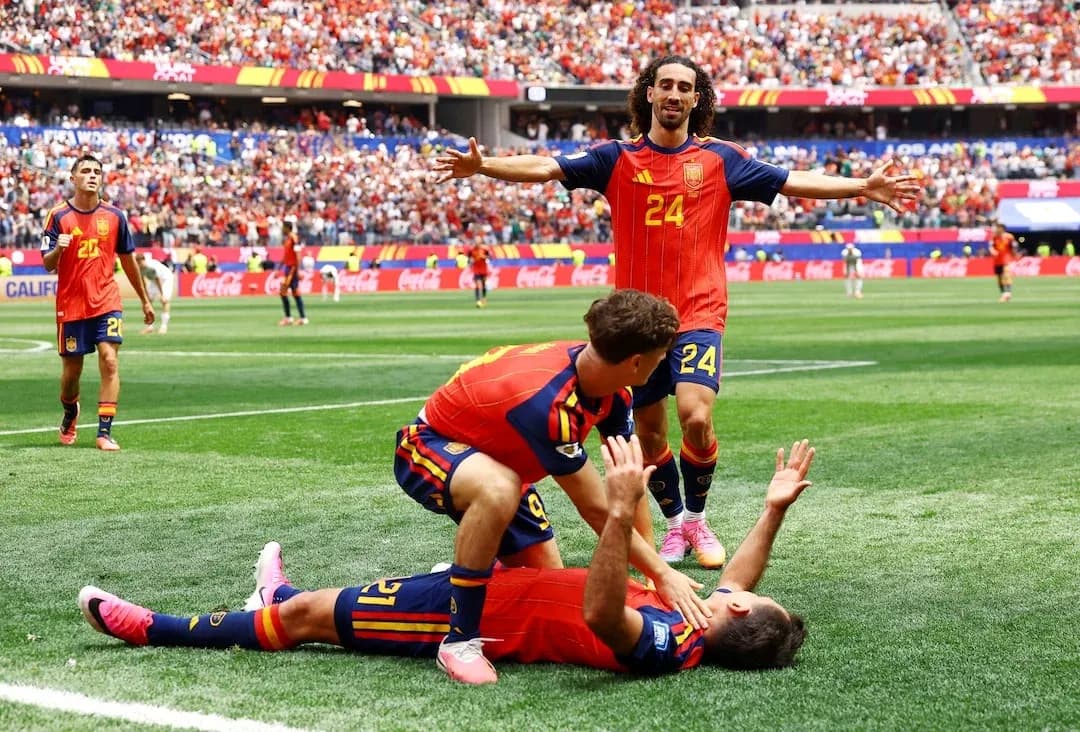
Oyarzabal’s opener at 36 minutes, assisted by Cucurella, was emblematic. Spain had already forced Austria into deep retreat, and the goal came from a patiently constructed move that manipulated the Austrian back line horizontally before finding Oyarzabal in a decisive pocket. The second goal at 66 minutes, Pedro Porro finishing from an Alex Baena assist, highlighted Spain’s capacity to attack from the opposite flank after drawing Austria over to one side. The third at 89 minutes, again Oyarzabal from another Cucurella delivery, underlined how Spain’s left-sided overloads remained effective even late, with Austria’s structure fatigued and stretched.
Without the ball, Spain’s dominance was as striking. Austria managed only 5 total shots, with none on goal and just 1 blocked effort. The Spanish press was well-timed rather than frenzied: the first line, led by Oyarzabal, curved its runs to cut off central access into Sabitzer, forcing Austria wide or long. Behind them, Rodri and the advanced midfielders squeezed second balls, keeping Austria from establishing any controlled possession phases. The defensive line held an aggressive height, comfortable knowing Austria rarely had the time or angle to play in behind.
Unai Simón (Spain) had an almost passive evening in terms of direct action, with Spain registering 0 goalkeeper saves. That number is not a reflection of indifference but of structural control: Austria simply did not reach situations where a save was required. By contrast, Alexander Schlager (Austria) was heavily involved, making 6 saves as Spain repeatedly broke through the last line. Austria’s negative goals prevented figure (-0.57) suggests that, relative to the quality of chances faced, their goalkeeping underperformed slightly, compounding the defensive strain.
Ralf Rangnick’s Austria set up with a back line featuring Stefan Posch, Kevin Danso, David Alaba, and Konrad Laimer, aiming for compactness and vertical transitions. However, with only 35% possession and 346 passes (284 accurate, 82%), they struggled to connect their first and second lines. The early double change at 46 minutes — Carney Chukwuemeka (IN) came on for Nicolas Seiwald (OUT) and Florian Grillitsch (IN) came on for Xaver Schlager (OUT) — was a clear attempt to inject more ball progression and press resistance. Yet Spain’s control of central zones meant Austria rarely progressed beyond the middle third with structure.
Austria’s attacking reference, Michael Gregoritsch, was isolated enough that he was withdrawn on 60 minutes, with Marko Arnautović (IN) coming on for Michael Gregoritsch (OUT), and Saša Kalajdžić (IN) replacing Romano Schmid (OUT) at the same time to add aerial presence and a dual-striker threat. Even then, Spain’s centre-backs managed distances expertly, winning first contacts and, crucially, having midfielders in position to claim second balls.
Discipline also mirrored the tactical story. Austria committed 15 fouls to Spain’s 8, often arriving late into duels as they chased play. The only card of the match came at 83 minutes: Stefan Posch (Austria) — Foul. It encapsulated Austria’s reactive defending, frequently forced into last-ditch interventions as Spain rotated the ball around their block. Moments later, Posch was withdrawn, with Alexander Prass (IN) coming on for Stefan Posch (OUT) at 85 minutes, a move that added fresh legs but could not alter the game’s trajectory.
Spain’s substitutions were tailored to maintain control rather than chase the game. At 71 minutes, Mikel Merino (IN) came on for Dani Olmo (OUT) and Ferran Torres (IN) came on for Alex Baena (OUT), adding energy and preserving the press. Later, Pablo Gavi (IN) came on for Lamine Yamal (OUT) at 85 minutes, then Marc Pubill (IN) for Aymeric Laporte (OUT) and Fabián Ruiz (IN) for Pedri (OUT), both at 90 minutes, ensuring defensive stability and possession security through to full time.
Statistically, the verdict is unambiguous. Spain’s 3-0 win, supported by an xG of 2.84, 10 shots on goal, and 65% possession, reflects a performance where process and outcome aligned. Austria’s 0.32 xG, 5 shots with none on target, and 0 corners illustrate how comprehensively they were contained. The card count — Spain: 0, Austria: 1, Total: 1 — underlines that this was not a chaotic contest but a controlled, one-sided tactical exhibition, with Spain’s structure suffocating Austria and efficiently converting territorial dominance into a place in the next round.