.svg&w=384&q=75 "GoalGist logo")
Portugal’s Tactical Mastery in 2-1 Victory Over Croatia
Portugal’s 2-1 victory over Croatia at BMO Field in this World Cup Round of 32 tie was defined by structural control versus transition threat. Roberto Martinez kept Portugal in a textbook 4-2-3-1, using the double pivot to dominate possession and compress Croatia’s midfield. Zlatko Dalic mirrored the 4-2-3-1 but with a deeper block and a clear intent to break through Ante Budimir and the wide midfielders attacking the space behind Portugal’s advanced full-backs.
With 61% of the ball and a 584–368 passing advantage, Portugal built patiently from Diogo Costa through Rúben Dias and Renato Veiga, using João Cancelo and Nuno Mendes as high, aggressive full-backs. The double pivot of João Neves and Vitinha gave Portugal a stable rest-defense: one holding behind the ball while the other stepped into half-spaces to connect with Bruno Fernandes and Rafael Leão. This allowed Portugal to sustain pressure, reflected in 15 total shots and 9 corners, and to pin Croatia back for long spells.
Croatia’s plan hinged on Modrić and Mateo Kovačić orchestrating from deeper zones, with Nikola Vlašić and Martin Baturina tucking inside to overload central areas while Ivan Perišić advanced from left-back. That asymmetry was crucial: Perišić’s high starting position and license to attack the back post helped Croatia create their best moments, including his 53rd-minute goal. By then, Croatia had already shown they could bypass Portugal’s counter-press with direct, vertical passes into Budimir and quick wide switches, generating 13 shots and 10 efforts inside the box despite their lower possession.
The disciplinary pattern also influenced the tactical tone. An early yellow for Rúben Dias (“Elbowing” at 17') forced Portugal’s center-back pairing to manage duels more cautiously, which Croatia tried to exploit with Budimir’s physical presence. Modrić’s booking for “Tripping” at 59' curtailed his aggression in counter-pressing, subtly weakening Croatia’s ability to disrupt Portugal’s build-up high.
The match hinged on how both coaches managed the 4-2-3-1 structure through substitutions. Dalic’s first move at 46' — Igor Matanović (IN) came on for Ante Budimir (OUT) — slightly changed Croatia’s reference point up front. Matanović offered more mobility than a pure target, encouraging Croatia to attack space behind Portugal’s line rather than play into feet. This helped create the platform for Perišić’s opener, as Croatia found joy attacking the left channel and exploiting Portugal’s advanced full-backs.
Martinez responded with a triple attacking recalibration between 62' and 63'. Bernardo Silva (IN) came on for Vitinha (OUT), Francisco Conceição (IN) came on for Pedro Neto (OUT), and Nélson Semedo (IN) came on for João Cancelo (OUT). These changes collectively sharpened Portugal’s right side: Bernardo gave more positional intelligence between the lines, Francisco Conceição added direct 1v1 threat, and Semedo provided a more balanced, defensively secure profile than Cancelo. The result was a clearer right-sided overload to complement Rafael Leão’s constant stretching on the left.
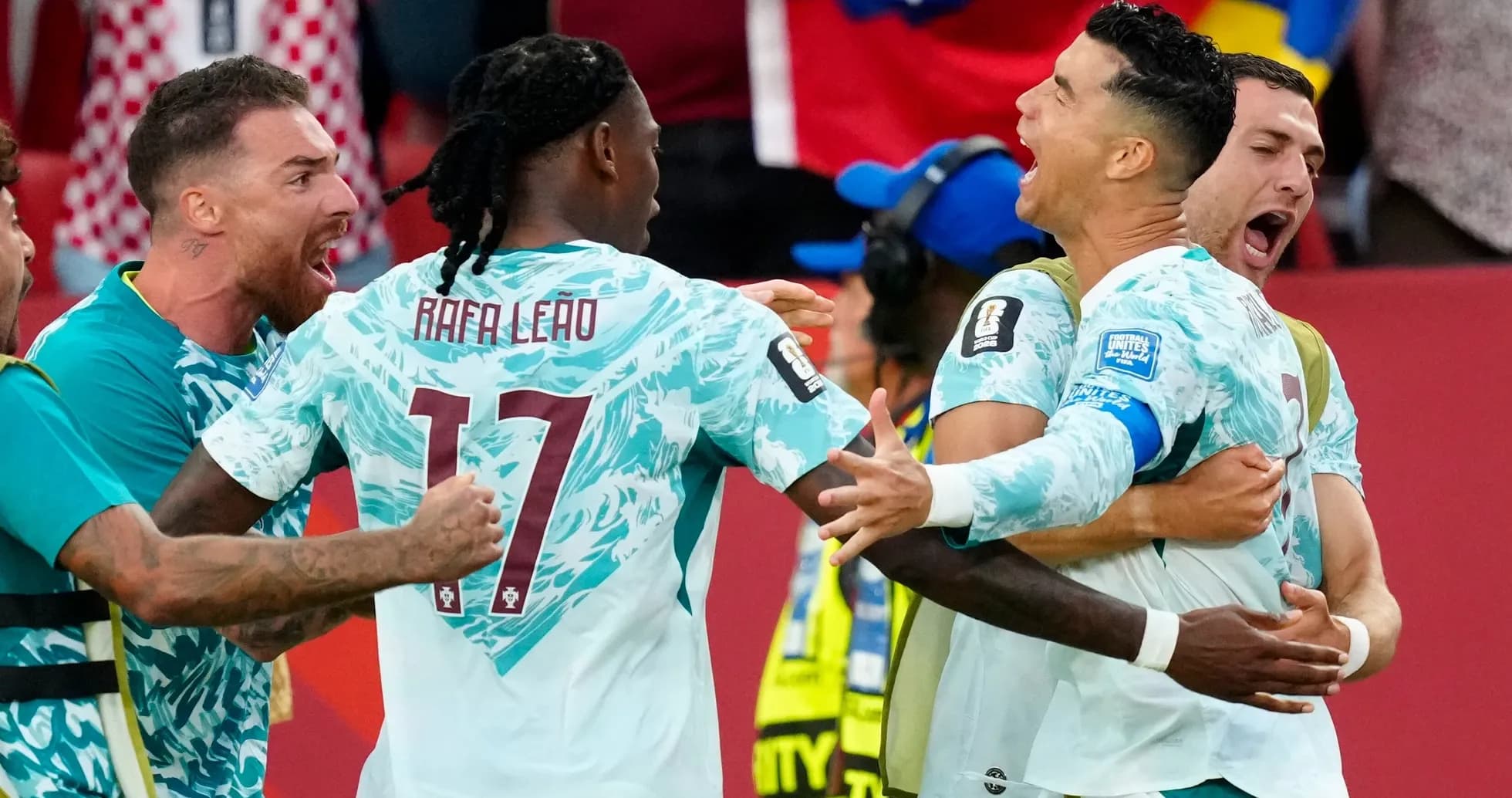
Cristiano Ronaldo’s penalty at 68' was the tactical reward for this territorial dominance and box occupation: Portugal’s 10 shots inside the area, compared to Croatia’s 10 from far less possession, underline how often they managed to install their striker and attacking midfielders in dangerous central zones. Earlier, a potential goal by Ronaldo had been disallowed by VAR for offside at 61', showing how consistently Portugal were getting him into finishing positions.
Croatia tried to reassert midfield control with Mario Pašalić (IN) coming on for Martin Baturina (OUT) at 68', aiming for more late box runs and physicality around second balls. Later, Josip Gvardiol (IN) came on for Nikola Vlašić (OUT) at 90+2', adding an extra defender and aerial power as Croatia chased a chaotic finish, and Andrej Kramarić (IN) came on for Mateo Kovačić (OUT) at 90+6' to stack the frontline with another finisher. These changes pushed Croatia into a more direct, high-risk shape, reflected in multiple late VAR interventions against them for offside (Petar Sučić at 81', Gvardiol at 90+13') as they overloaded the last line.
The decisive moment, however, belonged to Portugal’s bench: Gonçalo Ramos (IN) came on for Cristiano Ronaldo (OUT) at 81', and in 90+4' he converted from close range after Rafael Leão attacked the left channel and delivered the assist. This sequence encapsulated Portugal’s tactical arc: sustained possession, wide isolation for Leão, and a fresh penalty-box striker exploiting a tiring Croatian back line.
In goal, Diogo Costa (Portugal) made 5 saves, underpinning Portugal’s high line by confidently dealing with Croatia’s 6 shots on target and several box entries. His presence allowed the defensive unit to hold an aggressive starting position and commit numbers forward. At the other end, Dominik Livaković (Croatia) made 2 saves, a number that reflects Portugal’s shot profile: many efforts were either off target, blocked (4 blocked shots), or from close range where finishing quality rather than volume decided outcomes.
Statistically, the xG split — 2.18 for Portugal against 1.34 for Croatia — confirms that the 2-1 scoreline tracked the quality of chances created. Portugal’s higher xG, more total shots, and superior passing accuracy (584 passes, 532 accurate, 91%) show a side in control of territory and tempo, consistently constructing high-value situations in the box. Croatia’s 368 passes with 311 accurate (85%) and 39% possession illustrate a reactive, transition-oriented approach that nonetheless produced credible threat, particularly via Perišić and their late, more direct phases.
Discipline also framed the risk profiles: Portugal finished with 1 yellow card, Croatia with 2 (including Perišić’s late “Unsportsmanlike conduct” at 90+8'). Combined with Croatia’s 12 fouls to Portugal’s 6, this underlines how often Dalic’s side were forced into emergency defending and tactical infringements to disrupt Portugal’s positional attacks.
Overall, the tactical verdict is of a Portugal side using a well-drilled 4-2-3-1 and strong ball circulation to gradually suffocate Croatia, while Dalic’s team relied on structural tweaks and direct play to keep the tie alive. Portugal’s bench impact and superior box management ultimately tilted a finely balanced knockout contest in their favor.