.svg&w=384&q=75 "GoalGist logo")
Paris Saint Germain vs Arsenal: UEFA Champions League Final Preview
On 30 May 2026, under the sweeping stands of Puskas Arena in Budapest, Paris Saint Germain and Arsenal walk out knowing that one night will define their year in the UEFA Champions League. Paris Saint Germain arrive as dangerous outsiders from the play-off path, while Arsenal come in as the competition’s benchmark side, top of the standings phase. In a neutral cauldron, with the trophy and continental supremacy at stake, it is the French side’s firepower against the English club’s relentlessness on the biggest stage of all.
Season Context
For Paris Saint Germain, this campaign has been about turning attacking flair into a deep run. They come into this final having taken 14 points from 8 matches, scoring 21 goals and conceding 11, numbers that underline a potent but occasionally open side (21 goals for, 11 against). Ranked 11th in the overall table and coming from a “Promotion - Champions League (Play Offs: 1/16-finals)” position, they have already punched above their initial bracket to stand 90 minutes from glory.
Arsenal’s path has been one of near-perfection. They top the standings in the UEFA Champions League with 24 points from 8 games, winning every match along the way (8 wins, 23 goals scored, 4 conceded). A goal difference of +19 reflects a team that has combined ruthless efficiency in front of goal with a miserly defence (23 scored, only 4 conceded). From a “Promotion - Champions League (Play Offs: 1/8-finals)” berth, they have justified their status as the competition’s standard-setters.
Form & Momentum
Paris Saint Germain’s form line of DLDWL hints at inconsistency, but the underlying numbers show why they remain such a threat (21 goals from 8 games, averaging 2.63 per match). That attacking output makes them one of the most explosive sides in the competition, even if their 11 goals conceded (1.38 per game) reveal a vulnerability when games become stretched. Their ability to outscore opponents has carried them here, but the recent sequence suggests they can be disrupted (DLDWL).
Arsenal, by contrast, arrive in Budapest with a perfect recent run of WWWWW, fully in keeping with their flawless points haul (24 from 8). Their balance is striking: 23 goals scored (2.88 per game) and just 4 conceded (0.5 per game) paint the picture of a side that controls matches at both ends. That form string of WWWWW reflects a team that has been relentlessly efficient, rarely giving opponents a route back once they establish control.
Head-to-Head Patterns
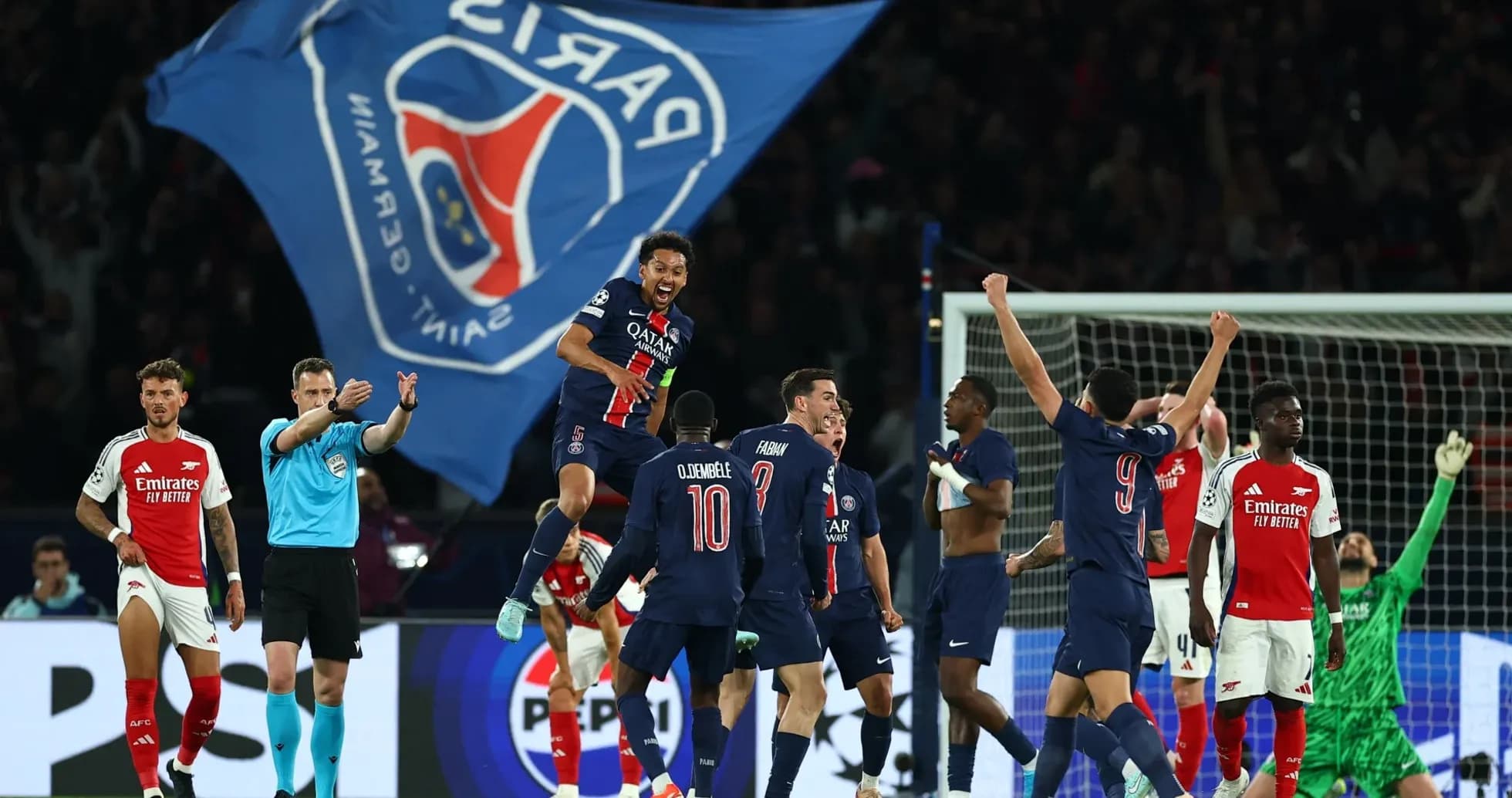
The recent European history between these clubs has been tight and dramatic. In the semi-finals of the UEFA Champions League, Paris Saint Germain edged Arsenal 2-1 in Paris on 7 May 2025, after leading 1-0 at half-time and holding their nerve in the closing stages ([2-1] (UEFA Champions League, season 2024, May 2025)). A week earlier at Emirates Stadium on 29 April 2025, Paris Saint Germain had also prevailed 1-0 away, striking before the interval and then defending their advantage with discipline ([0-1] (UEFA Champions League, season 2024, April 2025)). Go back to 1 October 2024 at Emirates Stadium and the picture flips, with Arsenal delivering a controlled 2-0 home victory, building a 2-0 lead by half-time and shutting the door thereafter ([2-0] (UEFA Champions League, season 2024, October 2024)). Across these three ties, the pattern is of fine margins, narrow scorelines and momentum swings between two elite sides.
Tactical Preview
Paris Saint Germain are expected to lean again on their familiar 4-3-3 structure, a system they have used in 16 matches in this competition. With 21 goals from 8 Champions League games (2.63 per match), they are built to attack, and the presence of high-end forwards is central to that plan. K. Kvaratskhelia, listed as an attacker, has been a driving force with 10 goals and 6 assists, backed by 30 shots and 18 on target, making him the natural focal point of their transitions and one-on-one situations. O. Dembélé, also an attacker, adds another cutting edge with 7 goals and 2 assists, his 24 shots and 13 on target underlining the volume of threat from the flanks. D. Doué, an attacker with 5 goals and 4 assists plus 50 attempted dribbles (23 successful), gives Paris Saint Germain a third creative outlet who can break lines off the wing.
Behind them, Vitinha as a midfielder offers control and tempo, his 1,553 completed passes at 93% accuracy and 23 key passes showing how Paris Saint Germain look to build through the middle before releasing their forwards. From deeper wide areas, A. Hakimi at defender brings width and progression, with 6 assists and 23 key passes pointing to his importance in overlapping runs and early deliveries. Defensively, Paris Saint Germain’s 11 goals conceded in 8 games (1.38 per match) suggest that while they can press high and commit numbers forward, there is space to exploit if their rest defence is not perfectly set.
Arsenal, with 23 goals scored and only 4 conceded in 8 matches, have a more balanced profile. Their team statistics show a preference for 4-3-3 (9 games) and 4-2-3-1 (5 games), systems that allow them to combine a strong midfield screen with wide attacking rotations. The defensive platform is formidable: just 4 goals against (0.5 per match) in the standings phase, supported by 9 clean sheets in the wider data, underline a structure that is both compact and disciplined. Midfielder Martín Zubimendi, despite being listed as a defender in the squad, has played as a key midfield presence in this competition, with 14 tackles, 10 interceptions and 4 yellow cards, embodying Arsenal’s aggressive but controlled approach to breaking up play.
In attack, Arsenal’s 23 goals (2.88 per game) are spread across a versatile front line. Gabriel Martinelli, listed as a midfielder, has contributed 6 goals and 2 assists, with 38 dribble attempts and 17 successes, making him a key outlet in wide areas and in transition. Around him, the broader squad depth in attacking roles like Gabriel Jesus, V. Gyökeres, K. Havertz, B. Saka and L. Trossard gives Arsenal multiple profiles to threaten Paris Saint Germain’s back line, whether they choose a more direct centre-forward or a fluid, interchanging front three. The predictions model’s comparison numbers lean slightly towards Arsenal overall (total 58.2% versus 42.0%), reflecting the sense that their structure and defensive solidity may be better suited to a tense final.
Statistical Snapshot
- Competition: UEFA Champions League, season 2025 — 30 May 2026.
- Venue: Puskas Arena, Budapest.
- Prediction: Win or draw — Double chance : draw or Arsenal.
- Win Probabilities: Home 10% / Draw 45% / Away 45%.
- Model: Paris Saint Germain 42.0% — Arsenal 58.2%.
Betting Verdict
The analytical picture tilts towards Arsenal’s resilience and balance: an immaculate 24 points from 8 games and just 4 goals conceded (0.5 per match) combine with a form line of WWWWW to support the “Win or draw” prediction. Paris Saint Germain’s attacking firepower (21 goals in 8, 2.63 per game) and recent head-to-head successes in April and May 2025 mean they cannot be discounted, but their DLDWL sequence and higher concession rate (1.38 per game) raise questions over their ability to contain Arsenal over 90 minutes. With most major bookmakers pricing the home win around 2.30–2.40 and the away win roughly in the 3.00–3.30 range, the value aligns with the model’s advice: the double chance on draw or Arsenal looks the more robust angle, especially given Arsenal’s defensive record and their 2-0 victory in October 2024 in this matchup. Expect a tight final in which Arsenal’s structure and depth give them a slight edge over Paris Saint Germain’s volatility.