.svg&w=384&q=75 "GoalGist logo")
Arsenal's Narrow 1–0 Victory Against Atletico Madrid
Arsenal edged a narrow 1–0 win over Atletico Madrid at Emirates Stadium in this UEFA Champions League semi-final, decided by a single first-half strike and then protected by disciplined, possession-based control. Mikel Arteta’s 4-2-3-1 used the ball to keep Atletico’s 4-4-2 at arm’s length, with Arsenal holding 54% possession and generating the higher attacking volume and xG. Diego Simeone’s side adjusted aggressively after the break with a wave of substitutions and more direct play, but they were held to just 0.53 xG and nine total shots. In a game of fine margins, Arsenal’s compact mid-block and secure build-up under pressure proved just enough to carry a 1–0 lead from half-time all the way to full-time.
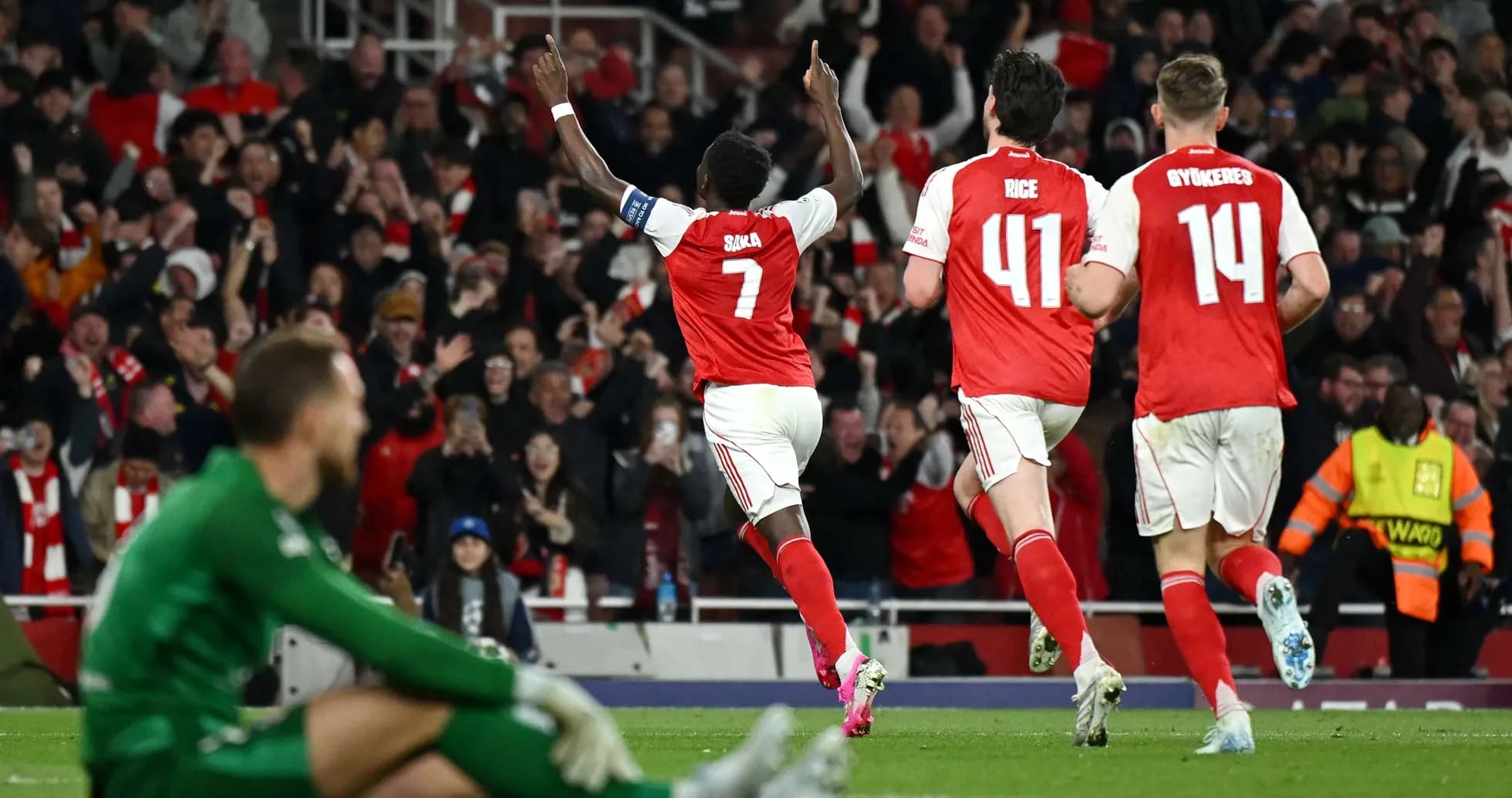
B. Saka’s goal at 44’ was the game’s only scoring action.
Operating from the right of the three behind V. Gyökeres, Saka found the decisive moment just before the interval, capitalising on Arsenal’s sustained territorial pressure and repeated entries into the box. With Arsenal already ahead 1–0 at the 45’ mark, that became the precise half-time score.
The disciplinary story began unusually early. At -5’, Kepa Arrizabalaga, listed as Arsenal substitute goalkeeper, received a yellow card for time wasting before the match had even kicked off, a rare pre-game caution that nevertheless set the tone for the referee’s strict management. Atletico’s cards came late and under pressure: Marc Pubill was booked at 81’ for a foul, reflecting his increasingly aggressive defending on Arsenal’s left-sided rotations, and Koke received a yellow card for a foul at 90+5’, as Atletico’s frustration peaked in stoppage time. Those were the only three cards shown: one yellow for Arsenal (Kepa Arrizabalaga, Time wasting) and two yellows for Atletico Madrid (Marc Pubill and Koke, both for fouls). There were no VAR interventions listed, no disallowed goals, and no red cards.
Second Half Substitutions
Substitutions reshaped the contest around the hour mark and defined the tactical battle of the second half. Simeone moved first at 57’, making three changes to chase the game and inject vertical threat. A. Sorloth (IN) came on for R. Le Normand (OUT), effectively sacrificing a centre-back to add a second striker with aerial and hold-up presence. Simultaneously, N. Molina (IN) came on for A. Lookman (OUT), adjusting the right flank balance from a more attack-minded wide midfielder to a full-back comfortable overlapping and delivering from deeper areas. In the same minute, J. Cardoso (IN) came on for G. Simeone (OUT), freshening central midfield legs and adding more ball-carrying from deep.
Arteta reacted instantly at 58’. On the right, N. Madueke (IN) came on for B. Saka (OUT), preserving the one-v-one dribbling threat against Atletico’s left side but with a slightly more direct, inside-cutting profile to exploit space if Atletico overcommitted. On the left of the back four, P. Hincapie (IN) came on for R. Calafiori (OUT), a like-for-like defensive change but with Hincapie offering a bit more pure duelling ability and recovery speed to cope with Atletico’s added striker. At 59’, the key creative axis shifted as M. Odegaard (IN) came on for E. Eze (OUT). Odegaard’s entry moved Arsenal from a more carry-and-drive No.10 to a classic positional playmaker, ideal for managing tempo and exploiting half-spaces once Atletico opened up.
Simeone’s second wave came at 66’, doubling down on attacking craft. A. Baena (IN) came on for A. Griezmann (OUT), trading star quality for fresh legs and late-arriving runs from midfield. At the same time, T. Almada (IN) came on for J. Alvarez (OUT), adding a more creative, between-the-lines forward to combine with Sorloth’s physical presence. These moves tilted Atletico towards a 4-2-3-1/4-2-4 hybrid in possession, with multiple players between Arsenal’s lines and frequent switches to stretch the back four.
Arteta’s response at 74’ was to stabilise the double pivot. M. Zubimendi (IN) came on for M. Lewis-Skelly (OUT), bringing a specialist holding midfielder into the six role. This tightened Arsenal’s central structure, improved their rest-defence against counters, and helped them close passing lanes into Sorloth’s feet and Almada’s pockets. Finally, at 83’, G. Martinelli (IN) came on for L. Trossard (OUT), giving Arsenal an outlet for direct transitions down the left, pinning back Pubill and limiting Atletico’s ability to overload that channel late on.
Goalkeeper Performances
In goal, D. Raya’s performance was defined by control rather than heroics. He faced two shots on target and made two saves, a modest but flawless shot-stopping line that aligned with the underlying numbers: Atletico’s xG of 0.53 suggests Arsenal’s defensive structure largely kept efforts to lower-quality zones. Raya’s distribution, supported by W. Saliba and Gabriel as the central pairing, underpinned Arsenal’s 444 total passes at 85% accuracy, allowing them to play through Atletico’s initial press and avoid the kind of turnovers Simeone’s sides thrive on.
At the other end, J. Oblak registered one save from Arsenal’s two shots on goal. The home side’s 1.58 xG from 13 total shots (six inside the box) shows they created the better chances, but not in overwhelming volume. Atletico’s back four, even after the reshuffle, limited clear-cut opportunities, while Oblak’s positioning meant that the margin between 1–0 and a potentially decisive second goal was thin. Both goalkeepers posted identical goals prevented figures of 0.02, underlining that the match was decided more by shot quality and game state than by extraordinary keeping.
Match Statistics
Statistically, Arsenal’s 54% possession and 5–2 advantage in corners reflect territorial control, while Atletico’s 13 fouls to Arsenal’s 10 and their two late yellow cards capture the increasing risk they took to recover the ball. Arsenal’s Overall Form in this match can be read as efficient rather than expansive: solid in build-up, effective in the final third just once, then pragmatic in game management. Defensively, their index on the night was strong: they conceded only nine shots, matched Atletico’s two shots on target, and held their shape even as Simeone moved to a more aggressive attacking structure. In a semi-final defined by control and detail, Arsenal executed their plan with enough precision to protect a slim but deserved 1–0 advantage.