.svg&w=384&q=75 "GoalGist logo")
Norway's Tactical Triumph Over Brazil in World Cup 2023
Brazil’s 2-1 defeat to Norway at MetLife Stadium in this World Cup Round of 16 tie was defined by a stark contrast between territorial control and chance quality. Norway, with 66% possession and 680 passes, dictated the rhythm, but Brazil’s more direct, transition-heavy approach produced the higher xG (2.73 to 0.84) and more shots (14 to 9). The game ultimately turned on Norway’s efficiency in the box and Brazil’s failure to convert their early and late penalty platforms into a broader attacking dominance.
Carlo Ancelotti set Brazil up to concede the ball but attack vertically through Vinícius Júnior, Matheus Cunha and the late-arriving midfielders. Despite no listed formation, the starters suggest a back four of Danilo, Marquinhos, Gabriel Magalhães and Douglas Santos behind a midfield trio of Casemiro, Bruno Guimarães and Rayan, with Gabriel Martinelli drifting inside from the left and Vinícius Júnior joining Cunha as the primary outlet. Brazil’s 34% possession and 329 passes underline that they were content to play without the ball, but the shot profile – 10 of 14 efforts from inside the box and 4 blocked – shows they consistently reached dangerous central zones when they did break.
Norway, under Stale Solbakken, leaned into a structured, possession-first plan. With Martin Ødegaard, Sander Berge and Patrick Berg in midfield, they built through short combinations, reflected in 91% pass accuracy (617 accurate of 680). The front three of Antonio Nusa, Erling Haaland and Alexander Sørloth were tasked with stretching Brazil’s back line, but Norway’s total of just 9 shots (7 inside the box) indicates that, despite territorial control, they struggled to turn phases of possession into volume of chances. Instead, they relied on a few high-impact moments, especially Haaland’s movement on the last line.
First Half
The early turning point tactically was the 12th-minute VAR intervention confirming a Brazil penalty for Matheus Cunha. Although Bruno Guimarães then produced a “Missed Penalty” at 14', the sequence exposed Norway’s vulnerability when defending sudden vertical attacks: Brazil’s forwards could isolate and unbalance the back line quickly, even against a settled block. From there, Norway tightened their penalty-box defending, and Brazil’s best chances increasingly came from broken play and second balls rather than sustained pressure.
Second Half
The second half was shaped immediately by Norway’s double change at 46', with Andreas Schjelderup (IN) coming on for Antonio Nusa (OUT) and Oscar Bobb (IN) for Alexander Sørloth (OUT). These moves recalibrated the front line around Haaland as the fixed reference point, with Schjelderup offering more between-the-lines craft and Bobb adding ball-carrying from deeper zones. The effect was to link Norway’s possession more directly to their centre-forward and reduce the disconnect that had limited first-half penetration.
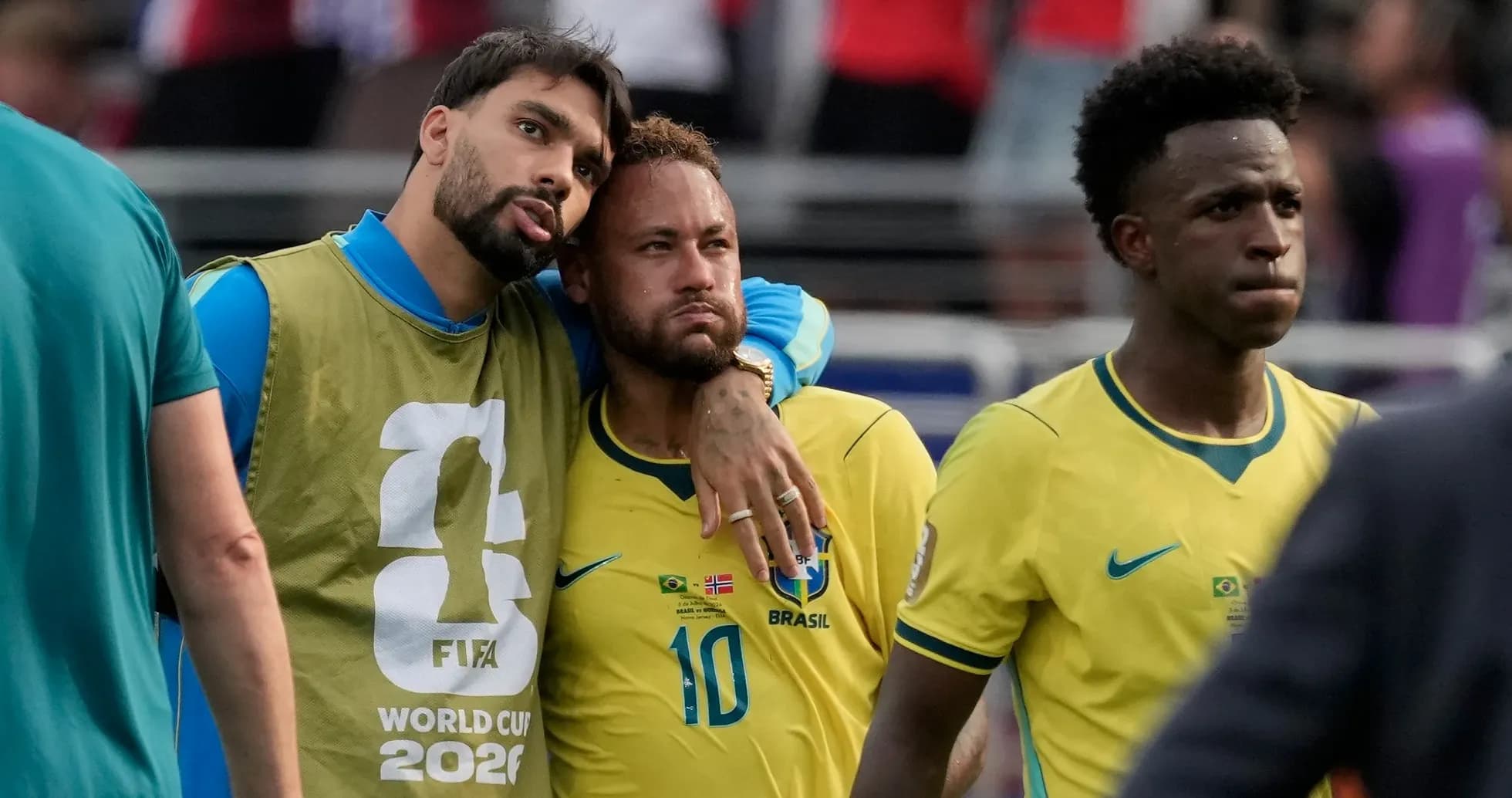
Ancelotti’s response came later and was more aggressive. At 58', Endrick (IN) came on for Matheus Cunha (OUT), introducing a more explosive, penalty-box-oriented presence. At 68', Danilo Santos (IN) replaced Rayan (OUT) and Neymar (IN) replaced Gabriel Martinelli (OUT), tilting Brazil into a more attacking, risk-embracing structure with Neymar operating as a central playmaker. At 79', Éderson (IN) came on for Bruno Guimarães (OUT), further refreshing the midfield legs to support late pressure. These changes pushed Brazil higher, increased the number of runners around the box and contributed to the late penalty that Neymar converted at 90+9', but they also opened transition lanes that Norway exploited.
Norway’s key structural tweak came at 63', when Fredrik Aursnes (IN) replaced Julian Ryerson (OUT). This added another technically secure midfielder to protect possession and help Norway manage Brazil’s growing attacking thrust. Combined with the earlier introduction of Schjelderup and Bobb, Norway’s midfield box around Ødegaard became central to controlling tempo and denying Brazil repeated waves of transition.
The decisive tactical pattern, however, was Norway’s exploitation of Haaland’s presence against a Brazilian defence that had to increasingly defend larger spaces. Haaland’s “Normal Goal” at 80', assisted by Schjelderup, epitomised this: Norway finally converted sustained possession into a vertical, penetrative action, with Schjelderup finding Haaland in a channel Brazil had struggled to protect once their full-backs pushed on. The second “Normal Goal” at 90', again Haaland assisted by Schjelderup, underlined the same theme – Norway’s capacity to be brutally efficient in the few moments when they broke through Brazil’s initial pressure.
From a defensive-structure standpoint, Brazil’s back four was asked to defend long stretches without the ball but still maintain compactness. The fact that Norway registered only 5 shots on target from 66% possession suggests Brazil’s block was initially well-organised. Yet, as substitutions tilted the side forward, the distances between Casemiro and the centre-backs grew, leaving more space for Ødegaard and Schjelderup to receive and turn. Norway’s 5 corner kicks to Brazil’s 5 reflect parity in set-piece volume, but the open-play control was increasingly Norwegian.
In goal, Alisson (Brazil) faced 5 shots on target and made 3 saves, with 0.76 goals prevented, indicating he performed to a solid level and limited the damage given the quality of Norway’s best chances. Ørjan Nyland (Norway), dealing with 4 shots on target and making 4 saves, also posted 0.76 goals prevented, underlining his importance, especially around the penalty incidents and Brazil’s late surge. Both goalkeepers’ metrics align with the tactical story: Brazil created more and better chances but were repeatedly denied at key moments, while Norway relied on their keeper to preserve the platform for Haaland’s decisive interventions.
Discipline and control also played a role. Brazil committed 7 fouls to Norway’s 6, and the only card of the match was Neymar’s Yellow Card for “Foul” at 90+6'. That late booking encapsulated Brazil’s increasingly desperate attempts to recover possession after pushing numbers forward in search of an equaliser.
Statistically, the verdict is of a match where process and outcome diverged for Brazil. Their higher xG, greater shot volume and heavy concentration of attempts inside the box suggest a game plan that, on another day, yields progression. Norway, by contrast, maximised their possession-based approach not by flooding the shot count but by engineering a small number of high-leverage situations for their elite finisher. In tactical terms, Solbakken’s adjustments around Haaland and Schjelderup proved more decisive than Ancelotti’s attacking reshuffle, as Norway converted control into clinical, late-game punishment while Brazil’s structural risk-taking went unrewarded on the scoreboard.