.svg&w=384&q=75 "GoalGist logo")
Napoli's Title Push Bruised by Bologna's 3-2 Victory
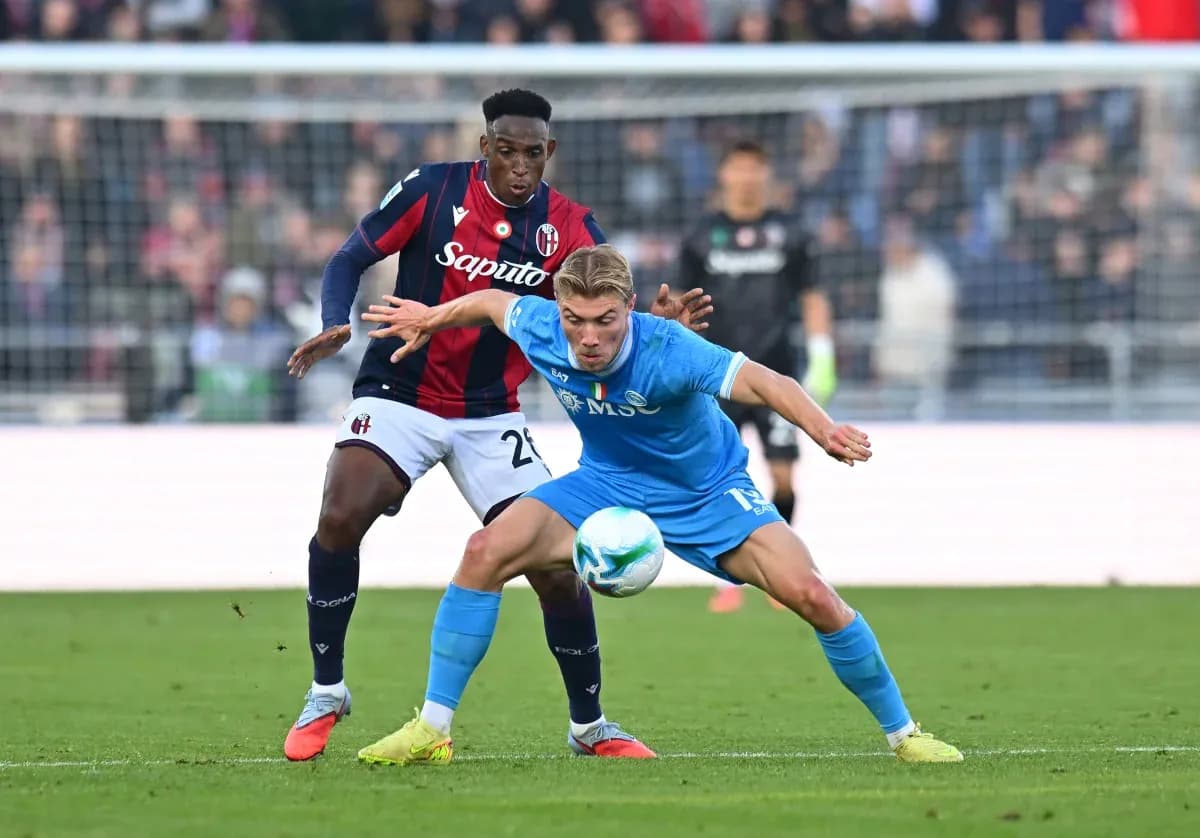
Under the Monday night lights at Stadio Diego Armando Maradona, a 3-2 defeat left Napoli’s title push bruised and Bologna’s European dream very much alive. Following this result, the table tells a stark story: Napoli, still 2nd on 70 points with a goal difference of 18 (54 scored, 36 conceded), were out‑punched by an 8th‑placed Bologna side on 52 points whose overall goal difference of 2 (45 for, 43 against) reflects a team that lives on the edge but rarely blinks.
I. The Big Picture – Structures and Season DNA
Antonio Conte doubled down on his seasonal blueprint, rolling out the 3-4-2-1 that has been his most-used shape (21 league games). The back three of G. Di Lorenzo, A. Rrahmani and A. Buongiorno sat in front of V. Milinkovic-Savic, with S. Lobotka and S. McTominay anchoring the midfield and wing-backs M. Politano and M. Gutierrez tasked with stretching Bologna horizontally. Giovane and Alisson Santos floated behind R. Hojlund, the Dane carrying the burden of a top scorer: in total this campaign he has 10 league goals and 4 assists, from 42 shots and 22 on target.
Napoli’s season numbers frame the frustration. In total this campaign they average 1.5 goals for per game, conceding 1.0, with a notably stronger profile at home: 32 goals scored at home across 18 matches, an average of 1.8, and only 18 conceded at home at exactly 1.0 per game. The 3-2 defeat therefore cut against the grain of a side that usually controls and suffocates visitors in Naples.
Vincenzo Italiano’s Bologna, by contrast, stepped away from their usual 4-2-3-1 (used 27 times in total this campaign) and chose a bold 4-3-3. M. Pessina in goal was shielded by a back four of Joao Mario, E. Fauske Helland, J. Lucumi and J. Miranda. The midfield trio of T. Pobega, R. Freuler and L. Ferguson formed a compact triangle, while R. Orsolini, S. Castro and F. Bernardeschi led the press and provided width.
Bologna’s season profile explains why they were so dangerous “on their travels”. Away, they have scored 29 goals in 18 matches, an average of 1.6 per game, while conceding 23 away at 1.3 per match. That away attacking edge, combined with Napoli’s open 3-4-2-1, set the stage for the three away goals that decided the night.
II. Tactical Voids – Absences and Discipline
This fixture was shaped as much by who was missing as who played. Napoli were without David Neres (ankle injury), K. De Bruyne (eye injury) and R. Lukaku (hip injury), all officially listed as “Missing Fixture”. The absence of De Bruyne in particular stripped Conte of his most natural line-breaking passer between the lines, pushing creative responsibility onto Politano and Giovane. Without Lukaku, Hojlund had no like-for-like strike partner or late-game target option to change the attacking reference.
Bologna, too, arrived depleted in defence and in wide areas: K. Bonifazi (inactive), N. Cambiaghi (muscle injury), N. Casale (calf injury) and M. Vitik (ankle injury) were all out. The loss of Cambiaghi — a winger who in total this campaign has 3 goals, 4 assists and has drawn 71 fouls — removed one of their best ball-carriers and pressing triggers. Italiano compensated by leaning on Bernardeschi’s experience and Orsolini’s directness.
From a disciplinary standpoint, both squads carried clear identities into the game. Heading into this match, Napoli’s yellow-card timing showed a sharp spike between 61-75 minutes, where 31.91% of their yellows arrived, and a late flurry: 14.89% between 76-90 and 10.64% between 91-105. Their two red cards this season both came in the 76-90 window, a genuine late-game risk zone. Bologna, meanwhile, are a combustible side: 27.27% of their yellows fall in the 61-75 period and 25.76% in 76-90, with red cards scattered through 16-30, 46-60, 61-75, 76-90 and 91-105. This is a team that often walks the disciplinary tightrope as fatigue and game-state pressure rise.
III. Key Matchups – Hunter vs Shield, Engine Room
The “Hunter vs Shield” duel was embodied by R. Hojlund against Bologna’s overall defensive record. In total this campaign, Bologna concede 1.2 goals per match, but that rises to 1.3 away. Hojlund, with 10 goals and 4 assists and 30 key passes in the league, is not merely a finisher but a reference point. Against a centre-back pairing of E. Fauske Helland and J. Lucumi, his duels (299 in total this campaign, 107 won) were central to Napoli’s attempts to pin Bologna back. Yet the away side’s willingness to defend deeper and compress central spaces often forced Hojlund into wider channels, reducing the quality of his touches inside the box.
On the other side, Bologna’s own “hunter” was R. Orsolini, whose 9 league goals and 4 penalties scored (with 2 missed) make him their most decisive forward. His duel with Buongiorno and Di Lorenzo down Napoli’s right was critical. Orsolini’s 67 dribbles attempted with 32 successful in total this campaign underline his readiness to attack full-backs one-on-one; each time he isolated Gutierrez or found the half-space, Bologna’s 4-3-3 snapped into a 4-2-4 in transition.
The “Engine Room” belonged to S. McTominay and S. Lobotka against R. Freuler and L. Ferguson. McTominay’s season numbers — 9 goals, 3 assists, 1202 passes at 88% accuracy, plus 28 tackles and 13 successful blocks — mark him as Conte’s box-to-box enforcer. His penalty record, though, carries a blemish: in total this campaign he has missed 1 penalty, a reminder that Napoli’s spot-kick reliability rests elsewhere. Lobotka was tasked with tempo and circulation, while Freuler and Ferguson focused on screening passing lanes into Giovane and Alisson Santos and springing counters.
IV. Statistical Prognosis – What This Result Says
Following this result, the statistical currents suggest a nuanced verdict. Napoli, whose home attack averages 1.8 goals per game and whose overall defence concedes 1.0 per match, were forced into a shootout they usually avoid. Conceding three at home to a Bologna side that, in total this campaign, averages 1.3 goals for and 1.2 against indicates structural vulnerability in Conte’s 3-4-2-1 when shorn of De Bruyne’s control and Lukaku’s hold-up play.
Bologna’s away identity — 1.6 goals scored and 1.3 conceded on their travels — translated almost perfectly into this 3-2 scoreline. Their capacity to live with risk, underpinned by a disciplined yet aggressive midfield and the cutting edge of Orsolini, Castro and Bernardeschi, suggests that their xG profile would likely show efficient finishing rather than sheer volume of chances.
From a tactical forecasting lens, Napoli remain a high-floor side: 13 clean sheets in total this campaign and only 8 losses across 36 matches underline their defensive solidity over time. But this defeat, especially at home, hints at a late-season tilt towards volatility — more open games, more reliance on individual quality from Hojlund, McTominay and Politano, and a pressing need to manage that dangerous 61-90 minute disciplinary window.
Bologna, meanwhile, emerge as the archetypal disruptive outsider: structurally flexible, emotionally combustible, but with enough attacking data — 45 goals in total this campaign, 29 of them away — to suggest that this was not an anomaly but a continuation of a trend. In a league defined by marginal xG edges and defensive discipline, their willingness to embrace chaos might just be their competitive advantage.